Why inconsistent infrastructure quietly erodes ROI, forecasts, and accountability
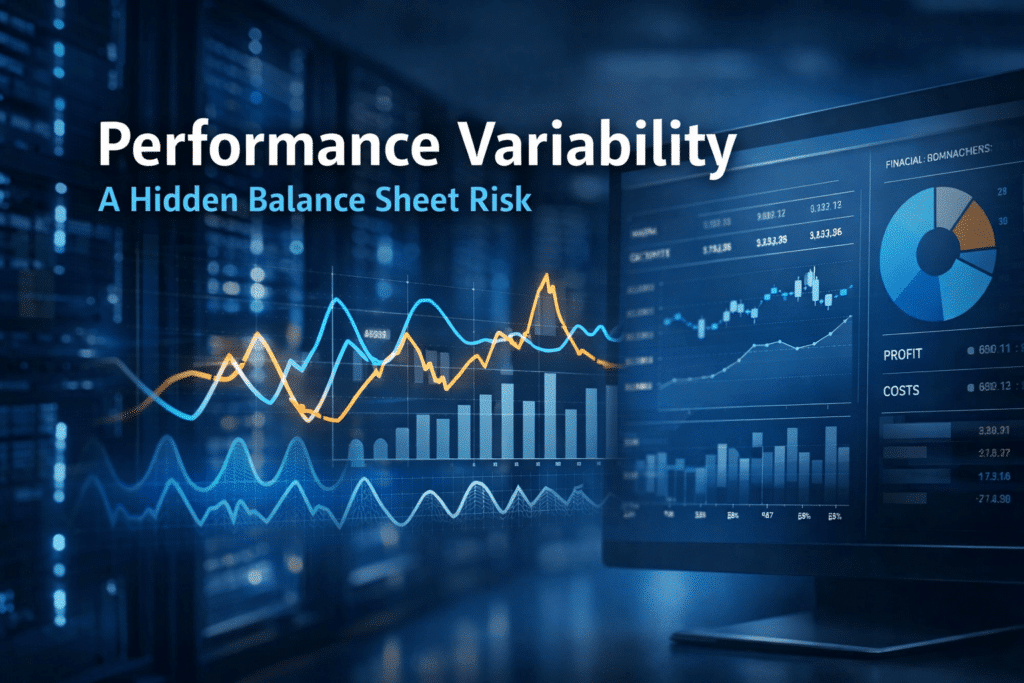
Finance teams spend enormous effort managing cost variability. Budgets are modeled, forecasts are stress-tested, and assumptions are debated in detail. Yet there is another source of volatility that rarely gets the same scrutiny: performance variability.
When infrastructure output fluctuates, the financial impact is real, even if the invoice never changes. Throughput swings, inconsistent latency, unpredictable I/O, and uneven compute performance all quietly distort unit economics. Over time, this creates a gap between what finance expects infrastructure to deliver and what it actually produces.
That gap is where ROI erodes.
The problem finance doesn’t see on the invoice
Infrastructure is often treated as a fixed or semi-fixed cost. As long as spend appears stable, performance is assumed to be stable as well. In reality, many modern environments deliver variable output for a fixed price.
One month, workloads complete faster, hit utilization targets, and support revenue goals. The next month, the same workloads take longer, stall under contention, or underfeed accelerators. From a finance perspective, this looks like “normal operational variance.” In truth, it’s a hidden efficiency leak.
When output fluctuates but cost does not, cost per unit silently rises.
Why performance variability breaks ROI models
ROI models rely on assumptions about consistency. If a system is expected to process a certain volume per hour, day, or month, finance builds forecasts around that baseline. But when performance drifts, those assumptions stop holding.
A workload that processes ten million records per hour one week and six million the next doesn’t just create a technical issue, it creates a financial one. Labor timelines stretch. Downstream systems wait. GPUs and CPUs sit idle while still depreciating. SLAs become harder to defend.
None of this shows up as a line-item increase. It shows up as missed expectations.
Variability creates accountability gaps
One of the most dangerous side effects of performance variability is that it’s hard to assign ownership. When costs spike, finance asks why. When performance dips, the explanation is often vague: noisy neighbors, transient congestion, shared resources, or “expected fluctuations.”
Over time, this creates an accountability blind spot. Finance can’t clearly tie outcomes to inputs. IT teams can’t guarantee consistent output. Leadership sees variance without a clear root cause.
From a governance perspective, that’s risk.
The audit and board lens
Auditors and boards don’t like volatility they can’t explain. Performance inconsistency introduces operational variance that doesn’t map cleanly to spend, staffing, or demand.
When results shift month-to-month without a corresponding change in strategy or investment, it raises uncomfortable questions. Is capacity sufficient? Are controls adequate? Is the organization truly in command of its infrastructure, or reacting to it?
Predictability matters not because it’s convenient, but because it’s defensible.
Performance predictability as a financial control
Stable infrastructure performance acts as a financial stabilizer. When throughput, latency, and resource availability are consistent, finance can trust its models. Unit economics hold. Capacity planning becomes reliable. ROI calculations remain intact over time.
This is where dedicated, guaranteed resources change the conversation. Not as a technical upgrade, but as a risk-reduction strategy. When performance stops fluctuating, finance regains control over outcomes, not just spend.
Finance takeaway
If infrastructure performance fluctuates, can your ROI assumptions still be defended?
Board and audit takeaway
Performance predictability is not a convenience. It is a control.
What this means for CFOs in 2026
In 2026, finance leaders won’t ask how scalable infrastructure is. They’ll ask how predictable it is; and whether that predictability supports reliable forecasts, accountable operations, and defensible ROI.
Predictable performance isn’t about speed.
It’s about removing variance from the balance sheet.
If your infrastructure introduces uncertainty into your financial models, it’s time to reassess whether it’s helping, or quietly holding you back.
FAQs
Why doesn’t performance variability show up clearly in financial reports?
Because the cost line often stays flat while output changes. Finance sees stable spend, but the organization delivers fewer results per dollar when performance dips.
Isn’t some performance variability unavoidable?
Minor fluctuation is normal. The problem is systemic variability caused by shared resources, contention, or unpredictable infrastructure behavior that repeatedly undermines forecasts.
How does performance variability affect budgeting and forecasting?
It weakens assumptions. When output can’t be relied on, forecasts require wider buffers, contingency spend increases, and confidence in projections erodes.
Why does this matter more for GPU and high-performance workloads?
Because idle or underfed accelerators are expensive. Every minute of reduced throughput directly inflates cost per unit and delays time-to-value.
How does predictable performance change ROI discussions?
It stabilizes them. When performance is consistent, finance can model returns with confidence, defend assumptions, and hold teams accountable to measurable outcomes.
Is this primarily a finance problem or an IT problem?
It becomes a finance problem the moment variability affects margins, delivery timelines, or forecast accuracy, even if the root cause is technical.
Performance variability isn’t an abstract infrastructure issue, it’s a compounding financial one. Each unanswered question above points to the same conclusion: when output can’t be relied on, neither can forecasts, ROI models, or accountability. Infrastructure that behaves differently from month to month forces finance teams to manage uncertainty instead of results. That’s why predictable performance isn’t about optimizing systems, it’s about restoring confidence in the numbers that guide decisions.
Ready to remove variability from your financial models?
If infrastructure performance introduces uncertainty, it’s no longer just an IT concern, it’s a finance risk. ProlimeHost helps organizations replace fluctuating output with predictable, dedicated performance that supports accurate forecasting, defensible ROI, and long-term accountability.
Let’s talk about infrastructure that behaves the way your models expect it to.
📞 Call: 877-477-9454
🌐 Visit: https://www.prolimehost.com
📧 Email: sa***@*********st.com
Predictable performance starts with predictable decisions.