For years, infrastructure risk has been framed around uptime.
Vendors advertise it, service level agreements promise it, and engineering teams monitor it relentlessly. If systems stay online, the assumption is that the business continues to operate normally.
In reality, that assumption is increasingly flawed.
Modern infrastructure rarely fails in dramatic, obvious ways.
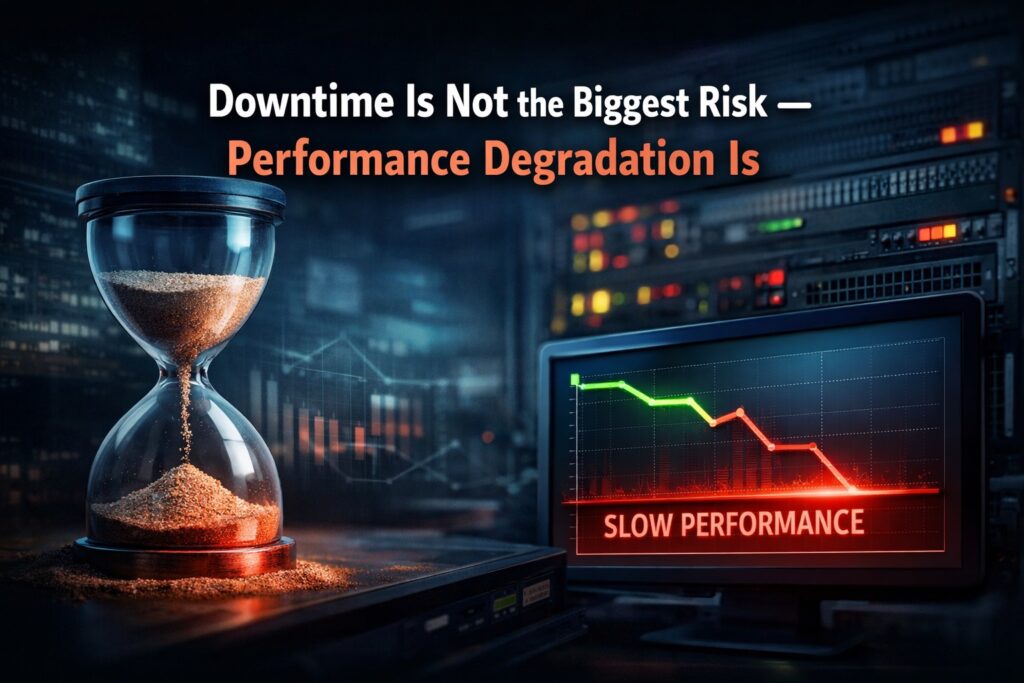
Instead, the far more common (and often more expensive) failure mode is performance degradation. Systems remain technically operational, but workloads slow down. Applications respond more slowly. Queries take longer to process. Training jobs run for days instead of hours.
Nothing appears broken. Yet the business begins to lose momentum.
Because everything is still technically “working,” these slowdowns often escape immediate attention.
Unlike downtime, which triggers alarms and incident calls, degraded performance tends to creep into operations gradually. Teams adapt to the slowdown rather than escalate it. Engineers work around it. Managers assume it is temporary.
But the economic impact accumulates quietly.
A platform that runs 25–30 percent slower affects every part of the organization that relies on it.
Product teams wait longer for builds and testing cycles. Analysts spend more time waiting on data queries. AI teams take longer to train models and deploy improvements. Customers encounter subtle latency that reduces engagement and conversion rates.
Each individual delay may appear small, but collectively they reduce the operational velocity of the entire company.
This is why performance degradation is often more financially damaging than downtime.
Downtime produces a visible event with a beginning and an end. Degraded performance, by contrast, spreads across days, weeks, and sometimes months. It reduces productivity incrementally but persistently.
Over time, that reduction in speed translates directly into business outcomes. Product releases take longer to reach market. Customer experiences become less responsive. Engineering teams spend more time optimizing around infrastructure limitations rather than building new capabilities.
The organization remains operational, but it operates below its potential.
In many cases, the root cause is not software inefficiency but infrastructure that has quietly fallen behind modern workload requirements.
Hardware that once supported applications comfortably begins to struggle as data volumes grow and compute demands increase. CPU architectures age, storage latency becomes more noticeable, and memory bandwidth limitations begin to surface.
None of these issues immediately break a system. They simply make everything run slower.
Companies often delay infrastructure upgrades in the belief that extending hardware life saves money.
From an accounting perspective, this can appear reasonable. Capital expenditures are deferred and equipment remains technically usable.
However, the financial calculation often ignores the cost of lost performance. When employees, systems, and customers interact with slower infrastructure every day, the resulting productivity loss frequently outweighs the savings from postponing hardware refresh cycles.
This distinction highlights an important shift in how infrastructure should be evaluated. Historically, availability was the dominant metric.
As long as systems remained online, infrastructure was considered reliable.
Today, availability alone is insufficient.
The more relevant question is whether systems operate at the speed required to support the organization’s goals. Infrastructure that is always available but consistently slow creates the illusion of stability while quietly eroding efficiency.
For data-intensive businesses, AI-driven platforms, SaaS applications, and analytics-heavy environments, infrastructure speed is no longer a technical detail. It has become an economic variable that influences productivity, product velocity, and ultimately revenue generation.
Organizations that recognize this shift increasingly prioritize predictable performance over theoretical peak performance. What matters most is not a benchmark number achieved under ideal conditions, but the ability of infrastructure to deliver consistent speed under real-world workloads.
When infrastructure performs reliably and predictably, teams can plan with confidence. Product development cycles remain stable, workloads scale smoothly, and operational efficiency remains high.
In this sense, infrastructure performance becomes a strategic advantage. Companies that maintain fast, consistent environments enable their teams to move faster and execute more effectively than competitors whose systems quietly slow them down.
Board / Executive Takeaway
Boards traditionally evaluate infrastructure risk through the lens of uptime. While availability remains important, modern organizations face a more subtle threat: systems that remain operational but run below optimal performance.
Performance degradation slows development cycles, reduces employee productivity, and weakens customer experience. These effects accumulate gradually but ultimately influence financial outcomes.
The fastest organizations are rarely those with the most engineers or the largest budgets. They are the ones whose infrastructure consistently operates at the speed their business demands.
Frequently Asked Questions
How does performance degradation affect revenue?
Slow infrastructure affects customer experience, internal productivity, and development velocity. Each of these factors directly influences revenue generation and operational efficiency.
Why is degraded performance harder to detect than downtime?
Downtime produces immediate service interruptions and alerts. Performance degradation typically emerges gradually, making it more difficult to recognize until productivity or customer experience begins to decline.
What causes infrastructure performance degradation most often?
Common causes include aging hardware, storage latency limitations, memory bandwidth constraints, and infrastructure environments that cannot keep pace with growing workloads.
Is cloud infrastructure immune to these issues?
No. Multi-tenant environments and virtualization layers can introduce unpredictable performance variability, particularly under heavy workloads.
When Infrastructure Speed Matters, Predictability Matters More
Organizations running AI workloads, high-performance analytics, SaaS platforms, or data-intensive applications depend on infrastructure that delivers consistent speed.
Avoiding downtime is only the starting point. The real objective is ensuring that systems operate at the performance level required to support business growth.
At ProlimeHost, our enterprise-grade dedicated servers are engineered to provide predictable performance for demanding workloads, helping organizations maintain operational velocity and financial efficiency.
If you are evaluating infrastructure for AI platforms, analytics environments, or mission-critical applications, our team would be happy to help.
🌐 https://www.prolimehost.com
📞 877-477-9454
✉ sa***@*********st.com