Executive Summary
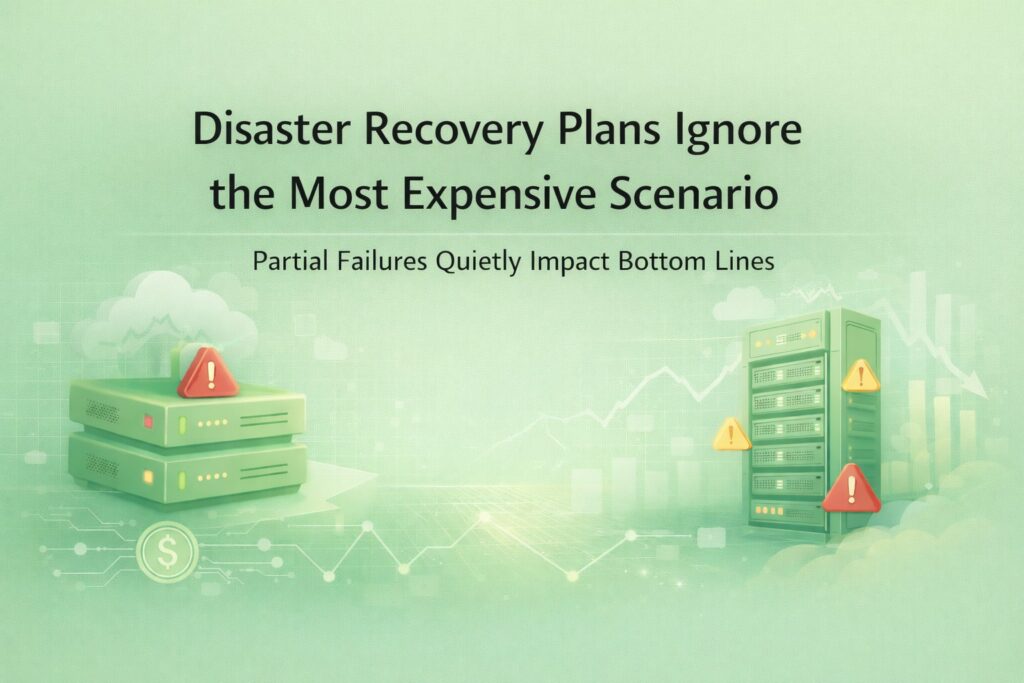
Most disaster recovery strategies are built around a simple assumption: systems will either be up or down. But the most expensive failures rarely look like outages.
They show up as degraded performance; systems that are technically online, but slower, inconsistent, and unreliable. These partial failures don’t trigger alarms the same way downtime does, yet they often create a larger and more sustained financial impact.
For finance leaders, this creates a blind spot. Because what isn’t measured isn’t managed and performance degradation is rarely modeled.
The False Binary: Up vs. Down
Traditional disaster recovery planning is designed around clear events. A system fails, and recovery begins. The focus is on how quickly services can be restored and how much downtime can be minimized.
This creates a binary view of risk. Either the system is available, or it is not. That model worked when infrastructure failures were more absolute. But modern environments don’t fail cleanly anymore. They degrade.
And once that happens, the traditional framework stops capturing the real risk.
The Reality: Most Failures Are Partial
In practice, systems rarely go completely offline. Instead, performance begins to slip. Latency increases. Queries take longer. Applications remain accessible, but they no longer respond with the speed users expect.
From a technical standpoint, everything appears functional. From a business standpoint, something is off. Customers don’t always report these issues. They simply disengage. Conversions drop slightly. Sessions shorten. Support complaints increase in ways that feel disconnected from infrastructure.
Nothing breaks. But performance is no longer aligned with expectations.
Why Degradation Is More Expensive Than Downtime
Downtime is immediate and visible. It forces a response. Teams mobilize, leadership is alerted, and the issue is resolved as quickly as possible.
Degradation operates differently. It stretches over time. It hides inside normal operations. It affects every transaction just a little, instead of stopping everything at once. That makes it more expensive.
A short outage has a defined cost. A prolonged period of degraded performance introduces a slow, compounding loss that is rarely attributed correctly. It often gets absorbed into marketing inefficiency, sales variability, or unexplained changes in customer behavior.
From a financial perspective, degradation introduces uncertainty. And uncertainty is far more difficult to manage than a discrete event.
The Gap in Most Disaster Recovery Strategies
Most disaster recovery plans are designed to restore availability. They ensure systems come back online, data is intact, and operations can resume. What they don’t guarantee is performance.
A failover environment may technically work, but operate at reduced capacity. Storage may become a bottleneck. Network latency may increase. Compute resources may be sufficient for uptime, but not for real production load. The result is a system that survives the event but performs below expectations.
Because the system is “up,” recovery is considered successful, even though the business impact continues.
From Recovery to Resilience
The next evolution of disaster recovery is not just about getting back online. It is about maintaining performance continuity.
That means designing infrastructure that behaves consistently under stress, not just in ideal conditions. It requires environments that can absorb load shifts without introducing latency, storage slowdowns, or resource contention.
Resilience, in this context, is not defined by how quickly you recover. It is defined by how little performance changes when something goes wrong.
Why This Matters for Finance Leaders
Downtime can be measured. It shows up clearly in reports and post-incident reviews. Degradation does not. It distorts performance quietly. It affects revenue without a clear attribution. It introduces variability into financial outcomes that appears disconnected from infrastructure decisions.
When systems perform inconsistently, business performance follows.
For finance leaders, this is where infrastructure risk becomes most dangerous, not when systems fail, but when they underperform without being recognized.
Board / Executive Takeaway
The greatest infrastructure risk is no longer downtime. It is undetected performance degradation. Organizations that focus only on recovery are protecting against the most visible risk, not the most expensive one.
The priority is no longer just restoring systems; it is ensuring they perform consistently, even under stress.
FAQs
Is downtime still a major concern?
Yes, but it is easier to detect and resolve. Degradation often lasts longer and impacts more transactions, making it more expensive over time.
Why isn’t degradation tracked the same way?
Because most monitoring is built around availability, not subtle performance changes that affect user behavior and revenue.
How can companies address this risk?
By aligning infrastructure performance with business metrics, and ensuring environments are designed to handle real production load without degradation.
My Thoughts
If your disaster recovery strategy is built around uptime alone, you may be protecting against the wrong risk. The more expensive scenario is not a system that goes down, it is a system that stays up but underperforms.
We help businesses design infrastructure that delivers consistent performance, even under stress, so revenue, customer experience, and financial outcomes remain predictable.
Contact
Steve Bloemer
Director of Sales & Operations
ProlimeHost
🌐 https://www.prolimehost.com
📞 877-477-9454
If you want, we can walk through your current environment and identify where performance degradation could already be impacting your business without being fully visible.