Executive Summary
At small scale, infrastructure decisions feel forgiving. A slightly slower server, occasional performance inconsistency, or minor operational friction doesn’t appear to materially impact the business. Costs stay low, systems function, and teams adapt. At scale, that same “good enough” infrastructure becomes a compounding liability.
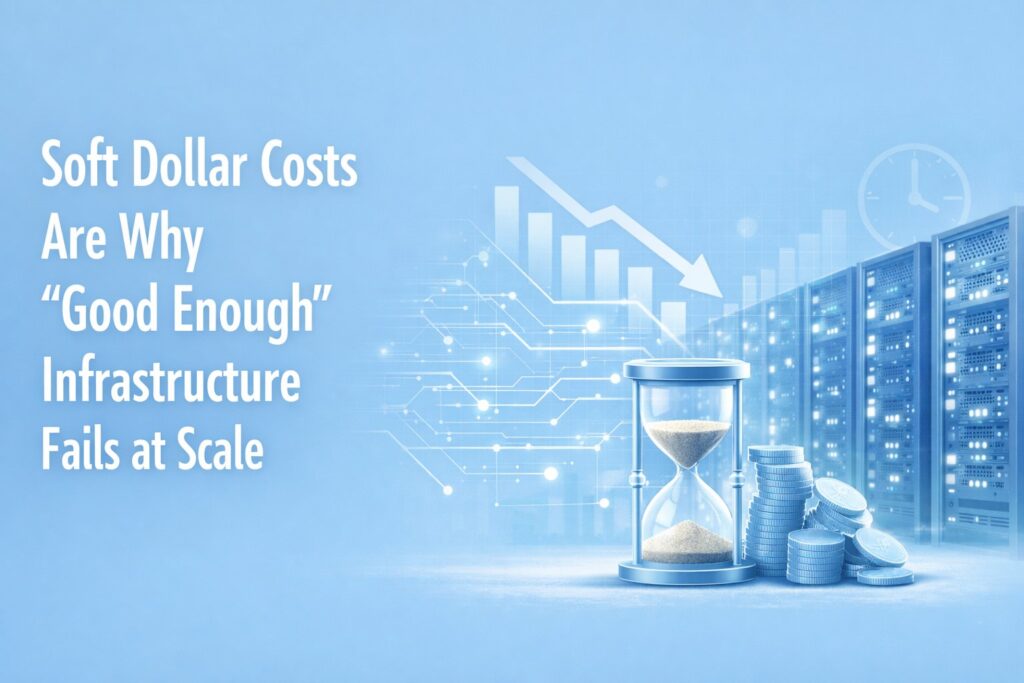
The issue is not the monthly lease. It is the accumulation of soft dollar costs; engineering time, delayed output, inefficiency, and missed opportunities that never appear cleanly on a balance sheet but directly impact margins, velocity, and valuation.
What looks cost-effective early becomes structurally expensive later.
The Illusion of Savings
A lower monthly infrastructure cost creates a false sense of efficiency. On paper, the decision is rational. Spend less, preserve cash, maintain flexibility. But infrastructure is not a static cost center. It is a production environment.
When performance is inconsistent, when systems require tuning, or when teams must work around limitations, the cost doesn’t disappear. It moves into engineering time, delayed deployments and reduced throughput. And most importantly, it moves into lost momentum.
None of these costs are itemized on an invoice. All of them show up in outcomes.
Where Soft Dollar Costs Actually Live
Soft dollar costs are not abstract. They are operational. They show up in the extra hours spent troubleshooting performance inconsistencies instead of building new features. They show up when deployments are delayed because infrastructure cannot keep up with demand. They show up when teams overprovision resources as a defensive measure, introducing inefficiency to compensate for unpredictability.
In AI and GPU-driven environments, this becomes even more pronounced. A GPU sitting idle while waiting on storage throughput or CPU coordination is not just underutilized hardware, it is lost ROI in real time.
At scale, these inefficiencies don’t remain isolated. They compound across teams, systems, and timelines.
Why Scale Changes Everything
The defining characteristic of scale is not size. It is sensitivity. Small inefficiencies that were once negligible begin to amplify. Latency becomes visible to users. Deployment delays begin to impact revenue timing. Engineering inefficiencies translate directly into higher labor costs per unit of output.
“Good enough” infrastructure assumes that inefficiencies remain contained. They don’t. They multiply.
This is where many organizations miscalculate. They assume that infrastructure cost scales linearly with usage. In reality, inefficiency scales exponentially with complexity.
The Shift from Cost Control to Output Optimization
The most important transition a finance team can make is moving from cost minimization to output maximization. The question is no longer: “How little can we spend on infrastructure?” It becomes: “How much output are we generating per dollar of infrastructure?”
When infrastructure introduces friction, the denominator expands while the numerator contracts. You spend less on paper, but you produce less in reality.
Enterprise-grade infrastructure flips that equation. Performance consistency reduces the need for workarounds. Faster systems compress development cycles. Reliable throughput ensures that hardware is fully utilized rather than intermittently idle.
The result is not just better performance. It is higher financial efficiency.
Why This Matters for Finance Leaders
Soft dollar costs rarely trigger alerts. They do not show up as line-item overruns. They do not create immediate budget variances. Instead, they appear as slower growth, reduced margins, and missed forecasts.
This is why infrastructure decisions are often underestimated at the executive level. They are framed as technical preferences rather than financial levers. In reality, infrastructure defines the efficiency of every downstream function; engineering, product, customer experience, and revenue generation.
At scale, that makes it a board-level concern.
Why This Matters in 2026
In 2026, infrastructure is no longer just supporting the business, t is driving it. AI workloads, real-time applications, and globally distributed users have eliminated the margin for inconsistency. Performance variability is no longer a technical inconvenience. It is a financial risk.
Organizations that continue to rely on “good enough” infrastructure will not fail immediately. They will simply move slower, operate less efficiently, and compete at a disadvantage that compounds over time.
Board / Executive Takeaway
Infrastructure cost is not defined by its monthly price. It is defined by how efficiently it converts spend into output.
Soft dollar costs (time, inefficiency, and lost opportunity) are the dominant expense at scale. Organizations that fail to account for them will consistently underestimate their true infrastructure cost structure.
FAQs
What are soft dollar costs in infrastructure?
They are indirect costs such as engineering time, performance inefficiencies, delays, and lost productivity that result from suboptimal infrastructure but are not directly reflected in billing.
Why don’t soft costs show up in financial reporting?
Because they are embedded across labor, timelines, and operational output rather than tied to a single measurable expense category.
When does “good enough” infrastructure become a problem?
Typically during growth phases, when increased demand exposes inefficiencies and amplifies their impact across systems and teams.
How do you reduce soft dollar costs?
By investing in infrastructure that delivers consistent, predictable performance, minimizing the need for human intervention and system-level workarounds.
Reduce Friction. Increase Output.
If your infrastructure requires constant tuning, troubleshooting, or compensation from your engineering team, you are already paying more than your invoice suggests.
At ProlimeHost, we focus on delivering predictable performance with enterprise-grade hardware, a premium Cisco-powered network, and in-house engineering support; so your infrastructure works as a production asset, not an operational burden.
The result is simple: less friction, higher throughput, and a more predictable return on every dollar invested.
Let’s evaluate where your infrastructure is quietly costing you more than it should.
🌐 https://www.prolimehost.com
📞 877-477-9454
✉️ sa***@*********st.com