Executive Summary
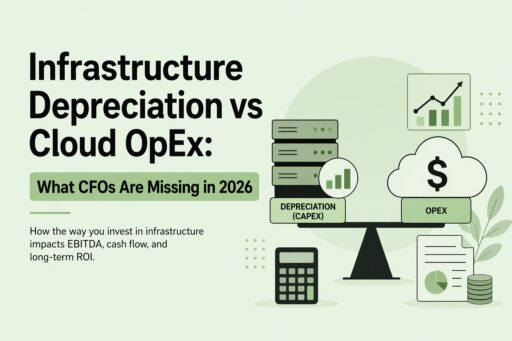
Most infrastructure decisions are still framed around cost. That framing is outdated. In 2026, the real issue is not how much infrastructure costs. It is how reliably those costs behave over time. Cloud environments promise flexibility, but that flexibility introduces variability. And variability is where financial models begin to fail.
Dedicated infrastructure, by contrast, does something far less flashy but far more valuable. It removes uncertainty. It turns infrastructure from a moving target into a fixed input.
That shift, from variable to predictable, is what ultimately determines ROI.
The Shift: From Cost Optimization to Cost Control
For years, the dominant question was simple: how do we reduce infrastructure spend? That question assumes costs are stable enough to optimize. In cloud environments, they are not.
Usage-based billing introduces fluctuations tied to traffic spikes, compute bursts, storage growth, and background processes that are often poorly understood outside engineering teams. What begins as flexibility at small scale becomes volatility at larger scale.
The result is subtle but significant. Finance teams stop trusting forecasts. Engineering teams begin overprovisioning to avoid performance risk. Leadership teams lose clarity on what infrastructure is actually costing the business.
At that point, cost is no longer the problem. Uncertainty is.
Where Cloud Cost Volatility Becomes a Financial Risk
Cloud pricing is designed to scale with demand. That sounds efficient in theory, but in practice it creates a non-linear cost structure. A modest increase in usage does not always produce a modest increase in cost. It can trigger cascading effects across compute, storage, bandwidth, and API usage, often surfacing as unexpected billing spikes.
For AI and GPU-driven workloads, this effect is amplified. Training cycles, inference spikes, and data movement can cause rapid cost expansion within short time windows. What appears manageable one month can become unpredictable the next.
The real issue is not that cloud is expensive. It is that cloud costs are difficult to model with confidence. And when costs cannot be modeled, they cannot be controlled.
The Financial Advantage of Dedicated Server Predictability
Dedicated infrastructure takes a fundamentally different approach. Instead of charging for every incremental unit of consumption, it establishes a fixed cost structure tied to known resources. Compute, memory, storage, and network capacity are defined upfront. That creates a stable baseline.
Performance does not fluctuate based on shared environments. Costs do not spike based on transient usage. Capacity planning becomes intentional rather than reactive. For finance teams, this translates into something far more valuable than marginal cost savings. It creates visibility.
When infrastructure behaves predictably, forecasts become reliable. When forecasts are reliable, margins can be managed with precision. And when margins are controlled, growth decisions become more strategic.
Cost Comparison: Behavior Matters More Than Price
The difference between cloud and dedicated infrastructure is not just what you pay. It is how those costs behave over time.
| Cost Factor | Cloud Infrastructure | Dedicated Server (ProlimeHost Model) |
|---|---|---|
| Monthly Cost Predictability | Variable, usage-based spikes | Fixed monthly pricing |
| Performance Consistency | Shared / burst-dependent | Dedicated resources |
| Cost Scaling | Non-linear and reactive | Linear and forecastable |
| Idle Resource Cost | Paid regardless of efficiency | Fully controlled allocation |
| GPU Workload Efficiency | Often shared or limited | Full utilization of dedicated GPUs |
| Billing Complexity | Fragmented, multi-line invoices | Simple, consolidated pricing |
| Forecast Accuracy | Low at scale | High predictability |
| ROI Visibility | Delayed and unclear | Immediate and measurable |
What stands out is not just the difference in cost, but the difference in structure. Cloud introduces variability into financial planning.
Dedicated infrastructure removes it.
Why This Matters More for AI and GPU Workloads
AI workloads expose the weaknesses of variable pricing models faster than almost any other use case. Training jobs require sustained compute power. Inference workloads demand consistent response times. Storage throughput directly impacts GPU utilization.
In a cloud environment, these variables are influenced by shared infrastructure and dynamic pricing layers. That can lead to underutilized GPUs, inconsistent performance, and cost inefficiencies that are difficult to isolate.
In a dedicated environment, those constraints disappear. Resources are reserved. Performance is consistent. GPUs operate at full capacity without interference.
The result is not just better performance. It is better cost efficiency per unit of output.
The Compounding Effect of Cost Variability
Cost variability does not remain isolated. It compounds. When infrastructure costs fluctuate, teams begin to compensate. They overprovision capacity to avoid risk. They delay deployments until cost patterns stabilize. They allocate budget buffers that reduce capital efficiency.
Each of these decisions introduces hidden costs. Over time, those hidden costs exceed the perceived savings of a flexible pricing model.
This is where many organizations get stuck. They are not overpaying for infrastructure. They are overpaying for unpredictability.
From Infrastructure Spend to Financial Strategy
The companies that are pulling ahead in 2026 are not necessarily spending less on infrastructure. They are managing it differently.
They prioritize environments where cost, performance, and capacity behave in ways that align with financial models. They reduce variance instead of chasing marginal savings. They treat infrastructure as a controllable input rather than an unpredictable expense.
That shift changes how infrastructure is evaluated. It moves the conversation from engineering preference to financial strategy.
FAQs
Why is cloud pricing considered unpredictable at scale?
Cloud pricing is based on usage, which means costs fluctuate depending on compute demand, storage growth, and traffic patterns. At scale, these fluctuations become harder to forecast accurately, leading to unexpected cost increases.
Are dedicated servers cheaper than cloud in 2026?
For sustained workloads, particularly in AI and high-performance computing, dedicated servers often provide a lower total cost of ownership due to fixed pricing and consistent performance.
When should a company move from cloud to dedicated infrastructure?
The transition typically makes sense when workloads become stable and resource-intensive, and when cloud cost variability begins to impact financial forecasting and margin control.
How does cost predictability affect ROI?
Predictable costs enable accurate forecasting, tighter budget control, and clearer measurement of return on investment, all of which are essential for scaling operations efficiently.
Do dedicated GPU servers improve cost efficiency for AI workloads?
Yes. Dedicated GPU servers ensure full utilization of resources without contention, which improves both performance and cost efficiency for training and inference tasks.
Conclusion: Predictability Is the Real Advantage
Most organizations are still trying to reduce infrastructure cost. The more important objective is eliminating cost uncertainty. Because once infrastructure becomes predictable, everything downstream improves. Forecasts stabilize. Margins become clearer. Growth becomes intentional instead of reactive.
At ProlimeHost, the focus is not just on delivering high-performance infrastructure. It is on delivering infrastructure that behaves predictably under real-world conditions. No variability. No hidden scaling surprises. No performance inconsistency that forces you to compensate elsewhere.
If your current environment is making it harder to forecast, harder to control costs, or harder to explain infrastructure spend at the executive level, it may be time to rethink the model behind it.
Predictable performance is not just an operational advantage. It is a financial one.
Contact ProlimeHost
If you’re evaluating a shift toward more predictable infrastructure or simply want a second set of eyes on your current cost structure, we’re happy to have a direct conversation.
ProlimeHost
🌐 https://www.prolimehost.com
📞 877-477-9454
📧 sa***@*********st.com
Steve Bloemer
Director of Sales & Operations
ProlimeHost
Let’s align your infrastructure with how your business actually needs to perform: predictably, efficiently, and at scale.