Executive Summary
Most infrastructure issues don’t show up as outages. They show up as systems that are almost fast enough. Almost responsive. Almost consistent. And that “almost” is where revenue quietly disappears.
In 2026, the real risk is no longer downtime. It is performance variability that escapes dashboards, avoids alerts, and still degrades user experience, operational throughput, and ultimately revenue.
The companies that win are not the ones with the highest uptime. They are the ones with the most predictable performance.
Performance Gap vs Revenue Impact: What “Almost Fast Enough” Really Costs
| Metric | “Almost Fast Enough” Infrastructure | High-Performance Dedicated Infrastructure |
|---|---|---|
| Page / Response Time | 250–500ms (inconsistent) | <100–150ms (stable) |
| User Experience | Slight lag, intermittent delays | Instant, predictable |
| Conversion Rate Impact | -5% to -20% over time | Optimized / maximized |
| Monitoring Visibility | Appears “within normal range” | Clearly within optimal thresholds |
| Revenue Leakage | Silent and cumulative | Minimal |
| Infrastructure Cost | Lower upfront | Slightly higher upfront |
| Cost per Revenue Dollar | Higher (due to inefficiency) | Lower (efficient conversion) |
| Scalability Behavior | Degrades under load | Maintains performance under load |
| Customer Retention | Gradual decline | Strong retention |
| ROI Predictability | Unstable | Predictable |
Everything Looks Fine Until It Isn’t
Modern monitoring is built to detect failure. It is very good at telling you when something breaks. A server goes offline, a service crashes, a network path drops. These are clear signals, and they trigger immediate action. What monitoring struggles to capture is drift.
A system that was responding in 80 milliseconds now takes 150. A query that used to be consistent starts fluctuating depending on load. An AI inference job that used to complete in predictable time begins to vary just enough to slow everything downstream.
Nothing is technically broken. The dashboards remain green. Alerts never fire. But the system is no longer performing the way your business expects it to.
Why “Almost Fast Enough” Becomes a Revenue Problem
There is a quiet assumption in most organizations that if a system is up, it is working. That assumption made sense when outages were the primary risk. That is no longer the case.
Performance directly shapes outcomes. When response times drift, users behave differently. They hesitate, they abandon sessions earlier, they complete fewer transactions. Internally, teams feel it as well. Processes take longer, outputs slow down, and what once felt efficient begins to feel inconsistent.
The impact is rarely dramatic in a single moment. It compounds over time. A slight delay here, a small inefficiency there, repeated across thousands or millions of interactions.
What you get is not an outage. You get erosion.
The Financial Blind Spot No One Talks About
This is where the conversation shifts from technical to financial. Most forecasts assume a stable relationship between input and output. A given system is expected to process a certain volume of work within a certain timeframe. Revenue projections, capacity planning, and even hiring decisions often rely on that assumption.
When infrastructure performance varies, that relationship breaks. Workloads take longer to complete. Throughput becomes inconsistent. Revenue that was expected to materialize within a given window begins to shift. Costs creep upward because more compute time is required to achieve the same result.
The model still looks correct on paper. In reality, it is built on performance that no longer exists.
The Difference Isn’t Flexibility. It’s Consistency
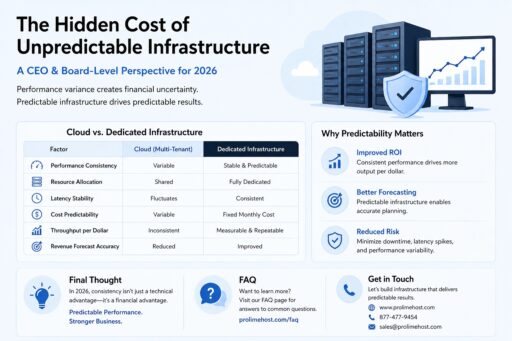
Infrastructure conversations are often framed around flexibility versus control. Cloud environments are positioned as elastic and adaptable, while dedicated environments are seen as fixed and predictable. What often gets missed is that elasticity introduces variability.
In shared environments, performance is influenced by factors outside your control. Resource contention, scheduling variability, and fluctuating availability all contribute to inconsistent outcomes. The system may scale, but it does not always behave the same way under load.
Dedicated environments remove that layer of uncertainty. Resources are not shared. Performance does not depend on who else is using the system. The result is not just speed, but consistency.
And consistency is what allows a business to operate with confidence.
Why Monitoring Doesn’t Save You
Traditional monitoring tools are built around thresholds. They are designed to tell you when something crosses a defined line. Above this latency, below this availability, beyond this error rate. “Almost fast enough” rarely crosses those lines.
Instead, it lives in the gray space where performance is technically acceptable but operationally inefficient. The system is still within tolerance, but no longer aligned with the expectations your business was built around.
This is why many organizations only recognize the problem after the effects become visible elsewhere. Conversion rates decline. Costs rise unexpectedly. Users begin to complain. Growth slows without a clear explanation.
By the time it is visible, it has already been happening for a while.
What Actually Protects Revenue
If uptime is not the metric that matters most, what is? It is predictability. Not peak performance in ideal conditions. Not theoretical scalability. Predictability in how the system behaves every single time it is used.
When performance is consistent, everything else becomes easier to manage. Forecasts become more reliable. User experience stabilizes. Scaling decisions are based on known outcomes rather than assumptions.
Most importantly, cost per unit of output remains stable. That is what turns infrastructure from a variable expense into a controllable one.
Why This Matters Now
As workloads become more real-time and more dependent on consistent compute, the tolerance for variability continues to shrink.
AI workloads amplify this effect. Small inefficiencies in performance translate directly into longer processing times and higher costs. Real-time applications make latency visible in ways that were easier to ignore in the past.
The gap between “fast” and “almost fast enough” is no longer technical nuance. It is financial impact.
Boardroom Takeaway
Infrastructure is still often evaluated based on cost and uptime. Those metrics are no longer sufficient.
What ultimately determines business performance is the consistency of output over time.
If infrastructure cannot deliver that consistency, then revenue becomes less predictable, costs become harder to control, and forecasts become less reliable.
That is not an IT issue. It is a business risk.
FAQs
Is a small delay really that impactful?
On its own, it may not seem significant. At scale, across repeated interactions, even small delays influence user behavior, reduce efficiency, and compound into measurable financial impact.
Why doesn’t monitoring alert us to this kind of issue?
Because most monitoring systems are designed to detect failure, not gradual performance drift within acceptable thresholds.
Can shared environments be optimized to avoid this?
They can be improved, but variability is inherent in shared infrastructure. It can be reduced, not eliminated.
How does this affect AI workloads?
Inconsistent performance leads to longer processing times, reduced efficiency, and higher cost per completed task, especially when GPU resources are involved.
What should organizations focus on instead?
Consistency of performance and stability of cost per output are far more meaningful indicators than uptime alone.
My Thoughts
If your infrastructure is “almost fast enough,” it is already impacting your business more than it appears.
At ProlimeHost, the focus is simple. Deliver consistent, predictable performance so your applications, workloads, and revenue behave the way you expect them to.
If you want to understand whether performance variability is affecting your environment, we are always open to a conversation.
Contact Us
https://www.prolimehost.com
877-477-9454