Executive Summary
Twelve months ago, most companies viewed artificial intelligence primarily as software. The conversation centered around models, prompts, APIs, and user interfaces. Infrastructure usually came later, if it was considered at all. Businesses moved quickly to integrate public AI services because deployment speed mattered more than operational control, and during the early stages of adoption, that approach made sense.
What many organizations are now discovering, however, is that AI eventually stops behaving like a simple application layer. Once internal teams begin relying on AI operationally, infrastructure decisions start carrying financial, compliance, and performance consequences that become difficult to ignore.
A customer support assistant processing thousands of conversations per day creates different infrastructure pressures than a small experimental chatbot. Internal AI search tools handling confidential documents introduce governance concerns that rarely exist during pilot programs. Even something as simple as inconsistent inference latency can create measurable downstream operational inefficiencies once AI systems become embedded inside business workflows.
This is why private AI infrastructure is growing rapidly in 2026.
Organizations want the advantages of modern AI systems without depending entirely on external providers for cost stability, performance consistency, compliance controls, and infrastructure governance. Instead of routing sensitive workloads through public APIs indefinitely, businesses are increasingly deploying self-hosted AI environments on dedicated GPU servers they directly control.
At ProlimeHost, we are seeing this shift accelerate across SaaS companies, healthcare organizations, analytics providers, financial firms, and software developers building long-term AI operational strategies rather than short-term experiments. What initially starts as a technical conversation often becomes a larger financial and operational discussion about predictability, ownership, and scalability.
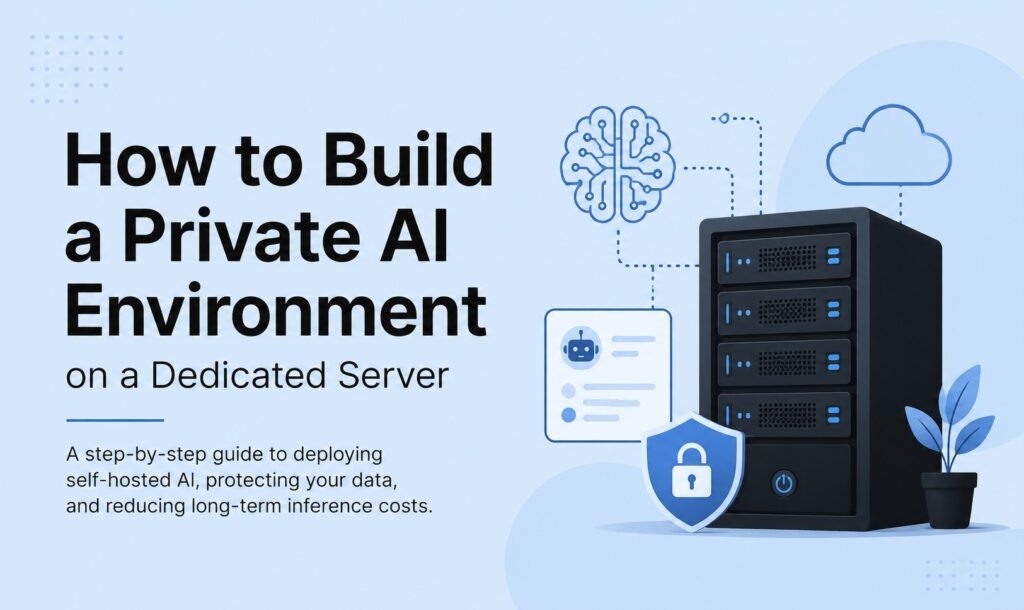
This guide explains how businesses are building private AI servers using dedicated GPU infrastructure, why self-hosted AI environments are becoming financially attractive, and how organizations are reducing long-term dependency on multitenant AI platforms while improving operational control.
Why Businesses Are Moving Toward Self-Hosted AI Infrastructure
The first phase of AI adoption was largely about access. Companies simply wanted to use large language models as quickly as possible. Today, the conversation is shifting toward ownership and operational control.
That change is happening because businesses are beginning to understand how much sensitive information eventually flows into AI systems. Internal documentation, support tickets, customer communications, legal contracts, analytics pipelines, proprietary source code, financial forecasting models, and operational reports all become potential AI inputs over time.
For many organizations, the concern is no longer theoretical.
Some companies have already discovered that compliance reviews become far more complicated once external AI providers are processing operational data continuously. Others are realizing that API costs can scale unpredictably as usage expands across departments. A number of SaaS businesses are also encountering performance inconsistency during periods of heavy shared GPU demand, particularly when inference workloads become customer-facing.
Interestingly, the technical side is often easier to solve than the operational side. Deploying the models themselves has become relatively straightforward compared to managing long-term infrastructure predictability and governance.
This is where private AI servers begin making sense financially and operationally.
Instead of renting access to AI capacity through public APIs indefinitely, businesses deploy dedicated GPU infrastructure internally and run inference workloads directly on their own hardware. The result is greater control over latency, compliance, concurrency, security, and operational planning.
The transition resembles what happened years ago with cloud infrastructure more broadly. Many businesses initially moved aggressively into public cloud environments for convenience, only to later realize that steady-state operational workloads often perform better financially on dedicated infrastructure with predictable performance characteristics.
AI infrastructure now appears to be entering a similar phase.
Organizations evaluating long-term infrastructure economics may also want to review our previous analysis on Bare Metal vs Cloud AI Cost Performance ROI 2026 and The Hidden Cost of Unpredictable Infrastructure.
What a Modern Private AI Environment Actually Looks Like
One of the biggest misconceptions surrounding private AI infrastructure is that it requires massive enterprise-scale complexity. In reality, many organizations are surprised by how accessible modern self-hosted AI environments have become.
A typical private AI server environment often starts with a dedicated GPU server equipped with RTX 4090s, RTX 5090s, NVIDIA A100s, or similar accelerators paired with high-speed NVMe storage and large DDR5 memory configurations. Fast networking matters as well, particularly when inference requests scale across multiple users or applications simultaneously.
On top of the hardware layer, businesses commonly deploy frameworks such as Ollama, vLLM, and Open WebUI to manage local LLM execution and user interaction. Docker containers simplify deployment while orchestration tools allow environments to scale as workloads grow.
What surprises many teams is how quickly these environments begin resembling commercial AI platforms from the end-user perspective. Employees can interact with private AI assistants, internal search systems, document summarization tools, or customer service automation platforms without realizing the inference environment is running entirely inside dedicated infrastructure.
A SaaS company processing customer support tickets, for example, may deploy a private RTX 5090 inference server internally so customer conversations never leave the organization’s environment. A legal services provider might run local LLMs to summarize case documentation privately without exposing sensitive material externally. Healthcare organizations are increasingly evaluating similar architectures for operational workflows where compliance sensitivity matters heavily.
These are no longer edge-case deployments. They are becoming increasingly practical operational decisions.
Choosing the Right Dedicated GPU Server for AI Workloads
The hardware layer matters more than many businesses initially expect.
GPU selection is obviously important, but organizations often underestimate how heavily AI environments depend on surrounding infrastructure components such as storage throughput, memory bandwidth, CPU scheduling performance, and networking consistency.
For many private AI deployments, RTX 4090 and RTX 5090 GPU servers currently provide some of the strongest performance-per-dollar ratios available. They deliver substantial VRAM capacity and excellent inference speeds while remaining dramatically more affordable than enterprise-only GPU environments.
Larger enterprise inference systems serving high concurrency workloads may still benefit from NVIDIA A100 or H100 deployments, particularly when running larger models or supporting multiple operational applications simultaneously.
Storage architecture also matters considerably. AI workloads frequently rely on rapid model loading, vector database access, caching systems, and high-speed dataset retrieval. Some teams discover after deployment that slow storage creates more operational friction than GPU limitations themselves.
CPU infrastructure remains equally important. Even heavily GPU-oriented AI environments still rely extensively on CPUs for orchestration, API handling, preprocessing, compression, networking, and scheduling. High-core-count AMD Ryzen and EPYC systems have become especially popular because they pair efficiently with modern GPU-heavy inference environments.
The table below reflects how many organizations currently align dedicated AI server infrastructure with workload type.
| Workload Type | Recommended GPU | Typical Use Case |
|---|---|---|
| Internal AI assistant | RTX 4090 | Employee AI tools and document search |
| Self-hosted SaaS inference | RTX 5090 | Customer-facing AI applications |
| Enterprise inference environment | NVIDIA A100 | High-concurrency AI workloads |
| AI analytics and experimentation | Multi-GPU RTX deployments | Research and operational analytics |
| Large LLM serving infrastructure | H100-class GPU environments | Enterprise-scale AI operations |
Businesses evaluating infrastructure sizing strategies may also benefit from reading Overbuilt or Undersized The Hidden Cost of Infrastructure Misalignment in 2026.
Deploying a Private AI Server Environment
The deployment process itself has become far less intimidating over the last two years.
Most private AI environments begin with a Linux-based operating system such as Ubuntu Server. GPU drivers and CUDA libraries are installed first, followed by Docker container environments used to simplify workload management and updates.
Frameworks such as Ollama and vLLM can then be deployed directly onto the dedicated AI server, allowing organizations to load and run local large language models internally. Open WebUI or similar front-end platforms provide conversational interfaces that resemble commercial AI systems employees are already familiar with.
This is usually the point where organizations realize private AI infrastructure is operationally achievable.
That said, deployment challenges still exist. Many teams discover quickly that deploying the models themselves is easier than optimizing GPU utilization efficiently once multiple departments begin using the environment simultaneously. Concurrency planning, model management, caching behavior, inference balancing, and storage tuning all become important once workloads scale operationally.
Security configuration also becomes critically important. Organizations should isolate management networks, restrict administrative access carefully, encrypt communications, and implement backup strategies early rather than treating them as secondary priorities later.
One of the largest operational advantages of dedicated AI infrastructure is consistency. Unlike heavily shared cloud GPU environments, dedicated GPU servers provide stable inference characteristics because the resources remain fully allocated to the organization itself. Once AI systems become operationally important, that predictability matters much more than many companies initially expect.
The Financial Reality of Public AI APIs vs Dedicated AI Servers
For many businesses, the financial side eventually becomes the deciding factor.
During experimentation phases, public AI APIs are often the correct choice because they allow organizations to move quickly without infrastructure overhead. The economics begin changing once AI usage becomes operational and continuous rather than occasional.
What many finance teams struggle with is not necessarily higher infrastructure cost. It is infrastructure unpredictability.
Inference demand grows. Departments expand usage. Token consumption increases. Concurrency spikes unexpectedly. Pricing models evolve. What initially looked inexpensive during early adoption phases can become difficult to forecast operationally only months later.
Dedicated AI infrastructure changes the model by converting variable inference spending into fixed infrastructure ownership. Instead of continuously paying for external access to shared AI capacity, businesses invest in dedicated GPU infrastructure capable of supporting known operational demand internally.
In practice, many organizations discover they are not moving toward private AI because they dislike cloud providers. They move because operational AI workloads eventually start behaving like critical infrastructure, and critical infrastructure is often easier to manage when performance and cost remain predictable.
Organizations interested in understanding infrastructure variance from a financial perspective may also want to review The Silent Profit Killer Why Infrastructure Variance Is the Hidden Risk Your Financial Models Ignore in 2026.
Compliance, Security, and Data Sovereignty
Compliance concerns are accelerating private AI adoption across healthcare, legal services, finance, manufacturing, SaaS, and analytics environments.
As AI systems become integrated into operational workflows, organizations are realizing how much sensitive information may eventually pass through inference pipelines. Customer communications, contracts, source code, research documents, forecasting models, and internal operational reports all create governance concerns once external processing becomes involved.
For businesses operating under GDPR, HIPAA, SOC-related frameworks, or industry-specific compliance requirements, maintaining direct infrastructure control simplifies risk management considerably.
Private AI infrastructure allows organizations to define where data resides, how inference is audited, who can access systems, and how long information is retained. Increasingly, enterprise customers themselves are also beginning to ask vendors deeper questions about AI processing environments and operational data exposure.
Those conversations are only going to become more common.
FAQs
Can businesses build a private ChatGPT-style server internally?
Yes. Modern self-hosted AI frameworks such as Ollama and Open WebUI allow businesses to deploy conversational AI environments privately on dedicated GPU infrastructure.
Is self-hosted AI cheaper than public AI APIs?
For organizations running steady inference workloads, dedicated AI servers often become substantially more cost-effective over time than continuously paying for external API access.
What GPU is best for a private AI server?
RTX 4090 and RTX 5090 GPU servers currently offer excellent performance-per-dollar ratios for many private AI deployments, while A100 and H100 infrastructure remains popular for enterprise-scale workloads.
How much RAM does a dedicated AI server need?
Most operational AI environments benefit from at least 128GB of DDR5 memory, while larger inference systems may require 256GB to 512GB depending on concurrency and workload size.
Can multiple users share a private AI environment?
Yes. Many businesses deploy multi-user inference environments supporting internal departments, customer-facing applications, and operational AI systems simultaneously.
Is dedicated GPU infrastructure better than cloud GPUs?
For many operational AI workloads, dedicated GPU servers provide greater performance consistency, infrastructure control, and financial predictability than heavily shared multitenant cloud GPU environments.
Final Thoughts
Artificial intelligence is rapidly evolving from an experimental software layer into core operational infrastructure. As that transition accelerates, infrastructure decisions are becoming business decisions rather than purely technical ones.
Organizations building sustainable AI operations in 2026 are increasingly prioritizing predictability, governance, compliance, and operational control alongside model capability itself. Private AI servers built on dedicated GPU infrastructure allow businesses to maintain that control while reducing long-term operational uncertainty.
For many companies, the question is no longer whether AI will become operationally important. The real question is whether the infrastructure underneath that AI environment remains financially and operationally sustainable as usage grows.
Dedicated GPU Servers for Private AI Infrastructure
ProlimeHost Dedicated GPU Servers provide high-performance infrastructure designed for self-hosted AI environments, local LLM deployment, private inference workloads, SaaS AI applications, and enterprise GPU operations.
Our infrastructure includes RTX 4090, RTX 5090, and enterprise GPU deployments paired with fast NVMe storage, enterprise networking, and rapid provisioning designed for modern AI workloads.
For businesses evaluating private AI infrastructure, self-hosted AI environments, or dedicated GPU server deployments, contact ProlimeHost today.
877-477-9454
***@*********st.com” target=”_blank” rel=”noopener” title=””>sa***@*********st.com
ProlimeHost