Executive Summary
Most organizations spend months evaluating infrastructure providers before signing a contract. Service levels are reviewed, pricing is negotiated, and technical teams conduct proof-of-concept testing. Yet surprisingly few organizations spend even a few hours discussing what would happen if they needed to leave that provider in the future.
At first, that may not seem important. After all, if performance is strong and support is responsive, why think about leaving? The problem is that vendor lock-in rarely becomes visible until the organization wants to make a change. By then, applications may depend on proprietary technologies, data may be difficult to export, and migration costs may be high enough to delay critical business decisions.
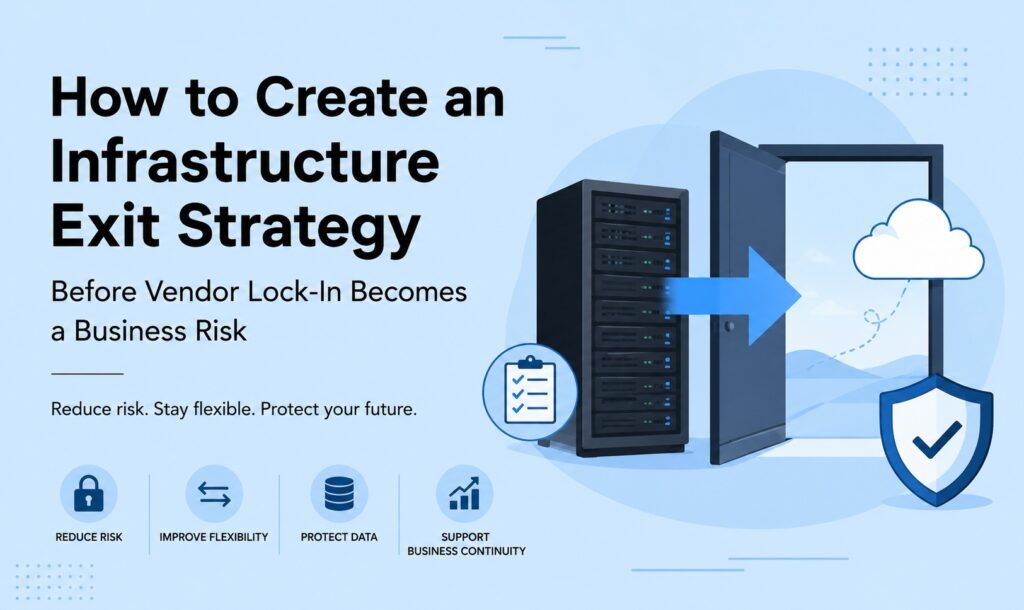
An effective Infrastructure Exit Strategy is not an admission that a provider will fail. Rather, it is a recognition that business requirements evolve. Markets change. Companies merge. Compliance requirements expand. Leadership teams change direction. The ability to move infrastructure without excessive cost or disruption becomes a strategic advantage rather than a technical consideration.
Organizations that plan their exits before they need them typically enjoy greater negotiating leverage, lower operational risk, and more flexibility when growth opportunities emerge.
Why Vendor Lock-In Is No Longer Just an IT Problem
A decade ago, infrastructure decisions were often viewed as technical matters. Today, they are business decisions that directly influence profitability, scalability, and risk management. When a company becomes dependent upon a single infrastructure provider, the consequences extend far beyond the data center.
Consider a rapidly growing software company that has spent five years building applications around proprietary cloud services. The architecture works well. Performance is acceptable. Everyone is comfortable with the environment. Then an acquisition opportunity appears. The acquiring organization wants to standardize infrastructure across all business units, but migration estimates reveal a multi-million-dollar project that could take eighteen months to complete.
Suddenly, what appeared to be an IT issue becomes a valuation issue.
This is why organizations increasingly incorporate infrastructure portability into broader governance discussions. Guidance from organizations such as the National Institute of Standards and Technology (NIST) and the Cybersecurity and Infrastructure Security Agency (CISA) continues to emphasize resilience, operational continuity, and risk management. Likewise, research from Gartner and Forrester Research increasingly highlights flexibility and portability as critical elements of long-term technology strategy.
The organizations that weather change most effectively are rarely those with the newest technology. More often, they are the organizations with the most options.
The Hidden Cost of Becoming Too Comfortable
One of the more interesting aspects of vendor lock-in is how quietly it develops. Few organizations deliberately choose to become dependent on a provider. Instead, dependency grows through a series of reasonable decisions made over months or years.
A specialized storage platform is implemented because it offers superior performance. A proprietary monitoring solution is adopted because it integrates easily with existing systems. Automation scripts are developed around platform-specific APIs because they save time. None of these decisions seem risky in isolation. Collectively, however, they can create an environment where migration becomes increasingly difficult.
The financial consequences often remain hidden until leadership attempts to evaluate alternatives. By that point, migration costs include far more than infrastructure expenses. There are consulting costs, engineering hours, retraining requirements, application modifications, testing cycles, compliance reviews, and business disruption risks.
Organizations that have already explored infrastructure risk topics through articles such as:
- How to Calculate the Cost of Infrastructure Technical Debt
- How to Audit Your Infrastructure Before It Becomes a Liability
- How to Measure Infrastructure ROI Beyond Uptime
- How to Consolidate Workloads and Reduce Infrastructure Sprawl
- How to Create Infrastructure Service Level Objectives (SLOs) That Support Business Growth
often discover that vendor lock-in and technical debt are closely related. Both accumulate gradually. Both are easy to ignore during periods of growth. And both become significantly more expensive the longer they remain unaddressed.
Building an Infrastructure Exit Strategy That Actually Works
The strongest exit strategies begin with visibility. An organization cannot realistically assess portability if it does not fully understand its current environment.
Start by documenting every significant dependency within the infrastructure ecosystem. This includes applications, databases, storage platforms, monitoring systems, automation tools, authentication services, networking components, and third-party integrations. The goal is not simply to create inventory documentation. The goal is to understand which components would create the greatest difficulty during migration.
Next, evaluate data portability. Many organizations focus heavily on application migration while underestimating the complexity of moving data. Data may exist in proprietary formats, be distributed across multiple systems, or require significant transformation before it can be used elsewhere. If data cannot be exported quickly and reliably, an organization may be more locked in than leadership realizes.
Contractual dependencies deserve equal attention. Long-term agreements, restrictive licensing terms, minimum commitments, and complex termination clauses can significantly increase migration costs. Sometimes the greatest barrier to flexibility isn’t technical at all. It’s contractual.
Perhaps most importantly, organizations should periodically test their assumptions. A migration plan that has never been validated is simply a theory. Small-scale migration exercises often reveal overlooked dependencies, undocumented processes, and operational challenges that would otherwise remain hidden until a crisis occurs.
Infrastructure Exit Strategy Comparison Chart
| Strategy Area | High Lock-In Risk | Lower Lock-In Risk |
|---|---|---|
| Data Storage | Proprietary formats | Open export formats |
| Applications | Platform-dependent | Portable architecture |
| Automation | Vendor-specific APIs | Standardized tooling |
| Documentation | Tribal knowledge | Centralized documentation |
| Contracts | Restrictive commitments | Flexible agreements |
| Recovery Planning | Single-provider dependency | Multi-environment readiness |
| Migration Testing | Never validated | Regularly tested |
Why Infrastructure Flexibility Matters to CFOs and Boards
Infrastructure teams often discuss uptime, performance, and scalability. Executive leadership, however, tends to focus on flexibility, predictability, and risk.
A CFO evaluating future growth opportunities may ask questions that are fundamentally different from those being asked by technical teams. How quickly can we integrate an acquisition? What happens if pricing changes significantly? How much negotiating leverage do we have with our providers? Could infrastructure limitations delay expansion into new markets?
These questions reveal why infrastructure flexibility has become a board-level discussion.
When an organization can migrate workloads, export data efficiently, and operate across multiple environments, it gains strategic freedom. That freedom improves negotiating leverage, strengthens business continuity planning, and reduces exposure to unforeseen market changes.
Interestingly, some organizations discover that the greatest value of an exit strategy is not the ability to leave. It is the ability to stay on favorable terms because providers understand they have alternatives.
How Dedicated Infrastructure Can Support Exit Planning
Many organizations pursuing long-term flexibility evaluate infrastructure platforms that rely on open standards and widely adopted technologies. This is one reason dedicated infrastructure continues to play an important role in many enterprise environments.
Workloads operating on standard operating systems, conventional networking architectures, and widely supported virtualization platforms are often easier to migrate than workloads built around highly specialized services. That does not mean every workload belongs on dedicated hardware, but it does mean portability considerations should be part of the evaluation process.
Organizations seeking greater control over infrastructure strategy frequently explore solutions such as Dedicated Server Hosting and GPU Dedicated Servers when balancing performance requirements with long-term flexibility objectives.
The conversation is not really about hardware versus cloud. It is about maintaining options.
And options, especially during periods of uncertainty, have measurable business value.
FAQs
Isn’t vendor lock-in unavoidable?
To some extent, yes. Every technology decision introduces dependencies. The objective is not eliminating all dependencies. The objective is ensuring those dependencies remain manageable and do not restrict future business decisions.
How often should an infrastructure exit strategy be reviewed?
Most organizations benefit from annual reviews, although rapidly growing companies may choose to evaluate portability and migration readiness more frequently. Significant architecture changes should always trigger a reassessment.
Is cloud infrastructure inherently riskier than dedicated infrastructure?
Not necessarily. Both environments can create lock-in risks depending on architectural decisions. The key consideration is portability rather than deployment location.
What is the biggest mistake organizations make?
Waiting too long. That’s usually the answer. Many organizations begin discussing exit strategies only after pricing increases, service issues, acquisition activity, or compliance requirements force the conversation. By then, migration costs are often substantially higher.
Who should own the exit strategy?
The most effective approach combines executive leadership, finance, operations, security, and infrastructure teams. Vendor lock-in is rarely a purely technical issue, so ownership should extend beyond IT.
Conclusion
The best time to create an infrastructure exit strategy is long before anyone thinks it is necessary. By the time an organization is actively searching for alternatives, many of the costs and risks associated with vendor lock-in have already materialized.
Businesses that prioritize portability, document dependencies, validate migration assumptions, and maintain contractual flexibility place themselves in a much stronger position for future growth. They gain negotiating leverage, reduce operational risk, and preserve the ability to adapt as markets evolve.
Ultimately, an infrastructure exit strategy is not about preparing to leave. It is about ensuring that your organization always has the freedom to choose its next move.
My Thoughts
At ProlimeHost, we help organizations build infrastructure strategies that prioritize performance, scalability, operational resilience, and long-term flexibility. Whether you are evaluating dedicated servers, GPU infrastructure, migration planning, or broader infrastructure modernization initiatives, our team can help you reduce vendor lock-in risks while supporting future growth.
Contact ProlimeHost today at 877-477-9454 or visit www.prolimehost.com to discuss infrastructure solutions designed around flexibility and business continuity.
Author
Steve Bloemer
Director of Sales & Operations, ProlimeHost
Steve Bloemer has spent decades helping organizations evaluate technology investments, reduce infrastructure risk, improve operational efficiency, and align IT decisions with business objectives. His experience spans web hosting, infrastructure modernization, sales leadership, aviation, entrepreneurship, and technology consulting.
He works directly with executives, IT leaders, and business owners to develop infrastructure strategies that support growth while maintaining flexibility and financial predictability.
Contact: 877-477-9454
Website: www.prolimehost.com