Executive Summary
Every IT department measures infrastructure performance. The challenge is that many organizations measure the wrong things.
Executives rarely make strategic decisions because CPU utilization increased by three percent or because storage latency decreased by a few milliseconds. Those numbers certainly matter to engineers, but they rarely answer the questions occupying the minds of CEOs, CFOs, boards of directors, or investors. Leadership wants to know whether infrastructure is supporting business growth, protecting revenue, reducing operational risk, and making future spending more predictable. If a performance metric cannot help answer one of those questions, it probably doesn’t belong on an executive dashboard.
Creating meaningful Infrastructure KPIs is therefore less about collecting more technical data and more about translating technology into business language. The organizations that consistently secure infrastructure funding are not necessarily the ones with the newest hardware or the largest IT budgets. More often, they are the ones that can clearly demonstrate how infrastructure investments improve customer experience, reduce financial exposure, increase operational efficiency, and support long-term strategic objectives.
This guide explores how infrastructure leaders can build executive-focused KPIs that drive better decisions, strengthen business cases, and create reports executives actually read instead of simply filing away after quarterly meetings.
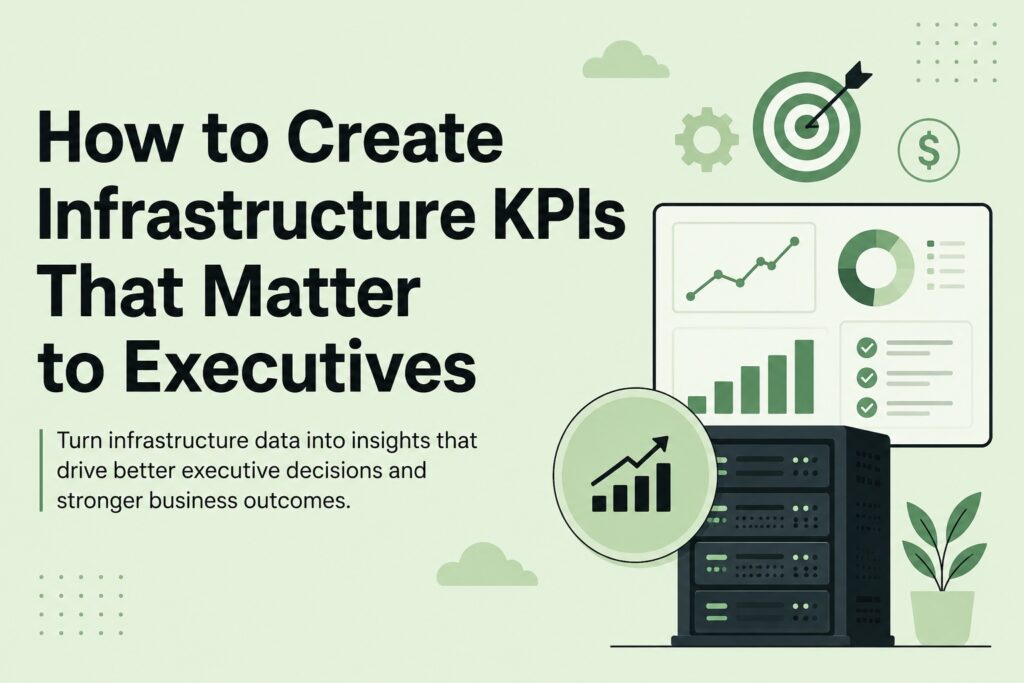
How to Create Infrastructure KPIs That Matter to Executives
There’s an interesting disconnect that exists inside many organizations. Infrastructure teams spend enormous amounts of time monitoring servers, storage arrays, virtualization platforms, network utilization, and security events. Modern monitoring platforms can generate thousands of metrics every minute, and many organizations proudly display elaborate dashboards filled with colorful graphs that update in real time.
Yet when quarterly leadership meetings begin, very little of that information influences executive decisions.
It’s not because executives don’t appreciate technology. Quite the opposite. Most executive teams understand that reliable infrastructure has become essential to revenue generation, customer satisfaction, cybersecurity, and business continuity. What they struggle with is determining which technical measurements actually deserve attention. A dashboard containing one hundred statistics may impress an engineer, but it often overwhelms a CFO who simply wants to understand whether infrastructure investments are reducing business risk or quietly increasing it.
That distinction changes everything. Instead of asking, “How is the infrastructure performing?” executives are usually asking a different question entirely: “Is our infrastructure helping the business perform better?” Once you recognize that difference, the design of every KPI begins to change.
Consider two very different presentations. The first proudly announces that average CPU utilization declined from 62 percent to 48 percent over the past quarter. The second explains that workload optimization postponed a six-figure hardware purchase while maintaining application performance during seasonal demand spikes. Both statements describe essentially the same operational improvement, yet only one immediately connects technology to financial outcomes. That’s the version executives remember.
Why Technical Metrics Alone Rarely Earn Executive Attention
Infrastructure professionals naturally think in terms of availability, latency, throughput, storage performance, and resource utilization because those measurements determine whether systems remain healthy. They are indispensable for day-to-day operations, troubleshooting, and capacity planning. The problem arises when those same operational metrics are presented to leadership without any business context.
Imagine telling your executive team that network latency improved by eight milliseconds. An engineer immediately understands the significance of that achievement. A chief executive, however, may reasonably wonder whether the improvement affected customer experience, employee productivity, or revenue generation. Without that connection, the number becomes little more than an interesting statistic.
The same principle applies to uptime. Nearly every infrastructure report proudly highlights availability percentages, often boasting figures of 99.9 percent or even 99.99 percent. Those numbers sound impressive, but executives tend to ask a much more practical question: what did that availability accomplish for the business?
A stronger KPI doesn’t simply celebrate uptime. Instead, it explains that maintaining service availability prevented customer interruptions during peak transaction periods, protected contractual service commitments, and avoided potentially significant financial losses associated with unplanned outages. Suddenly, the conversation shifts from technology to business resilience.
Research from the Uptime Institute consistently demonstrates that major infrastructure outages frequently cost organizations hundreds of thousands of dollars, while larger enterprises often experience losses reaching into the millions. Likewise, Gartner has long encouraged organizations to align IT performance measurements with measurable business outcomes rather than relying exclusively on operational statistics. These findings reinforce a simple reality that many organizations overlook: executives are not interested in fewer metrics; they are interested in more meaningful metrics.
Start with Executive Questions Instead of Technical Answers
One of the most effective ways to build valuable Infrastructure KPIs is surprisingly straightforward. Before selecting a single measurement, identify the business questions executives need answered.
For example, perhaps the board is concerned about controlling infrastructure costs over the next three years. Another organization may be preparing for rapid expansion into new markets and wants confidence that existing systems can scale without disrupting customer experience. Others may be responding to increased cybersecurity requirements, stricter regulatory compliance, or growing concerns about business continuity. Each of those priorities requires different performance indicators because each represents a different business objective.
When organizations begin with executive priorities instead of existing technical dashboards, reporting becomes dramatically more relevant. Infrastructure teams stop measuring activity simply because they can and begin measuring progress toward business goals instead. That subtle shift changes the entire conversation.
Suppose leadership wants greater financial predictability. Rather than emphasizing processor utilization or disk consumption, executive dashboards might highlight infrastructure cost per application, revenue supported per server, forecasted capacity timelines, infrastructure spending as a percentage of revenue, and projected hardware refresh costs over the next budget cycle. Those KPIs immediately support planning discussions because they help executives understand future investment requirements before they become urgent.
On the other hand, if customer experience has become the organization’s primary competitive advantage, infrastructure reporting should naturally evolve to emphasize application responsiveness, transaction completion rates, service availability during peak demand, and customer-facing incident trends. The underlying technology remains exactly the same, yet the metrics now tell a story executives can connect directly to business performance.
Translate Infrastructure Performance into Financial Value
One of the biggest opportunities for infrastructure leaders lies not in collecting additional data, but in presenting familiar data differently. Technology departments often underestimate how comfortable executives are discussing technical issues, provided those discussions remain connected to financial outcomes, operational stability, or strategic planning.
For example, saying that storage utilization increased by fifteen percent provides useful operational information, but it leaves executives wondering whether action is required. Explaining that current storage growth indicates available capacity will be exhausted within twelve months and that expanding storage during scheduled procurement cycles could avoid substantially higher emergency purchasing costs—creates an entirely different discussion. The metric now supports budgeting rather than merely describing system behavior.
The same approach applies across nearly every aspect of infrastructure management. Lower incident counts become evidence of improved operational resilience. Faster application response times become indicators of stronger customer satisfaction and increased productivity. Improved workload balancing demonstrates how organizations can postpone capital expenditures without sacrificing performance. Even routine capacity planning becomes more compelling when expressed as reduced financial risk instead of increased hardware utilization.
This is also where infrastructure strategy intersects with purchasing decisions. Organizations evaluating Dedicated Server Hosting often discover that predictable monthly infrastructure costs simplify executive forecasting compared with highly variable cloud spending. Likewise, businesses experiencing growing AI workloads may find that purpose-built GPU Dedicated Servers deliver more consistent long-term performance for compute-intensive applications than attempting to continually scale general-purpose infrastructure.
Whether infrastructure resides in private data centers, colocated environments, or dedicated hosting platforms, executives ultimately evaluate investments using the same criteria: Does this improve business performance, reduce uncertainty, and support future growth? The most effective KPIs answer those questions before executives even have to ask them.
As we’ve explored in our earlier guides, including How to Build an Infrastructure Business Case That Wins Budget Approval, How to Evaluate Colocation vs Dedicated Servers for Long-Term Cost Efficiency, How to Measure Server Utilization Before Buying Additional Hardware, How to Create Infrastructure Service Level Objectives (SLOs) That Support Business Growth, and How to Create an Infrastructure Exit Strategy Before Vendor Lock-In Becomes a Business Risk, infrastructure decisions become significantly easier when technical measurements are translated into business outcomes instead of isolated operational statistics.
That’s really the purpose of executive KPIs. They don’t simplify infrastructure because executives aren’t capable of understanding technology. They simplify decision-making by showing exactly how infrastructure supports the broader mission of the business, allowing leadership to allocate resources with greater confidence and fewer surprises.
Focus on a Small Number of KPIs That Drive Action
One of the most common mistakes organizations make is assuming that more metrics create greater visibility. In reality, the opposite is usually true. When executives receive dashboards containing dozens of charts and pages of operational statistics, important trends often disappear beneath the sheer volume of information. Instead of improving decision-making, excessive reporting creates noise.
The most effective executive dashboards are surprisingly concise. Rather than attempting to summarize every aspect of the infrastructure environment, they focus on a handful of indicators that consistently influence planning, budgeting, and strategic direction. A well-designed dashboard should allow an executive to understand the health of the organization’s infrastructure in just a few minutes while also identifying where further discussion may be needed.
Consider the questions executives ask most frequently. Is infrastructure spending remaining within forecast? Can current systems support projected business growth? Has operational risk increased since last quarter? Are customer-facing services becoming more reliable? Is the organization postponing necessary hardware investments for financial reasons, or because capacity planning genuinely supports it? Those are business questions, and the KPIs selected should help answer them without requiring an engineering background.
That doesn’t mean eliminating technical detail altogether. Supporting metrics should always be available for infrastructure teams, but the executive dashboard should remain focused on business outcomes first and technical diagnostics second. Think of it as an executive summary rather than a complete operational report. The details remain available whenever leadership wants to explore further, but they no longer distract from the broader story.
Build KPIs That Encourage Better Behavior
Every KPI influences behavior, whether intentionally or not. That’s why thoughtful KPI design is just as important as accurate measurement.
Suppose an infrastructure team is evaluated primarily on maintaining very low CPU utilization. The predictable response is to deploy additional servers long before they are actually needed. Utilization falls, the KPI improves, and the organization spends significantly more money than necessary. On paper, performance appears excellent. Financially, however, efficiency has declined.
The same unintended consequences appear in many organizations. Measuring only ticket volume may encourage teams to close incidents quickly instead of solving root causes. Rewarding zero downtime without considering maintenance windows may discourage proactive upgrades. Celebrating reduced infrastructure spending without evaluating service quality can ultimately create technical debt that becomes far more expensive to address later.
Well-designed Infrastructure KPIs encourage balanced decision-making. Capacity utilization should be measured alongside application performance. Infrastructure costs should be evaluated together with customer experience. Availability should be considered in relation to revenue protection and contractual obligations rather than existing as an isolated percentage. When metrics complement one another instead of competing with one another, executives gain a much more accurate picture of organizational health.
Executive Dashboards Should Tell a Story
Perhaps the simplest test of any executive dashboard is this: if someone unfamiliar with the infrastructure environment reviewed it for five minutes, would they understand what decisions the business should make next?
The strongest dashboards answer that question naturally because every KPI contributes to a larger narrative. Capacity forecasts explain whether infrastructure can support projected growth. Financial trends demonstrate whether spending remains aligned with business objectives. Service availability illustrates operational resilience. Security indicators reveal changes in organizational risk. Customer-facing performance metrics show whether technology investments are improving the experience clients actually receive.
Notice what ties these measurements together. None of them exist solely to celebrate technical excellence. Instead, each provides evidence that infrastructure is helping the organization achieve broader strategic objectives.
This storytelling approach becomes especially valuable during annual budgeting cycles. Rather than requesting additional infrastructure investment because utilization has increased, IT leaders can demonstrate how proactive investment prevents future operational disruption, supports anticipated business expansion, and reduces long-term financial risk. That is a fundamentally different conversation, and one executives are far more likely to support.
Industry guidance from organizations such as the National Institute of Standards and Technology (NIST), the Cloud Security Alliance, and the Information Systems Audit and Control Association (ISACA) all reinforce the importance of governance frameworks that align technology performance with enterprise objectives. Their recommendations consistently emphasize measuring business outcomes alongside operational performance rather than treating infrastructure as an isolated technical function.
Executive Infrastructure KPI Comparison
| Executive Objective | Traditional IT Metric | Executive KPI That Matters | Business Value |
|---|---|---|---|
| Reduce Costs | CPU Utilization | Infrastructure Cost per Application | Improves forecasting and budgeting |
| Support Growth | Server Capacity | Forecasted Capacity Remaining | Enables proactive expansion |
| Improve Customer Experience | Network Latency | Transaction Response Time | Protects customer satisfaction |
| Reduce Risk | Uptime Percentage | Revenue Protected Through Availability | Connects reliability to financial outcomes |
| Improve Efficiency | Incident Count | Mean Time to Business Recovery | Demonstrates operational resilience |
| Plan Investments | Storage Usage | Months Until Capacity Expansion Required | Supports capital planning |
| Measure ROI | Hardware Performance | Revenue Supported per Infrastructure Dollar | Demonstrates infrastructure value |
Frequently Asked Questions
Should executives still receive technical reports?
Absolutely. Executive dashboards should summarize business performance, while detailed operational reports remain available for infrastructure managers, architects, and engineers. The two reports serve different audiences, and that’s perfectly appropriate.
How many KPIs should appear on an executive dashboard?
There’s no universal number, but most organizations find that between six and ten carefully selected KPIs provide sufficient visibility without overwhelming decision-makers. Beyond that, dashboards often become increasingly difficult to interpret.
How often should executive KPIs be reviewed?
Most organizations review strategic infrastructure KPIs monthly or quarterly, depending on the pace of business. Operational teams, of course, continue monitoring technical metrics continuously. Executive reporting should support strategic planning rather than minute-by-minute operations.
Can cloud environments use the same KPI framework?
Yes. Whether infrastructure operates in cloud, colocation, hybrid, or dedicated environments, executive KPIs should remain focused on business outcomes. The underlying technology may change, but leadership still needs to understand cost predictability, operational resilience, scalability, and return on investment.
Final Thoughts
Infrastructure has become far more than a collection of servers housed in a data center. Today it supports customer experience, protects organizational reputation, enables digital transformation, and increasingly influences financial performance across every department. That reality means infrastructure reporting must evolve as well.
The organizations that communicate infrastructure performance most effectively aren’t necessarily collecting more information than everyone else. They’re simply presenting information differently. By connecting operational measurements to financial outcomes, strategic planning, customer experience, and organizational resilience, infrastructure leaders transform dashboards from technical scorecards into business decision tools.
That transformation often becomes the difference between infrastructure being viewed as an operational expense and being recognized as a strategic business asset. Once executives begin seeing technology through that lens, conversations about budgeting, modernization, scalability, and long-term investment become far more productive.
Ready to Build Infrastructure That Supports Executive Goals?
Whether you’re modernizing legacy infrastructure, planning future growth, or looking for predictable hosting costs that simplify executive forecasting, ProlimeHost provides enterprise-grade infrastructure designed for performance, scalability, and reliability.
Learn more about our Dedicated Server Hosting:
https://www.prolimehost.com/dedicated-server-hosting/
Explore our high-performance GPU Dedicated Servers for AI, analytics, rendering, and compute-intensive workloads:
https://www.prolimehost.com/gpu-dedicated-servers/
Our infrastructure specialists are available 24/7 to help you design solutions that align technical performance with long-term business objectives.
About the Author
Steve Bloemer is Director of Sales & Operations at ProlimeHost and has spent more than two decades helping organizations design secure, scalable, and cost-effective hosting solutions. Working with businesses ranging from growing startups to enterprise organizations, Steve specializes in aligning infrastructure strategy with measurable business outcomes.
His writing focuses on helping executives understand the financial, operational, and strategic impact of infrastructure decisions while translating complex technical concepts into practical business guidance.
ProlimeHost
Website: https://www.prolimehost.com
Sales: 877-477-9454