Executive Summary
Most organizations eventually discover that storage is far more than simply choosing between SSDs and hard drives. It becomes an architectural decision that affects application responsiveness, infrastructure costs, backup windows, scalability, operational efficiency, and even customer satisfaction. Yet surprisingly, many infrastructures still treat all data as if it deserves identical hardware, identical performance characteristics, and identical expense.
That approach rarely survives growth.
As organizations accumulate applications, virtual machines, databases, AI workloads, customer files, backups, analytics platforms, development environments, and archived information, their storage environments often evolve organically rather than strategically. New disks are added whenever capacity becomes tight. Faster drives are purchased whenever an application begins slowing down. Archived data remains on premium storage because nobody wants to risk moving it. Before long, expensive NVMe arrays become filled with information that may not have been accessed for months, while business-critical databases compete for resources with forgotten virtual machines and inactive project files.
A carefully designed storage tiering strategy addresses this imbalance by matching the value and performance requirements of data with the most appropriate storage technology. Instead of purchasing premium hardware for every workload, organizations allocate their fastest storage where it produces measurable business value while moving less active information to increasingly economical tiers. The result is often lower infrastructure costs, improved application performance, simplified capacity planning, and significantly better long-term return on infrastructure investments.
Designing such a strategy, however, requires much more than selecting NVMe, SSD, and HDD drives. It requires understanding business priorities, workload characteristics, application behavior, future growth patterns, lifecycle management, recovery objectives, governance policies, and financial planning. The organizations that consistently outperform their competitors are rarely those purchasing the fastest storage available. More often, they are the ones placing the right data on the right storage at precisely the right time.
That distinction makes all the difference.
Why Storage Tiering Has Become a Business Strategy
Several years ago, storage purchasing decisions were relatively straightforward. Database servers received the fastest disks available, file servers received larger drives, and backups were written wherever capacity happened to exist. Performance expectations were modest, virtualization was limited, and data volumes remained manageable.
Today’s infrastructure landscape bears little resemblance to that environment.
Organizations routinely operate hundreds of virtual machines, multiple database engines, containerized applications, AI training environments, analytics platforms, media repositories, development labs, customer portals, and compliance archives, all competing for storage resources simultaneously. Some workloads generate millions of input/output operations every hour. Others may remain untouched for weeks before suddenly becoming business critical again.
Should all of these workloads occupy identical storage? Probably not.
One of the most common mistakes infrastructure teams make is confusing storage capacity with storage performance. Having twenty terabytes of available space says very little about how efficiently applications will perform. Likewise, installing every workload onto premium NVMe drives often produces diminishing returns because many applications simply cannot utilize the additional performance they’re being given.
This is where a thoughtful storage tiering strategy begins changing the conversation.
Instead of asking, “What is our fastest storage option?” experienced infrastructure architects ask a different question altogether:
“Which workloads genuinely require premium performance, and which ones simply require dependable capacity?”
That subtle shift in thinking transforms storage from a purchasing exercise into a long-term business strategy.
Organizations that adopt this mindset frequently discover they can delay expensive storage expansions, reduce capital expenditures, improve virtualization density, accelerate customer-facing applications, and simplify future infrastructure planning without sacrificing performance where it actually matters.
Interestingly, storage optimization often produces a ripple effect throughout the entire infrastructure ecosystem. Faster databases reduce CPU wait states. Virtual machines respond more consistently during peak demand. Backup operations complete within shorter maintenance windows. Disaster recovery synchronization becomes more predictable. Monitoring tools report fewer performance anomalies because storage bottlenecks are isolated before they become enterprise-wide problems.
These improvements are not accidental. They are the result of intentional architectural planning rather than reactive purchasing.
This philosophy closely aligns with our earlier discussion in How to Build a Server Standardization Strategy (https://www.prolimehost.com/blogs/how-to-build-a-server-standardization-strategy/), where standardized infrastructure decisions improve operational consistency, and How to Design Infrastructure for Five Years of Business Growth (https://www.prolimehost.com/blogs/how-to-design-infrastructure-for-five-years-of-business-growth/), which examines how long-term architectural planning reduces operational surprises as organizations scale. Storage tiering extends those same principles deeper into the data layer itself, ensuring that infrastructure investments remain aligned with business objectives rather than becoming fragmented over time.
Understanding Modern Storage Tiers
Not every byte of information deserves identical treatment.
That statement may seem obvious, yet many organizations continue storing every workload on identical hardware because it appears administratively simpler. Initially, that simplicity can be attractive. Over time, however, it becomes extraordinarily expensive.
Modern enterprise storage generally falls into several performance tiers, each designed to satisfy different operational requirements.
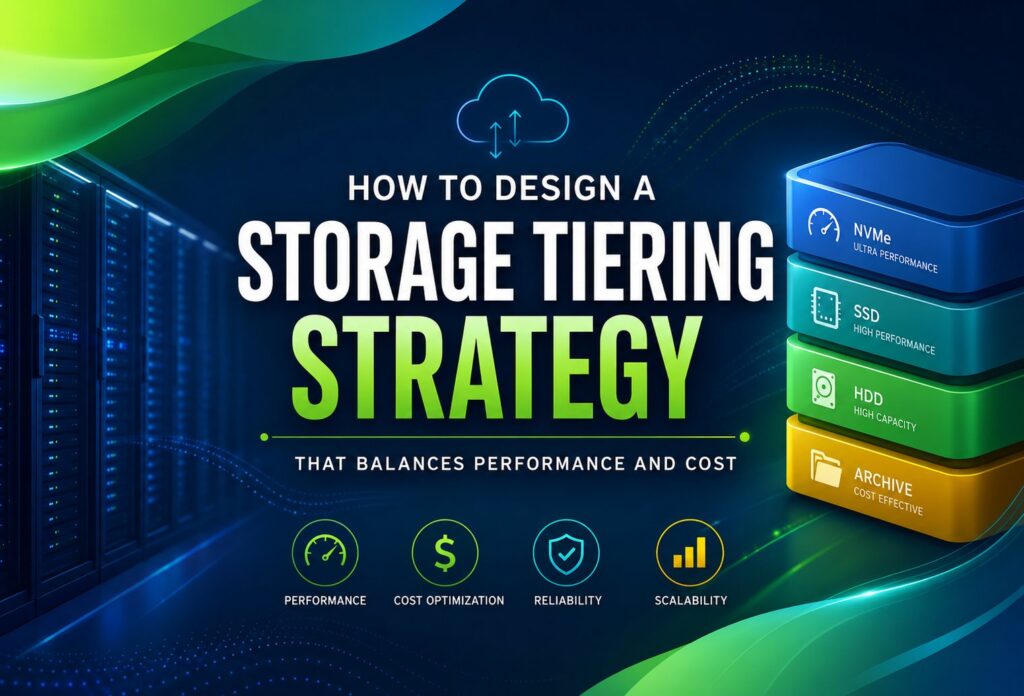
At the highest level sits ultra-low-latency storage built on NVMe technology. These devices deliver exceptional throughput, extremely low response times, and outstanding parallel processing capabilities. Mission-critical SQL databases, high-transaction ERP platforms, virtualization clusters, AI inference systems, financial applications, and customer-facing transactional workloads typically benefit most from this tier because milliseconds often translate directly into productivity, customer satisfaction, or revenue.
The next tier commonly consists of enterprise SSD storage. While slightly slower than NVMe under sustained workloads, enterprise SSDs continue to provide impressive responsiveness and reliability for application servers, virtualization platforms, collaborative business applications, development environments, and frequently accessed shared data. For many organizations, this tier delivers the optimal balance between cost and performance, making it the workhorse of modern infrastructure.
Traditional enterprise hard drives remain remarkably valuable despite frequent predictions of their demise. Their strength lies not in raw performance but in economical capacity. Backup repositories, archival datasets, compliance records, surveillance footage, historical analytics, inactive virtual machines, and long-term document retention all benefit from high-capacity storage where access frequency matters far less than cost per terabyte.
Beyond these internal tiers, many organizations now extend their storage architecture into hybrid environments that include object storage, cloud repositories, immutable backup platforms, and geographically distributed disaster recovery systems. Rather than replacing on-premises infrastructure, these additional layers complement it by supporting retention policies, business continuity objectives, and global accessibility.
What matters is not the individual technology itself. What matters is ensuring each workload resides where its business value justifies its operational expense.
Imagine a law firm retaining closed case files for seven years to satisfy regulatory requirements. Keeping every document on premium NVMe storage offers virtually no measurable benefit while significantly increasing infrastructure costs. Conversely, relocating active litigation databases onto slow archival storage would likely frustrate attorneys, delay document retrieval, and reduce billable productivity.
Neither decision would represent sound infrastructure management.
Successful enterprise storage planning continuously evaluates the relationship between performance, utilization, accessibility, and business value rather than treating storage as a static purchase. That philosophy becomes even more important as organizations begin integrating virtualization, AI processing, and increasingly data-intensive business applications into their long-term infrastructure strategies.
Designing Storage Around Workloads Instead of Hardware
One of the more interesting shifts taking place inside mature IT organizations is that infrastructure teams are no longer beginning their storage discussions with hardware specifications. Ten years ago the conversation almost always started with questions such as, “Should we purchase another SAN?” or “Do we need larger SSD arrays?” Today, experienced architects are far more likely to begin somewhere entirely different.
They start by examining the workloads.
That distinction sounds subtle, but it changes nearly every decision that follows. Hardware eventually becomes a consequence of understanding the workload instead of being the starting point. The organizations that consistently build efficient infrastructure understand that applications have personalities. Some generate constant, random reads throughout the day. Others produce bursts of writes during overnight processing. Certain databases demand extremely low latency every second of every day, while file repositories may experience heavy activity only once each quarter. If every application is treated identically, storage costs inevitably begin climbing faster than business value.
A successful storage tiering strategy therefore begins with classification rather than procurement.
Infrastructure teams should spend time measuring input/output operations, latency requirements, throughput patterns, growth rates, backup frequencies, recovery objectives, compliance obligations, and user expectations before deciding where workloads belong. This process often uncovers surprising results. Applications that everyone assumed required premium storage sometimes perform almost identically on enterprise SSDs, while seemingly modest workloads reveal transaction patterns that justify investment in high-performance NVMe.
Those discoveries are valuable because they replace assumptions with measurable evidence.
This workload-first philosophy closely complements the planning principles discussed in How to Build an Infrastructure Reference Architecture That Eliminates Deployment Inconsistencies (https://www.prolimehost.com/blogs/build-infrastructure-reference-architecture/). Standardized architectural decisions become much easier when every workload is categorized using consistent technical and business criteria instead of individual administrator preferences. Storage stops being an isolated component and becomes another governed element of an overall infrastructure framework.
Equally important is recognizing that workloads evolve. A database supporting fifty employees today may support five hundred within three years. A development environment can become production with remarkably little warning. Analytics platforms often grow exponentially as organizations discover new ways to leverage operational data. Designing storage based solely on today’s utilization creates tomorrow’s migration project.
That is rarely an efficient outcome.
Data Has a Lifecycle—Your Storage Should Too
Perhaps the largest financial mistake organizations make is assuming that data retains the same value forever.
It doesn’t.
The value of information changes almost continuously. Fresh transactional records may be accessed thousands of times per hour. Three months later those same records become historical references. After several years they may exist only for compliance purposes. Yet many infrastructures continue storing every stage of that lifecycle on premium hardware simply because nobody established policies for moving information as its business importance changed.
The consequence isn’t merely wasted capacity.
Premium storage becomes increasingly crowded with inactive information, backup windows grow longer, replication consumes additional bandwidth, virtualization platforms experience unnecessary contention, and expansion projects occur months—or even years—earlier than necessary. Ironically, organizations often purchase additional high-performance storage when better lifecycle management would have postponed the investment entirely.
A mature data lifecycle management strategy recognizes several natural transitions.
Newly created operational data generally occupies high-performance storage because response times directly affect employees, customers, or applications. As access frequency begins declining, that information migrates toward enterprise SSD tiers where responsiveness remains excellent but costs decrease. Eventually, inactive records transition into high-capacity storage designed primarily for retention, auditing, legal compliance, or disaster recovery.
Notice what isn’t happening.
Nothing is being deleted prematurely, and nothing is sacrificing availability. The organization is simply matching storage economics to actual business behavior.
That distinction becomes increasingly important as artificial intelligence, business intelligence platforms, and predictive analytics continue consuming larger datasets. Historical information frequently remains valuable, but it rarely needs the same performance characteristics as active production databases. Recognizing that difference is one of the defining characteristics separating strategic infrastructure planning from reactive infrastructure management.
Financial Planning Should Influence Technical Design
Storage discussions frequently become dominated by technical terminology—IOPS, latency, throughput, PCIe generations, cache architectures, replication protocols, deduplication ratios and while each metric certainly has merit, executive leadership usually evaluates infrastructure through a different lens.
Their questions sound more like this. How long will this investment last? Can expansion occur without disruption? What risks does postponing upgrades introduce? Will additional performance generate measurable business value? How predictable are future costs?
Those questions deserve technical answers.
An effective enterprise storage strategy connects engineering decisions directly to financial outcomes. Premium NVMe capacity should be reserved for workloads where improved response times create measurable productivity gains, increased customer satisfaction, higher transaction volume, or accelerated revenue generation. Enterprise SSDs should support applications requiring consistent responsiveness without the premium pricing associated with ultra-low latency storage. Large-capacity disks should absorb information whose primary requirement is economical retention rather than instantaneous retrieval.
Viewed this way, storage architecture becomes an investment portfolio.
Some assets produce immediate operational returns. Others preserve long-term value at lower cost. The objective is balance—not maximizing performance everywhere, but maximizing business return everywhere.
This perspective aligns closely with concepts explored in How to Build an Infrastructure Resilience Strategy That Protects Revenue During Unexpected Failures (https://www.prolimehost.com/blogs/how-to-build-an-infrastructure-resilience-strategy-that-protects-revenue-during-unexpected-failures/). Infrastructure investments should strengthen business continuity while remaining financially sustainable over multiple hardware refresh cycles. Storage planning cannot be isolated from broader financial governance because every expansion decision influences depreciation schedules, operational expenses, maintenance contracts, and future procurement planning.
It also reinforces another important reality that executives occasionally overlook. The least expensive storage purchase is not necessarily the lowest-cost solution over five years.
Hardware that reaches capacity prematurely, creates performance bottlenecks, or requires repeated migrations often becomes substantially more expensive than a slightly larger initial investment supported by a thoughtful tiering strategy.
Automation Should Become Part of the Architecture
One misconception surrounding storage tiering is that administrators will simply move data manually whenever utilization changes.
That may work inside a small environment. It rarely scales.
As infrastructures grow into hundreds of virtual machines, thousands of user accounts, multiple application clusters, container platforms, and petabytes of business information, manual storage administration becomes increasingly impractical. Human judgment remains essential for defining policies, but execution should be automated wherever possible.
Modern storage platforms increasingly support policy-driven data movement based on measurable characteristics rather than administrator intervention. Access frequency, modification dates, latency requirements, storage utilization, retention policies, file age, database activity, and compliance classifications can all influence automated placement decisions. Instead of waiting for storage volumes to become critically full, organizations establish rules that continuously optimize placement behind the scenes.
Automation also reduces another problem that is rarely discussed.
Consistency.
Two administrators evaluating the same workload manually may reach different conclusions depending on experience, urgency, or available documentation. Automated governance applies identical rules every time, creating predictable behavior throughout the infrastructure. Predictability, after all, is one of the fundamental goals of enterprise architecture.
Organizations implementing dedicated infrastructure frequently discover that these automation capabilities become even more valuable as workloads diversify. Whether deploying virtualization clusters, database farms, AI processing environments, or high-density application hosting, properly designed storage policies allow infrastructure to adapt naturally as business demands evolve.
For organizations planning future infrastructure deployments or hardware refreshes, ProlimeHost’s Dedicated Server Hosting platform (https://www.prolimehost.com/dedicated-server-hosting/) provides flexible enterprise configurations capable of supporting sophisticated multi-tier storage architectures. Businesses deploying machine learning pipelines, large-scale analytics, or GPU-intensive processing can likewise build tiered storage environments around ProlimeHost’s GPU Dedicated Servers (https://www.prolimehost.com/gpu-dedicated-servers/), ensuring that compute performance is matched with equally intelligent storage allocation.
Ultimately, automation should never replace architectural thinking.
It should reinforce it.
The strongest storage environments are not those with the fastest disks, the newest hardware, or the largest budgets. They are the environments where every storage decision reflects an understanding of workload behavior, business priorities, financial discipline, and long-term operational strategy. When those elements begin working together instead of competing with one another, storage quietly becomes one of the most efficient assets within the entire infrastructure ecosystem.
Governance Is What Keeps a Tiering Strategy Effective
One of the easiest mistakes to make after successfully deploying a storage tiering strategy is assuming the project is finished. In reality, this is the point where the strategy either begins delivering long-term value or gradually falls apart.
Infrastructure has a remarkable tendency to drift.
New applications appear because a business unit needs them quickly. Development teams request additional virtual machines. Marketing launches a new analytics platform. Finance introduces another reporting database. Artificial intelligence projects suddenly require petabytes of training data. Months later, nobody remembers why a particular workload occupies premium NVMe storage, only that moving it “might break something.”
Sound familiar?
Without governance, storage slowly returns to the same condition that prompted the redesign in the first place.
Effective governance doesn’t have to introduce unnecessary bureaucracy. Instead, it establishes a repeatable framework for evaluating where workloads belong, how often placement should be reviewed, who approves changes, and what performance objectives justify premium storage resources. The emphasis shifts away from individual opinions and toward measurable business criteria.
For example, an application supporting online customer transactions may legitimately remain within the highest performance tier because every reduction in latency contributes directly to customer experience and revenue generation. A departmental reporting database, however, might perform equally well on enterprise SSD storage while reducing infrastructure costs considerably. Neither decision should depend on who requested the server or which administrator happened to provision it.
It should depend upon documented business requirements.
Organizations that formalize these policies typically experience fewer emergency storage purchases, fewer unexpected capacity shortages, and significantly less disagreement between infrastructure teams and executive leadership. Storage allocation becomes transparent because everyone understands the reasoning behind placement decisions.
That governance model closely mirrors the planning discipline discussed in How to Create an Enterprise Hardware Qualification Process (https://www.prolimehost.com/blogs/how-to-create-an-enterprise-hardware-qualification-process/), where standardized evaluation criteria improve consistency across future purchasing decisions. The same philosophy applies here: standardized governance produces predictable infrastructure.
Capacity Planning Is Really About Predictability
Capacity planning often receives less attention than performance tuning because it’s perceived as less exciting. Administrators naturally enjoy discussing PCIe generations, cache algorithms, and storage benchmarks. Forecasting capacity growth, by comparison, feels almost administrative.
Yet capacity planning frequently determines whether an organization expands efficiently or reacts under pressure.
Storage consumption rarely increases in a perfectly straight line. Some businesses experience seasonal spikes. Others acquire companies, launch new digital services, expand into additional markets, or introduce AI-driven analytics that multiply storage requirements almost overnight. Infrastructure designed only for today’s utilization quickly becomes tomorrow’s bottleneck.
This is where storage tiering demonstrates one of its greatest advantages.
Rather than continuously purchasing premium storage as data volumes grow, organizations can forecast which information will remain performance-sensitive and which will naturally migrate toward lower-cost storage over time. Premium capacity is preserved for workloads that genuinely require it, while economical tiers absorb predictable long-term growth.
The result is not merely lower capital expenditure.
Forecasting becomes substantially more accurate.
Finance departments appreciate this because infrastructure investments become easier to model over three- to five-year planning cycles. Operations teams benefit because hardware refreshes occur proactively instead of reactively. Procurement gains negotiating leverage because purchases can be planned months in advance rather than rushed during capacity emergencies.
Perhaps more importantly, executive leadership develops greater confidence in IT planning because infrastructure decisions begin following measurable business forecasts instead of responding to operational surprises.
That confidence has real value.
Performance Monitoring Should Drive Placement Decisions
No storage tiering strategy remains accurate forever. Applications evolve. User behavior changes. Databases grow.
Artificial intelligence introduces workloads that didn’t exist twelve months earlier. Virtualization clusters expand. Customer expectations continue increasing. Consequently, workload placement should never become permanent simply because it was correct during the original deployment.
Continuous monitoring provides the evidence necessary to refine placement over time.
The most effective organizations measure storage performance using several perspectives simultaneously. Technical metrics such as latency, throughput, queue depth, cache utilization, and IOPS remain essential because they identify infrastructure bottlenecks before users experience them. Business metrics are equally important. Application response times, transaction completion rates, report generation windows, customer satisfaction indicators, and revenue-producing workflows often reveal whether storage performance is creating tangible business outcomes.
Those two viewpoints should reinforce one another.
Imagine discovering that a reporting database consumes significant NVMe resources while generating minimal business impact. Conversely, an AI inference engine operating from enterprise SSD storage might demonstrate measurable revenue improvements if promoted to the highest performance tier. Without monitoring, neither opportunity becomes obvious.
Monitoring therefore transforms storage tiering into a living optimization process rather than a static hardware deployment.
Organizations that periodically review workload behavior often uncover optimization opportunities long after the original architecture has been implemented. Those incremental improvements accumulate surprisingly quickly over several years.
Storage Tiering and Business Continuity Cannot Be Separated
Performance receives considerable attention during infrastructure planning. Availability deserves at least as much.
An exceptionally fast storage platform provides little value if business operations cannot recover after an unexpected failure. Likewise, inexpensive archival storage loses its appeal if recovery objectives cannot be achieved within acceptable timeframes.
This relationship between storage architecture and resilience is sometimes underestimated.
Each storage tier should support recovery objectives appropriate for the business value of the data it contains. Mission-critical transactional databases typically require aggressive replication, frequent snapshots, and rapid failover capabilities. Collaborative business systems may require scheduled replication with modest recovery windows. Historical archives often emphasize data durability rather than immediate availability.
The storage technology itself becomes only one component of a much broader resilience strategy.
Replication policies, immutable backups, geographic redundancy, disaster recovery testing, retention schedules, ransomware protection, and recovery automation all interact with storage tiering decisions. Treating these disciplines independently often creates conflicting objectives. Designing them together produces infrastructure that performs efficiently while remaining resilient under adverse conditions.
This concept expands naturally upon the resilience planning explored in How to Build an Infrastructure Resilience Strategy That Protects Revenue During Unexpected Failures (https://www.prolimehost.com/blogs/how-to-build-an-infrastructure-resilience-strategy-that-protects-revenue-during-unexpected-failures/). Storage architecture should contribute to organizational continuity, not simply operational performance.
The question executives should continually ask isn’t merely, “How quickly can our applications run?” A more valuable question might be, “How confidently can our business continue operating regardless of what happens?”
Those are not identical objectives.
Looking Beyond Today’s Infrastructure
Technology has a habit of changing more quickly than budgeting cycles.
Five years ago, widespread AI inference workloads were uncommon inside many mid-sized enterprises. Today, organizations routinely evaluate GPU clusters, real-time analytics, massive datasets, and increasingly sophisticated machine learning applications. Data volumes continue expanding, and storage architectures designed solely around yesterday’s applications often struggle to support tomorrow’s initiatives.
A forward-looking enterprise storage strategy anticipates this evolution.
Instead of designing fixed storage pools with rigid performance boundaries, mature organizations increasingly build modular architectures capable of adapting as workloads change. Additional NVMe capacity can be introduced without redesigning the environment. SSD pools can expand independently. High-capacity archival systems continue growing without affecting production performance. Cloud object storage may integrate seamlessly with on-premises infrastructure where appropriate.
Flexibility becomes part of the architecture itself. That flexibility also protects infrastructure investments.
Hardware refreshes become incremental rather than disruptive. New technologies can be introduced gradually. Legacy systems retire according to business priorities instead of technical emergencies. Procurement decisions become strategic because the architecture already anticipates future expansion.
In many respects, this represents the true objective of storage tiering. It isn’t merely about placing files on different disks.
It is about creating an infrastructure capable of evolving alongside the business without requiring continuous redesign. When storage architecture achieves that level of maturity, it quietly becomes one of the organization’s strongest competitive advantages—supporting growth, controlling costs, improving operational consistency, and giving leadership confidence that infrastructure will continue enabling the business rather than limiting it.
Implementing a Storage Tiering Strategy Without Creating Operational Disruption
One of the reasons organizations postpone implementing a storage tiering strategy is the assumption that the transition itself will introduce unacceptable operational risk. Executives worry about downtime. Infrastructure teams worry about migration complexity. Application owners worry that performance may actually decline before it improves.
Those concerns are understandable. Fortunately, they are usually avoidable.
The most successful implementations are rarely “big bang” migrations. Instead, they begin with observation. Organizations first establish performance baselines, inventory workloads, measure storage utilization, and classify applications according to measurable business value. Only after those facts are understood do they begin moving workloads between tiers.
That sequencing matters because migration decisions become evidence-based rather than assumption-based.
Many organizations are surprised to discover that only a relatively small percentage of their total data actually requires premium storage. Transactional databases, heavily utilized virtualization platforms, AI inference datasets, customer-facing applications, and latency-sensitive workloads often account for a minority of total capacity while producing the majority of business value. Everything else can frequently reside on lower-cost storage without users noticing any meaningful difference.
Another best practice is introducing automation gradually. Rather than immediately allowing policies to relocate every eligible workload, administrators should validate movement within carefully selected application groups. This phased approach provides confidence that placement rules behave exactly as expected before being expanded across the entire environment.
Periodic reviews should remain part of the operational rhythm long after deployment concludes. Quarterly storage assessments, annual architectural reviews, and lifecycle evaluations ensure that yesterday’s optimal placement continues supporting today’s business priorities.
Storage architecture should evolve. Businesses certainly do.
Storage Tier Comparison
| Storage Tier | Typical Workloads | Performance | Relative Cost | Primary Objective |
|---|---|---|---|---|
| NVMe Enterprise | Mission-critical databases, AI inference, ERP, virtualization clusters, transactional systems | Extremely High | Highest | Lowest latency and maximum throughput |
| Enterprise SSD | Application servers, web hosting, development environments, collaboration platforms, frequently accessed data | High | Moderate | Balance of speed, reliability, and cost |
| Enterprise HDD | File servers, backups, compliance archives, historical records, inactive virtual machines | Moderate | Low | High-capacity economical storage |
| Object / Archive Storage | Long-term retention, immutable backups, disaster recovery copies, regulatory archives | Variable | Lowest | Long-term preservation and scalability |
Frequently Asked Questions
How many storage tiers should an organization implement?
There isn’t a universal answer because the appropriate number depends upon workload diversity rather than organizational size. Many mid-sized businesses perform exceptionally well with three primary tiers; NVMe, enterprise SSD, and high-capacity HDD while larger enterprises may introduce additional archive, object storage, or cloud-integrated layers. The objective is not creating more tiers; it’s creating meaningful separation between performance requirements and storage costs.
Does every virtual machine require SSD or NVMe storage?
Not at all.
This is one of the more persistent misconceptions in infrastructure planning. Some virtual machines spend much of their lives performing relatively modest workloads where enterprise SSDs are more than sufficient. Others, particularly database servers or highly transactional applications, genuinely benefit from NVMe performance. Measuring utilization almost always produces better decisions than relying on assumptions.
Should storage tiering be automated?
Generally, yes…but thoughtfully.
Automation provides consistency and reduces administrative overhead, yet policy decisions should first be validated manually. Once organizations understand workload behavior and business priorities, automation becomes an outstanding mechanism for maintaining placement consistency over time without requiring continual human intervention.
Is cloud storage replacing traditional storage tiers?
Not really, although the conversation has become more nuanced.
Hybrid environments are becoming increasingly common because different storage technologies solve different business problems. Many organizations continue operating high-performance on-premises infrastructure while leveraging cloud or object storage for backup retention, disaster recovery, compliance, or global accessibility. Rather than replacing one another, these technologies frequently complement each other.
When should an organization review its storage strategy?
Infrastructure should never become “set and forget.”
Annual architectural reviews represent a reasonable minimum, but organizations experiencing rapid growth, acquisitions, AI expansion, virtualization projects, or significant application changes often benefit from reviewing storage placement every quarter. Waiting until performance problems become visible usually means the opportunity for proactive optimization has already passed.
Final Thoughts
Designing an effective storage tiering strategy is not ultimately about disks, controllers, interfaces, or benchmarking charts.
It is about aligning technology with business value.
Organizations that consistently outperform their competitors recognize that infrastructure decisions are financial decisions just as much as technical ones. Every terabyte allocated to premium storage represents capital that should produce measurable operational benefit. Every workload placed on the appropriate storage tier improves resource utilization. Every lifecycle policy reduces unnecessary expansion. Every governance process strengthens long-term predictability.
Those individual improvements may appear incremental. Collectively, however, they reshape how infrastructure supports the business.
Perhaps the most significant outcome isn’t improved storage performance at all. It is confidence. Confidence that applications will continue performing as expected. Confidence that infrastructure investments will scale responsibly. Confidence that future growth can occur without repeated architectural redesigns or unexpected spending.
That is precisely what mature infrastructure planning should provide. Storage is no longer simply where information resides.
It has become an active participant in business performance.
Ready to Build a Smarter Storage Infrastructure?
Whether you’re modernizing legacy infrastructure, deploying virtualization clusters, supporting AI workloads, or preparing for years of business growth, ProlimeHost delivers enterprise-grade infrastructure designed for performance, scalability, and long-term value.
Learn more about our Dedicated Server Hosting solutions at https://www.prolimehost.com/dedicated-server-hosting/ or explore our GPU Dedicated Servers for AI, machine learning, and high-performance computing at https://www.prolimehost.com/gpu-dedicated-servers/.
Our team can help you design infrastructure that aligns storage performance with business objectives not simply hardware specifications.
About the Author
Steve Bloemer
Director of Sales & Operations
ProlimeHost
Steve has spent decades helping organizations design, optimize, and modernize enterprise hosting infrastructure for sustained business growth. His work focuses on dedicated servers, virtualization platforms, GPU computing, infrastructure architecture, long-term capacity planning, cybersecurity, financial optimization, and executive technology strategy. Rather than recommending one-size-fits-all solutions, he works with organizations to align infrastructure investments with measurable operational outcomes, predictable budgeting, and scalable business growth.
Contact ProlimeHost
Website: https://www.prolimehost.com
Sales: 877-477-9454