When infrastructure supports mission-critical applications, the real question is not “What does the server cost?”
The real question is:
What does failure cost?
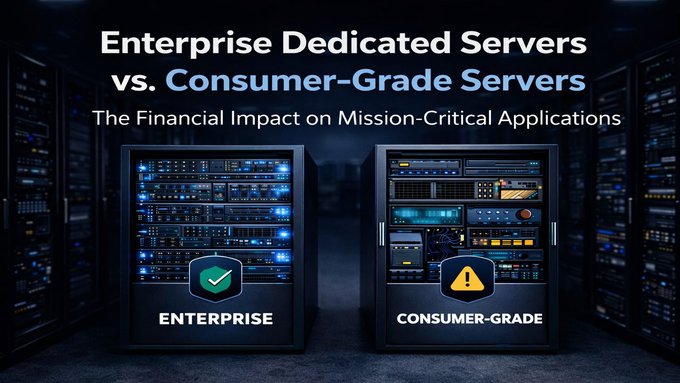
For CFOs and executive teams, the difference between enterprise dedicated servers and consumer-grade servers is not a technical distinction. It is a risk management decision. And risk, properly measured, always shows up on the balance sheet.
The Hardware Difference Is Really a Risk Difference
Enterprise dedicated servers are built for continuous 24/7 production environments. They use data center-grade processors, ECC memory, enterprise-class NVMe or SSD storage, redundant power supplies, and validated firmware stacks. These systems are engineered for sustained performance under constant load.
Consumer-grade systems, even if powerful on paper, are built with desktop-class components. They often lack ECC memory, redundant power, validated RAID infrastructure, and enterprise endurance storage.
The difference may not be obvious during normal operation. It becomes obvious during stress. A memory fault in a consumer system can corrupt data. A non-redundant power supply can take down a live production application. A lower-endurance drive can fail under sustained I/O load.
When applications generate revenue, hardware fragility becomes a financial exposure.
Reliability and Redundancy Protect Revenue
Enterprise environments are designed with failure mitigation in mind. Drives are hot-swappable. Power supplies are redundant. Remote management allows intervention without physical downtime. Monitoring systems identify degradation before it becomes an outage.
Consumer-grade environments typically react after failure occurs.
For companies running SaaS platforms, payment systems, AI inference workloads, healthcare applications, or transactional systems, downtime is not theoretical. Every minute offline can mean lost revenue, SLA penalties, customer churn, or reputational damage.
Redundancy is not a luxury feature. It is revenue protection.
Performance Consistency Impacts Conversion and Retention
Enterprise infrastructure is engineered for sustained throughput. Cooling systems, rack density, and network capacity are designed to support continuous, high-demand workloads.
Consumer hardware may perform well in short bursts but can degrade under sustained stress due to thermal throttling, storage limitations, or bandwidth constraints.
Performance variance affects the bottom line in less visible ways:
Slower application response reduces conversion rates.
Latency spikes increase abandonment.
Delayed processing limits throughput.
For mission-critical systems, consistent performance supports consistent revenue flow. Variance introduces financial unpredictability.
Support Structure Determines Financial Exposure
Enterprise hosting providers operate with defined SLAs, structured escalation paths, and experienced engineering teams capable of resolving complex issues quickly.
Consumer-grade environments often rely on generalized support models with longer resolution times.
When infrastructure drives revenue, time-to-resolution becomes a financial metric. A delayed fix is not merely a technical inconvenience. It is extended revenue disruption.
Compliance and Governance Reduce Hidden Risk
Enterprise deployments typically include documented operational procedures, structured access controls, and hardened environments that align with regulatory standards.
Consumer environments frequently lack formal governance layers. This increases the likelihood of audit findings, compliance failures, or cybersecurity vulnerabilities.
For regulated industries, one compliance breach can outweigh years of hosting savings. From a finance perspective, governance maturity reduces unpredictable liability.
The Bottom-Line Impact
The invoice for enterprise infrastructure may appear higher than consumer-grade alternatives. But that comparison is incomplete. A proper financial evaluation must consider: the cost of downtime, degraded performance, data corruption, compliance failure, reputational damage and operational unpredictability.
Mission-critical applications magnify all of these variables.
Enterprise infrastructure reduces variance. Consumer-grade infrastructure increases it. And in financial modeling, variance is expensive.
Why This Matters to CFOs in 2026
Boards are scrutinizing infrastructure investments more closely than ever. Cloud cost volatility has made finance teams wary of unpredictable technology spending.
Enterprise dedicated servers, when properly engineered, provide: stable monthly cost structures, predictable performance characteristics, lower operational risk exposure and improved forecasting accuracy.
Predictability strengthens margin discipline. Margin discipline strengthens enterprise valuation. Infrastructure, in this context, is not simply IT spend. It is financial control.
Frequently Asked Questions
Is consumer-grade infrastructure ever appropriate for production?
It can be appropriate for development, testing, or non-revenue workloads. However, for applications that directly generate revenue or support critical operations, the financial risks typically outweigh the initial cost savings.
How do enterprise servers improve ROI?
They reduce downtime probability, minimize performance variance, and decrease operational risk. Over time, fewer disruptions and greater predictability improve customer retention and protect revenue streams.
Isn’t cloud elasticity more flexible?
Elasticity offers scaling convenience, but it often introduces cost variability. For steady-state, mission-critical workloads, dedicated enterprise infrastructure frequently delivers better cost predictability and performance consistency.
How should finance teams evaluate infrastructure decisions?
Evaluate total cost of ownership, not just monthly price. Include risk-adjusted modeling for downtime, performance degradation, compliance exposure, and support responsiveness.
My Thoughts
If your organization runs applications that generate revenue, process transactions, or support critical operations, infrastructure is not a commodity purchase.
It is a risk management decision. Before selecting infrastructure based on price alone, ask:
What is the financial impact of one hour of downtime?
What does performance variance do to conversion rates?
How much risk is introduced by non-redundant hardware?
Can we forecast our infrastructure costs 12–24 months forward with confidence?
If those questions matter to your organization, it’s time to evaluate enterprise-grade infrastructure through a financial lens.
ProlimeHost
Enterprise Dedicated & GPU Infrastructure
Predictable Performance. Predictable ROI.
Call: 877-477-9454
Email: sa***@*********st.com
Website: https://www.prolimehost.com
Let’s design infrastructure that protects revenue, stabilizes margins, and reduces operational risk — not infrastructure that finance has to explain after the fact.