Most organizations treat server age as a technical detail. Finance teams should not.
Hardware lifecycle decisions quietly shape margins, risk exposure, forecasting accuracy, and capital efficiency. When infrastructure ages beyond its economic usefulness, the cost doesn’t show up as a line item labeled “old servers.” It shows up everywhere else; slower execution, higher operating risk, inflated cloud bills, and teams compensating for performance gaps with labor and overprovisioning.
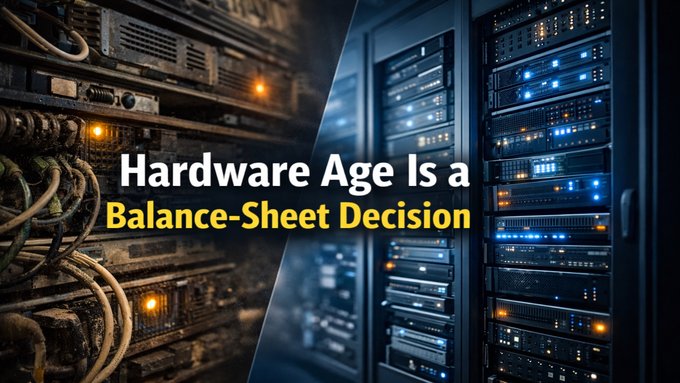
This is why hardware age belongs in financial conversations, not just IT refresh cycles.
Depreciation Ends Before Economic Cost Does
On paper, servers are depreciated over a fixed schedule. In reality, their economic efficiency starts declining long before the accounting lifecycle ends.
As hardware ages, performance per watt drops. Workloads take longer to complete. Power and cooling costs rise. Failure rates increase. Maintenance windows grow. None of this triggers an immediate alarm, but each factor compounds operating expense.
From a finance perspective, the issue isn’t whether a server still “works.” It’s whether it still produces output efficiently relative to capital already deployed elsewhere in the business.
Aging Hardware Forces Hidden Overhead
When infrastructure slows down, teams adapt, but not cheaply.
Developers wait longer for builds. Analytics jobs run overnight instead of during the workday. AI training pipelines stretch timelines. Ops teams add capacity to compensate for inefficiency rather than addressing the root cause.
The result is a quiet expansion of indirect costs. More labor hours. More cloud burst usage. More “temporary” fixes that become permanent spend.
None of this shows up as a server problem on the balance sheet. It shows up as margin pressure.
Risk Increases as Predictability Decreases
Older hardware isn’t just slower, it’s less predictable.
Failure rates rise nonlinearly with age. Firmware limitations restrict security posture. Replacement parts become scarce. Downtime risk becomes harder to quantify and harder to insure against.
For finance leaders, this matters because unpredictability destroys forecasting accuracy. Infrastructure that behaves inconsistently introduces variance into revenue operations, customer experience, and internal delivery timelines.
Predictability is a financial asset. Aging hardware erodes it.
Deferred Refreshes Are Often False Savings
Many organizations delay hardware refreshes to avoid capital expenditure. On the surface, this looks prudent. In practice, the cost simply migrates.
It moves into higher cloud bills, larger power costs, additional headcount, delayed product releases, customer churn from performance issues, and emergency replacements under unfavorable terms.
What looks like CAPEX avoidance often becomes OPEX leakage; spread across departments and invisible without intentional analysis.
Modern Hardware Compresses Cost per Outcome
Newer server platforms don’t just offer incremental speed improvements. They fundamentally change cost efficiency. More work per core. Higher memory density. Faster I/O. Better virtualization and container density. Lower energy consumption per workload.
From a finance lens, this translates to fewer servers doing more work, tighter capacity planning, and infrastructure that scales with demand rather than fighting it.
The return isn’t measured in benchmarks. It’s measured in faster execution, lower operational friction, and fewer compensating costs.
The Board-Level Takeaway
Hardware age is not an IT housekeeping issue.
It is a balance-sheet decision that affects margins, risk exposure, forecasting accuracy, and capital efficiency. Organizations that align hardware lifecycle planning with financial outcomes operate more predictably, move faster, and waste less.
Those that don’t slowly bleed value without ever seeing a single catastrophic failure.
Executive Summary
Infrastructure decisions rarely appear in board discussions, yet they influence operational efficiency, financial predictability, and enterprise risk. Server hardware age is not simply an IT management issue; it is a capital allocation decision that affects how efficiently the organization converts infrastructure investment into business output.
As hardware ages, performance per watt declines, failure risk increases, and workloads take longer to complete. These effects rarely appear as obvious line items on financial statements. Instead, they manifest indirectly through higher operating costs, delayed product delivery, increased reliance on cloud bursting, and greater variability in system performance. Over time, these hidden inefficiencies quietly compress margins.
Deferred hardware refreshes are often justified as prudent cost control, but in many environments they simply shift expenses elsewhere. Organizations compensate for aging infrastructure with additional labor, excess capacity, and reactive operational fixes. What appears to be avoided capital expenditure frequently becomes fragmented operating expense distributed across departments.
Boards should therefore view infrastructure lifecycle planning through the same lens applied to other capital investments: return on capital, risk exposure, and predictability of outcomes. Modern enterprise hardware platforms can materially improve performance density, energy efficiency, and workload throughput, reducing the cost required to deliver each unit of business output.
The strategic takeaway is straightforward: infrastructure age directly influences financial performance and operational stability. Organizations that align hardware lifecycle decisions with financial strategy improve predictability, reduce hidden operational costs, and position themselves to scale more efficiently.
FAQs
Doesn’t cloud infrastructure eliminate hardware lifecycle concerns?
Not entirely. Cloud shifts the responsibility, but aging underlying hardware still affects performance consistency, cost efficiency, and pricing volatility passed downstream.
Isn’t keeping servers longer more financially conservative?
Only if total cost of ownership remains lower. In many cases, deferred refreshes increase indirect operating costs that exceed the avoided capital spend.
How often should hardware be refreshed?
There is no universal answer. The right cadence depends on workload intensity, performance sensitivity, energy costs, and the financial value of predictability.
The Bottom Line
Infrastructure decisions do not live in isolation.
Hardware age determines how efficiently capital is converted into output. When finance leaders participate in lifecycle planning, infrastructure stops being a cost center and starts behaving like an asset that compounds value.
Contact ProlimeHost
If your organization is evaluating whether its current infrastructure is still economically justified (or quietly eroding ROI) our team can help assess the financial and operational impact of your current hardware environment.
ProlimeHost specializes in enterprise-grade dedicated infrastructure designed for predictable performance, stable costs, and long-term operational efficiency.
To discuss your infrastructure requirements or evaluate potential hardware refresh strategies, contact our team:
ProlimeHost
🌐 https://www.prolimehost.com
📧 sa***@*********st.com
📞 877-477-9454