Executive Summary
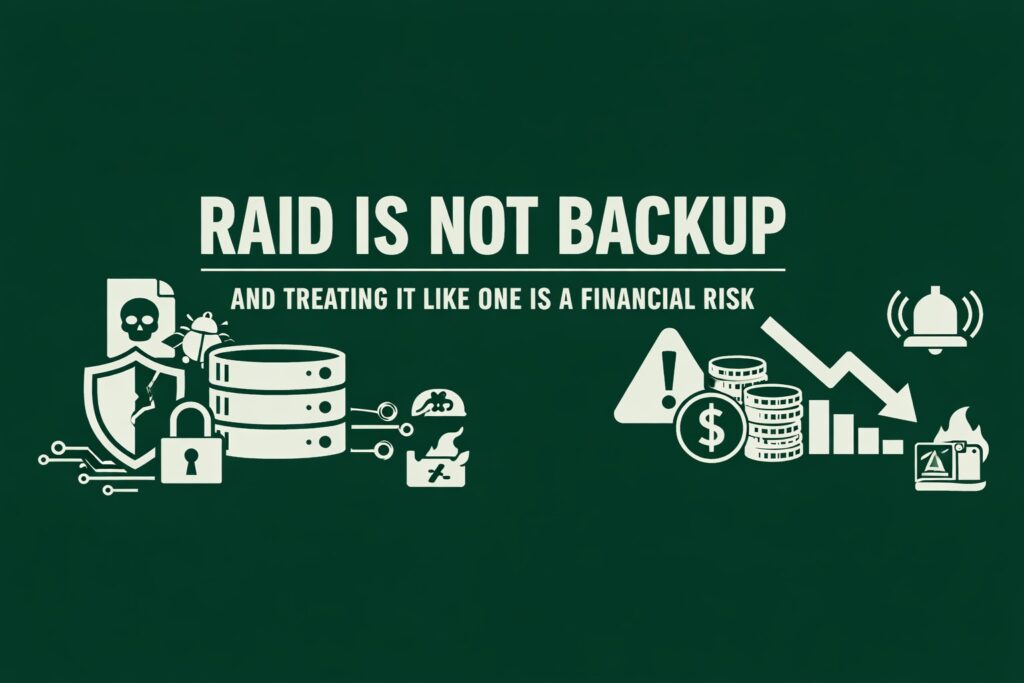
RAID is one of the most misunderstood components in modern infrastructure. It is often treated as a safety mechanism for data, when in reality it was never designed to protect data at all. Its purpose is continuity, keeping systems running when hardware fails.
That distinction matters more than most organizations realize. When RAID is mistaken for backup, risk is not reduced. It is quietly concentrated. The result is not hypothetical; it shows up in the form of data loss events, recovery failures, and unexpected financial exposure.
For finance leaders, this is not an engineering nuance. It is a structural risk embedded in infrastructure decisions.
The Illusion of Safety
At a glance, RAID feels like protection. Multiple disks, redundancy, failover; on paper it looks resilient. In practice, it only solves one very narrow problem: physical disk failure. It does that well. If a drive fails, the system continues operating. There is no interruption, no immediate loss of availability. From an operational standpoint, RAID delivers exactly what it promises. The problem is everything it doesn’t promise.
If someone deletes critical data, RAID preserves that deletion perfectly. If a database becomes corrupted, RAID ensures that corruption is mirrored or distributed across every disk in the array. If ransomware encrypts your environment, RAID accelerates the process by applying that encryption across all drives simultaneously.
In other words, RAID protects the system, not the integrity of the data inside it.
What RAID Actually Does
Each RAID level is designed around tradeoffs between performance, redundancy, and efficiency, but none of them introduce true data protection.
RAID 0 prioritizes speed by striping data across disks, but it removes any form of redundancy. One failure results in total loss. It is a pure performance play.
RAID 1 mirrors data across drives, creating a duplicate copy. This protects against a single disk failure, but it also duplicates mistakes instantly. There is no version history, no rollback capability, no recovery point.
RAID 5 and RAID 6 introduce parity, allowing one or two disks to fail without immediate loss. These configurations are often viewed as “safe,” but that safety is limited to hardware events. As drive sizes grow, rebuild times become longer and risk during recovery increases. More importantly, they still cannot recover data that has been logically damaged.
RAID 10, often favored in enterprise environments, combines performance and redundancy. It reduces rebuild stress and improves reliability under load. But even here, the same limitation remains. It ensures availability, not recoverability.
Across all configurations, the pattern is consistent. RAID keeps systems online. It does not give you the ability to go backward in time.
The Financial Consequences of Getting This Wrong
The most expensive infrastructure failures rarely come from hardware. They come from data events. A dataset is overwritten. A script runs incorrectly. A system update introduces corruption. An attacker gains access and encrypts production. When that happens in a RAID-only environment, there is no recovery path. The system is still running, but the data is unusable. That is where the real cost begins to surface.
Revenue is interrupted. Engineering teams are pulled into emergency response. Customers are impacted. In regulated industries, compliance exposure follows quickly behind. In the worst cases, data is permanently lost. This is the moment where organizations realize they did not have a resilience strategy. They had an uptime strategy.
From a financial perspective, that distinction is significant. One protects continuity. The other protects value.
Why This Lands at the Board Level
Infrastructure decisions often sit inside IT, but their consequences do not stay there. When data cannot be recovered, the impact moves immediately into financial reporting, operational continuity, and risk management.
An environment without proper backup is effectively carrying uninsured data risk. It introduces volatility into forecasting, increases exposure during audits, and creates the potential for sudden, unplanned costs. What makes this particularly dangerous is that it often goes unnoticed until failure occurs. Everything appears stable until it isn’t.
This is why the separation between RAID and backup is not just technical clarity. It is governance.
What Real Data Protection Looks Like
A proper data protection strategy introduces something RAID never attempts to provide: time. Instead of simply keeping data online, it creates the ability to return to a known good state. That requires separating production systems from recovery systems.
In practice, that means backups that exist outside the primary server, with versioning that allows point-in-time restoration. It often includes geographic separation, ensuring that a single event cannot impact both production and backup environments. Increasingly, it also involves immutability, preventing backups from being altered or encrypted after they are created.
The goal is straightforward. When something goes wrong, you are not trying to fix the present. You are restoring the past. That is the difference between resilience and hope.
How ProlimeHost Aligns Performance With Recovery
This is where infrastructure design becomes a strategic advantage rather than a technical checkbox.
At ProlimeHost, RAID is implemented as it should be, as a performance and availability layer. It is optimized for workload demands, whether that involves high-throughput NVMe storage, GPU-driven pipelines, or latency-sensitive applications. But it is never positioned as a backup solution.
Instead, environments are built with separation in mind. Production systems are paired with dedicated backup architectures that operate independently. Data movement happens across secure, high-speed private networks, ensuring that backups are both efficient and isolated from external risk.
This approach allows organizations to achieve two outcomes simultaneously. Systems remain fast and continuously available, while data remains recoverable under a wide range of failure scenarios.
The result is not just uptime. It is predictability.
Why This Matters in 2026
The frequency of data-related incidents is increasing, not decreasing. Automation, scale, and interconnected systems have made environments more powerful, but also more fragile in new ways.
The organizations that perform best are not the ones that avoid failure entirely. They are the ones that recover cleanly, quickly, and without financial disruption. That capability does not come from RAID.
It comes from designing infrastructure with recovery as a first-class requirement.
FAQs
Is RAID ever enough on its own?
It isn’t. It addresses hardware failure, but it does not protect against the far more common causes of data loss.
What is the minimum acceptable backup approach?
At a baseline, there should be an off-system, versioned backup that allows restoration to a previous point in time.
Is RAID 10 safer than RAID 5 or RAID 6?
It is generally more resilient and performs better under load, but it still does not replace backup.
Can backups exist on the same server as RAID?
They can, but relying on that alone creates a single point of failure. Separation is what creates real protection.
How often should backups be validated?
Regularly. A backup that has not been tested is simply an assumption.
Board-Level Takeaway
RAID reduces downtime. Backup prevents loss. Confusing the two creates a gap that only becomes visible when it is most expensive.
Organizations that close that gap gain something far more valuable than availability. They gain control over outcomes.
Eliminate Hidden Infrastructure Risk
If your current environment relies on RAID as a safety mechanism, there is a gap, and it will only surface under pressure. ProlimeHost helps organizations design infrastructure where performance, uptime, and recoverability work together, not against each other.
If you want to understand where your current risks sit and how to correct them, we should talk.
📞 877-477-9454
🌐 prolimehost.com