Executive Summary
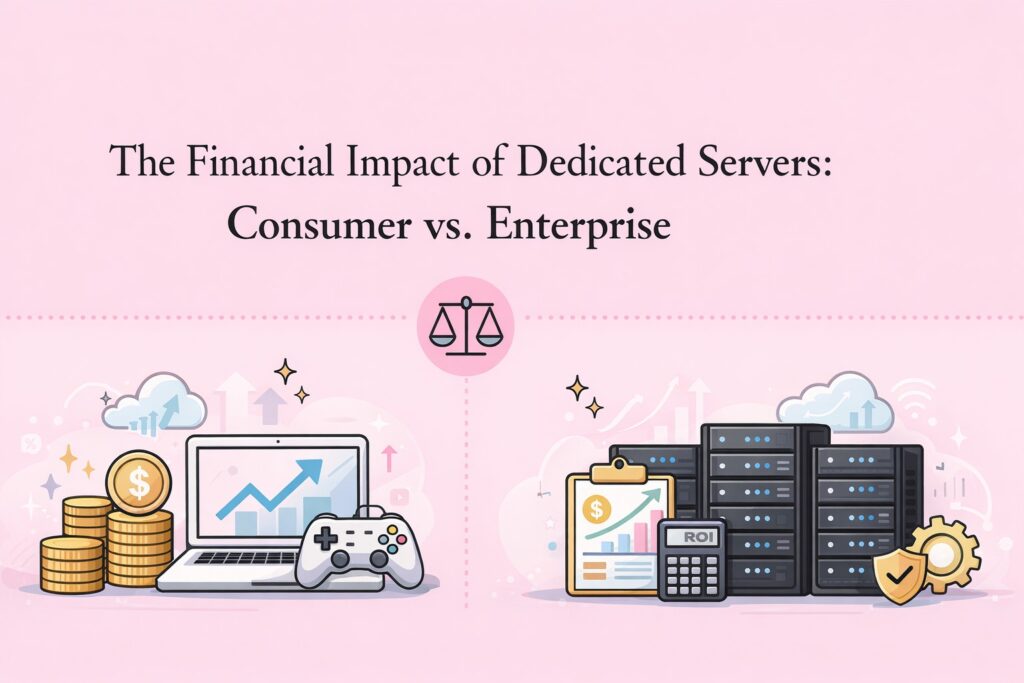
The difference between consumer-grade and enterprise-grade dedicated servers is not about hardware class, it’s about financial behavior under pressure.
Consumer systems are designed to be fast, affordable, and responsive in short bursts. Enterprise systems are designed to be predictable, durable, and accountable under continuous load. That distinction directly shapes ROI.
At small scale, consumer infrastructure feels efficient. As workloads become persistent and revenue-dependent, that same infrastructure introduces variability; performance swings, failure risk, and recovery delays. Enterprise infrastructure removes that variability.
And in finance terms, removing variability is what creates predictable ROI.
The Core Difference: How the System Behaves When It Matters
Consumer-grade servers are built on the assumption that workloads are intermittent. They handle spikes well, but they are not engineered for sustained, uninterrupted pressure. Over time, that shows up as throttling, wear, and unpredictable slowdowns.
Enterprise-grade systems are built for the opposite reality. They assume constant demand. Every component, from memory to storage to power delivery, is designed to operate continuously without degradation becoming visible to the application layer.
This is where the real divide emerges. Not in peak performance, but in performance continuity.
Because businesses don’t monetize peak benchmarks. They monetize consistent output over time.
Failure Behavior Is Where ROI Is Won or Lost
The most important distinction between consumer and enterprise infrastructure is what happens when something goes wrong. Consumer systems tend to fail abruptly. A drive dies, a system crashes, and recovery becomes reactive. There is little built-in protection against cascading failure.
Enterprise systems are designed to fail gracefully. Redundancy, error correction, and failover mechanisms ensure that a single component issue does not become a business interruption. From a financial standpoint, this changes everything.
Downtime is visible. But what’s more damaging, and often ignored, is partial failure. Slow queries, degraded application performance, and intermittent instability quietly erode revenue, user trust, and operational efficiency.
Enterprise infrastructure is designed specifically to prevent that kind of silent loss.
The Illusion of “Cheaper Infrastructure”
Consumer-grade servers often win the comparison at purchase price. On paper, they look like the more efficient decision. But that comparison assumes that hardware cost is the primary variable. It isn’t.
The real cost of infrastructure is tied to what the system enables or disrupts. If a slower system delays transactions, if instability causes user drop-off, or if failures require engineering time to resolve, the initial savings disappear quickly.
Enterprise infrastructure reframes the equation. Instead of asking, “What does this server cost?” the question becomes: “What does this system allow us to reliably produce?”
That shift, from cost to output, is where ROI becomes clear.
Where the Break Point Happens
Most organizations don’t start with enterprise infrastructure. They grow into the need for it. The transition point usually isn’t triggered by scale alone. It’s triggered by dependency.
When infrastructure begins to directly influence revenue, customer experience, or operational continuity, the tolerance for variability disappears. At that moment, consumer-grade systems stop being a cost-saving tool and start becoming a risk factor.
That’s when enterprise infrastructure stops being optional.
How This Connects to ProlimeHost
Enterprise hardware alone doesn’t guarantee ROI. It has to be delivered in an environment that preserves its advantages. This is where ProlimeHost becomes relevant.
The value isn’t just in the hardware itself, but in how the entire system is delivered and supported. Dedicated resources eliminate contention. The Cisco-powered network ensures consistent throughput and low latency. Hardware is deployed with enterprise-grade components designed for sustained workloads. Support is handled in-house, which shortens resolution time and removes layers of uncertainty.
Most importantly, the model is built around predictability. Performance is stable. Costs are known. Capacity is controlled. That combination allows businesses to align infrastructure behavior with financial expectations.
Instead of chasing performance in an elastic environment where both output and cost fluctuate, organizations gain a system where performance and cost move in sync with planning.
That alignment is what turns infrastructure into a financial asset rather than a variable expense.
The ROI Shift in Plain Terms
The transition from consumer to enterprise infrastructure is not about upgrading hardware. It’s about eliminating unpredictability. Consumer systems introduce variability in performance, lifespan, and failure outcomes. Enterprise systems remove that variability and replace it with controlled, measurable behavior.
And in business, control is what enables forecasting. Forecasting is what enables scaling. And scaling without disruption is what drives ROI.
FAQs
Is consumer-grade infrastructure ever the right choice?
Yes, when workloads are non-critical, intermittent, or not tied directly to revenue outcomes. Development environments and internal tools are common examples.
Why does enterprise infrastructure cost more upfront?
Because it is built to prevent failure, not just recover from it. That includes higher-end components, redundancy, and support structures that reduce long-term risk.
How does this actually improve ROI?
By stabilizing performance, reducing downtime, extending usable lifespan, and eliminating the hidden costs associated with variability.
Is cloud infrastructure equivalent to enterprise dedicated servers?
Not necessarily. Cloud environments often introduce variability in both performance and cost. Dedicated enterprise servers provide more consistent output and predictable expense.
When should a business make the move?
When infrastructure performance begins to directly impact revenue, customer experience, or operational continuity.
Board / Executive Takeaway
Infrastructure is no longer a background technical decision. It is a financial control mechanism.
Consumer-grade systems introduce variability that makes forecasting difficult and risk harder to manage. Enterprise infrastructure when deployed correctly removes that variability and aligns system performance with business expectations.
That alignment is what supports margin stability and long-term growth.
Move From Variable Performance to Predictable ROI
If your infrastructure is still operating on assumptions that no longer match your business reality, the gap will show up in performance, cost, or both.
ProlimeHost helps organizations transition to enterprise-grade dedicated and GPU infrastructure built around consistency, reliability, and financial predictability.
If you want to evaluate where your current environment sits or model what a predictable infrastructure layer would look like for your workloads, we can walk through it with you.
Contact ProlimeHost
🌐 https://www.prolimehost.com
📞 877-477-9454
📧 sa***@*********st.com
Steve Bloemer
Director of Sales & Operations
ProlimeHost