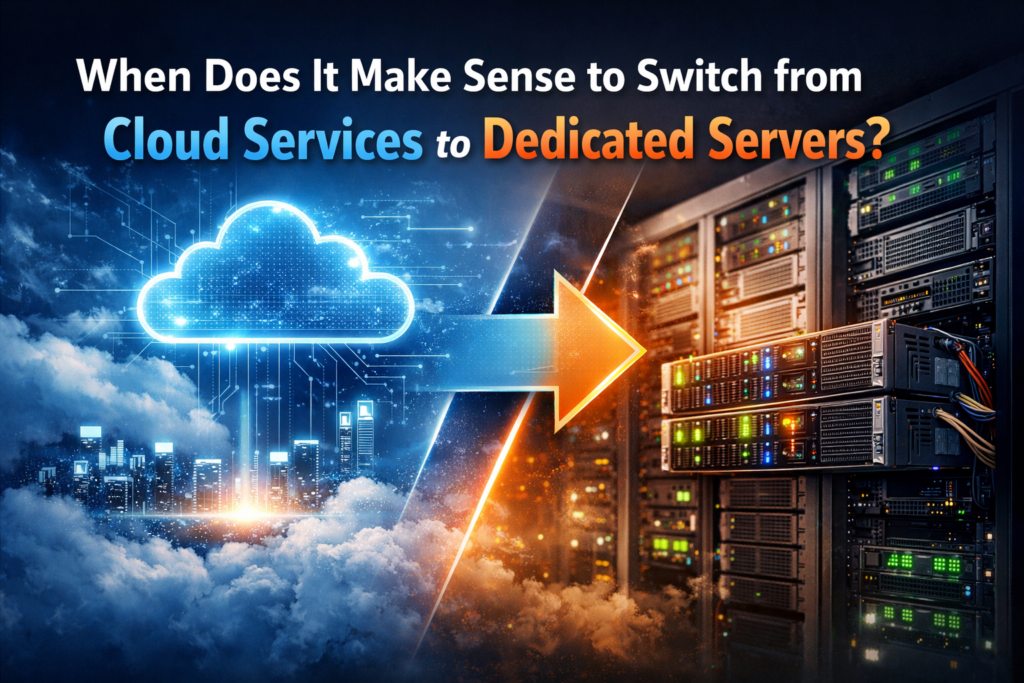
For many businesses, cloud hosting is the logical starting point. It offers speed, flexibility, and the ability to launch infrastructure without upfront commitments. But over time, what once felt agile can quietly become expensive, unpredictable, and restrictive. The question isn’t whether businesses outgrow the cloud, it’s when the economics and performance realities no longer make sense.
That moment usually arrives when workloads stabilize.
Once usage patterns become predictable, the core value proposition of cloud services (elasticity) begins to lose its impact. Monthly bills stop fluctuating wildly, yet they continue to rise. At that stage, companies are no longer paying for flexibility; they’re paying a premium for it.
Dedicated servers step in precisely at this point.
Instead of renting shared virtual resources at a markup, dedicated infrastructure provides guaranteed CPU, memory, storage, and bandwidth at a fixed cost. Performance becomes consistent, billing becomes transparent, and infrastructure planning shifts from reactive to strategic. For businesses running steady applications, databases, SaaS platforms, AI workloads, or data-intensive services, this change can dramatically improve ROI.
Performance is often the next breaking point.
Even premium cloud tiers are still shared environments. Under sustained load, latency fluctuations, storage throttling, and noisy-neighbor effects can surface, especially for I/O-heavy or compute-intensive workloads. Dedicated servers remove those variables entirely. Every resource is yours, every day, without contention.
Cost transparency also plays a major role in the decision.
Cloud pricing models frequently distribute expenses across compute, storage, snapshots, backups, and data egress. Individually, those charges seem manageable. Together, they can become one of the largest operational expenses on the balance sheet. Dedicated servers replace that uncertainty with predictable monthly pricing, flat-rate bandwidth, and storage performance that doesn’t change behind the scenes.
Control is the final piece of the puzzle.
As infrastructure matures, teams often want deeper visibility and customization, from RAID layouts and NVMe tuning to security hardening and performance optimization at the hardware level. Dedicated servers eliminate abstraction layers and provider black boxes, allowing engineering teams to optimize infrastructure around real workloads rather than provider defaults.
That said, cloud services still have their place. Highly bursty traffic, experimental environments, and rapid global scaling can justify cloud deployments. Many organizations ultimately land on a hybrid approach, keeping cloud resources where elasticity is genuinely valuable while moving predictable, revenue-critical workloads to dedicated infrastructure.
The real shift isn’t about technology preference. It’s about economics.
When businesses move from paying for potential to paying for performance, dedicated servers stop being an alternative and start becoming the smarter long-term investment.
Frequently Asked Questions
Is there a spending threshold where dedicated servers make more sense than cloud?
In many cases, once predictable cloud spend reaches the $2,500–$5,000 per month range for steady workloads, dedicated servers begin to offer significantly better ROI with higher performance and fewer surprise costs.
Will I lose scalability if I move away from the cloud?
Not necessarily. Dedicated infrastructure can be scaled deliberately and efficiently, and many businesses combine dedicated servers with cloud services in a hybrid model to retain elasticity where it’s needed.
Are dedicated servers slower to deploy than cloud instances?
Modern dedicated servers can be provisioned quickly, often within hours or days, and they deliver consistent performance from day one without throttling or shared resource risks.
What workloads benefit most from dedicated servers?
Databases, SaaS platforms, AI and GPU workloads, high-traffic applications, storage-heavy environments, and performance-sensitive systems see the biggest gains.
Is migration complex?
Migration can be straightforward with proper planning. Many providers assist with architecture design and data migration to minimize downtime and risk.
Ready to Build Infrastructure with Predictable ROI?
If your cloud costs are rising, performance is inconsistent, or you want full control over your infrastructure, it may be time to evaluate a dedicated solution designed around your workloads, not generic assumptions.
Talk to an infrastructure specialist today and find out what predictable performance really looks like.
📞 Call us at 877-477-9454
🌐 Visit: https://www.prolimehost.com
Let’s build infrastructure that works for your business, not against your budget.