Executive Summary
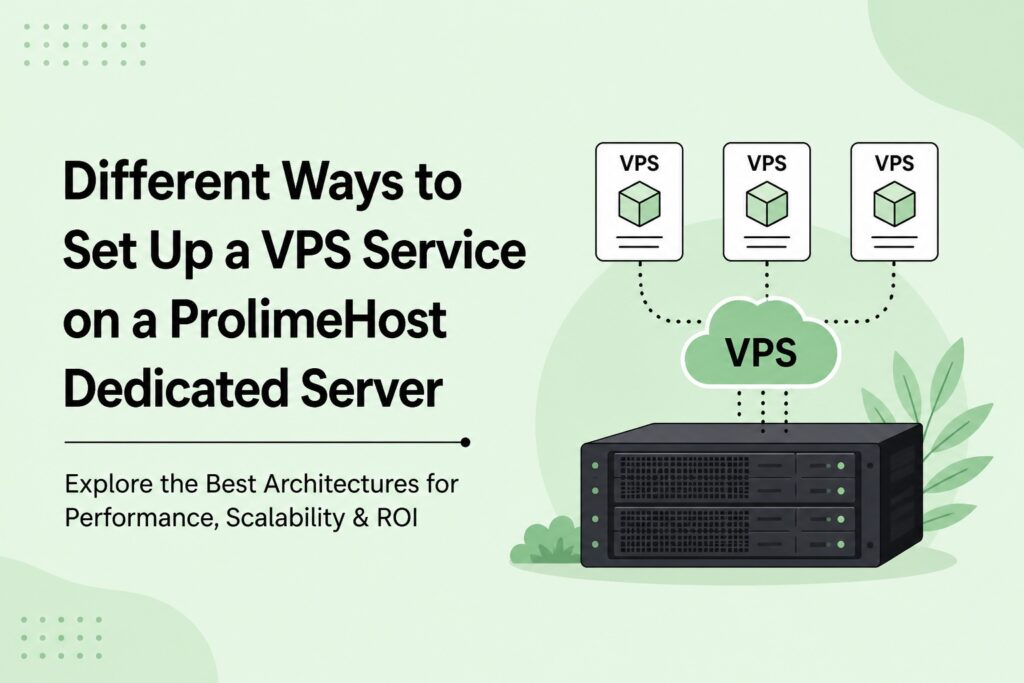
Building a VPS service looks simple from the outside, but the structure underneath determines whether it becomes a stable revenue engine or a constant balancing act. On a ProlimeHost dedicated server, you are not just dividing hardware into smaller pieces. You are deciding how performance behaves under pressure, how predictable that performance remains, and how confidently you can price what you sell.
Most VPS platforms struggle not because of hardware limitations, but because of architectural choices that introduce variability. When performance shifts under load, customers feel it immediately, even if monitoring doesn’t fully capture it. Over time, that inconsistency turns into churn, support overhead, and margin erosion.
The providers who win approach VPS design as a financial strategy, not just a technical deployment.
The Foundation: What You Are Actually Building
A VPS is fundamentally a controlled allocation of compute, memory, and storage from a physical system. Virtualization allows a single server to behave like many, but the way those resources are distributed defines the experience.
If resources are loosely shared, workloads can interfere with one another. If they are tightly controlled, performance becomes consistent and predictable. That difference may seem subtle at deployment, but it becomes obvious at scale, especially when customers begin running production workloads tied to revenue.
This is why virtualization is not just a backend choice. It is the core of your product.
KVM-Based VPS: Stability That You Can Price Around
KVM virtualization effectively transforms a dedicated server into multiple independent systems. Each VPS runs its own kernel, operates in isolation, and behaves like a true standalone machine. For customers, that translates into reliability. For you, it creates a product that holds its value under load.
The key advantage of KVM is resource certainty. CPU, RAM, and disk performance are allocated in a way that prevents one customer from impacting another. As utilization increases, performance remains consistent instead of fluctuating unpredictably.
There is a tradeoff in density. You will host fewer VPS instances compared to lighter virtualization models. But that limitation often becomes an advantage.
It positions your offering toward customers who prioritize stability over cost, including SaaS platforms, API providers, and AI-driven workloads.
Container-Based VPS: Efficiency with Hidden Tradeoffs
Container-based environments take a different approach by sharing the host system’s kernel and reducing overhead. This allows for faster provisioning, higher density, and lower cost per instance. At first glance, it looks like the most efficient way to build a VPS platform.
The challenge is how performance behaves over time. Because resources are shared more dynamically, workloads can influence each other in ways that are difficult to predict. Under light usage, everything runs smoothly. Under heavier demand, inconsistencies begin to appear.
For development environments or low-cost hosting tiers, this model can work well. It is fast, flexible, and cost-efficient.
But for applications where performance stability directly impacts revenue, those inconsistencies can create friction that customers eventually move away from.
The Hybrid Approach: Where Flexibility Meets Control
More advanced VPS platforms combine virtualization and containerization into a layered model. KVM provides the base level of isolation, while containers operate inside each VPS, giving customers the ability to scale applications within their own environment.
This approach aligns with how modern software is built. A customer might deploy a stable VPS for core infrastructure and then use Docker or similar tools to manage services internally.
From your perspective, you are delivering a consistent VPS product. From theirs, they gain flexibility without sacrificing reliability.
Cloud-Style VPS on Dedicated Infrastructure
Some VPS providers extend their architecture further by introducing shared storage and failover systems. This creates a cloud-like experience with features such as redundancy and migration capabilities.
While this can increase uptime resilience, it also introduces additional complexity and cost.
Storage performance becomes dependent on network behavior, and additional layers can sometimes reduce predictability rather than improve it.
The Real Comparison: Where Performance and ROI Actually Separate
When you step back and look at these models through a financial lens, the differences become much clearer. It’s not about which technology is “better,” but which one aligns with the type of customers you want to serve and the level of performance consistency they require.
| VPS Model | Resource Isolation | Performance Consistency | Density (VPS per Server) | Cost Efficiency | Best Fit |
|---|---|---|---|---|---|
| KVM VPS | High | Very High | Moderate | Moderate | SaaS, APIs, AI workloads |
| Container VPS | Low to Moderate | Variable | High | High | Budget hosting, dev environments |
| Hybrid (KVM + Containers) | High | High | Moderate | High | Scalable SaaS, microservices |
| Cloud-Style VPS | High | High to Very High | Moderate | Lower | High availability systems |
What stands out here is that consistency and density rarely move in the same direction. The more you optimize for packing customers onto a server, the more you introduce performance variability.
The more you optimize for isolation, the more stable and valuable each VPS becomes.
Why This Is Ultimately a Financial Decision
Infrastructure choices ripple outward into business outcomes. When performance fluctuates, it does not show up as a technical metric. It shows up as slower transactions, failed requests, and degraded user experience.
That is why performance consistency is better understood as a financial control mechanism. The more predictable your infrastructure, the more predictable your customer outcomes become.
On ProlimeHost infrastructure, the goal is not just to maximize utilization. It is to create an environment where performance remains stable regardless of load, allowing your VPS offering to scale without introducing risk.
For a deeper perspective on how infrastructure variability impacts ROI, this article connects the dots clearly:
https://www.prolimehost.com/blogs/the-hidden-cost-of-unpredictable-infrastructure/
And for a financial framework around efficiency and output, this is worth reviewing:
https://www.prolimehost.com/blogs/cost-per-compute-unit-the-only-infrastructure-metric-that-actually-matters/
FAQs
What is the best way to start a VPS hosting service?
Starting with a KVM-based architecture on a high-performance dedicated server provides the best balance of stability and scalability while supporting production workloads from day one.
Can containers replace traditional VPS environments?
They can in certain scenarios, particularly for development or lower-cost offerings, but they generally lack the consistency required for performance-sensitive applications.
Is a hybrid VPS model worth implementing?
In most cases, yes. It allows you to deliver a more flexible and scalable product while maintaining the stability that customers expect.
Do all VPS platforms need cloud-style infrastructure?
No. Many workloads perform better on well-designed dedicated environments without the added complexity of distributed systems.
Final Thoughts
The VPS market is shifting toward consistency over capacity. The providers who succeed are not the ones fitting the most customers onto a server, but the ones delivering the most reliable experience to each customer.
When you design your VPS platform around predictable performance, everything else becomes easier. Pricing becomes more confident, customers stay longer, and support becomes less reactive.
That is what turns infrastructure into a business advantage rather than a constant optimization problem.
Notes
If you are building or scaling a VPS hosting platform, the foundation you choose will define how far you can take it.
ProlimeHost delivers dedicated infrastructure engineered for predictable performance, high uptime, and scalable VPS deployment. Whether you are launching a new service or refining an existing one, the right environment makes all the difference.
🌐 https://www.prolimehost.com
📞 877-477-9454
If your goal is to build a VPS platform that performs consistently under real-world demand, it starts with infrastructure that removes variability instead of introducing it.