The Hidden Cost of Unpredictable Infrastructure: A CEO and Board-Level Analysis of Performance Variance and ROI in 2026
In 2026, infrastructure decisions have moved out of the server room and into the boardroom. What was once a technical discussion around uptime, scalability, and utilization has become a financial conversation centered on predictability, revenue timing, and return on investment. The shift is not driven by new technology alone, but by the realization that performance variance is now a measurable financial risk.
Most organizations still evaluate infrastructure using cost-based frameworks.
Monthly spend, cost per instance, and short-term flexibility dominate the conversation. On paper, cloud environments appear efficient and aligned with modern business needs. But that surface-level efficiency masks a deeper issue that boards are beginning to recognize: inconsistent performance creates inconsistent financial outcomes.
In multi-tenant environments, workloads compete for shared resources.
CPU cycles, GPU availability, memory bandwidth, and network throughput are not guaranteed at a fixed level. They fluctuate based on factors outside the organization’s control. This introduces variability into application performance, which then cascades into variability in output, customer experience, and ultimately revenue realization.
Systems that lack consistency create operational inefficiencies that compound over time
What appears to be a marginal fluctuation at the infrastructure level becomes a material impact at the financial level when scaled across millions of transactions, AI inference cycles, or customer interactions.
This is where the concept of infrastructure must be reframed. It is no longer simply a cost center or an operational necessity. It is a determinant of revenue timing and financial predictability. When performance is stable, output becomes measurable. When output is measurable, revenue becomes forecastable. That linkage is what matters at the executive level.
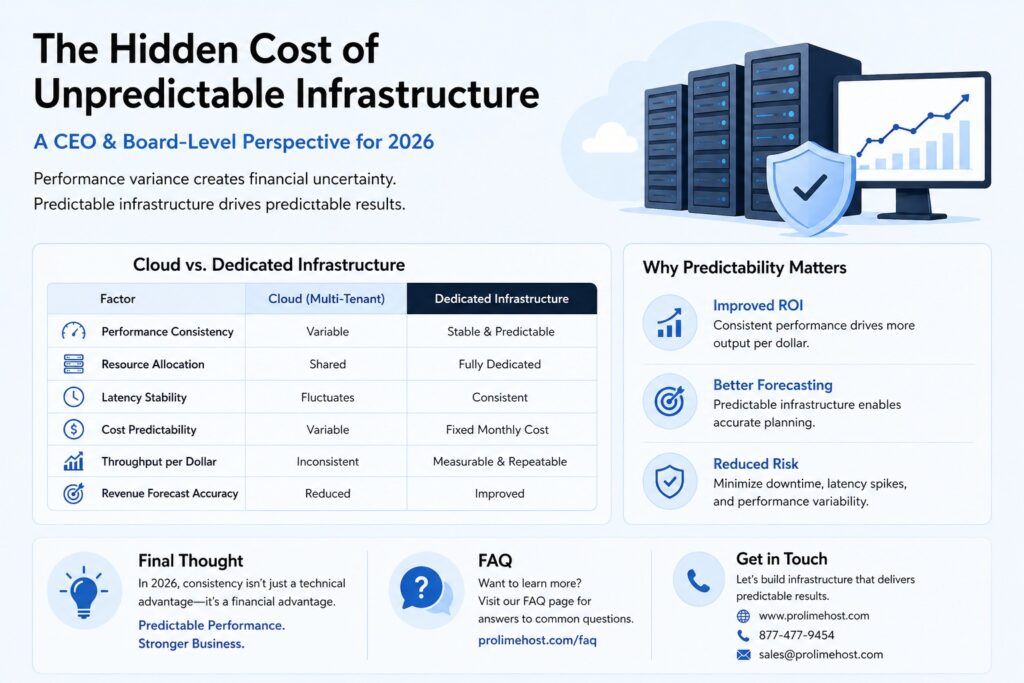
To illustrate the difference, consider the following comparison between cloud-based multi-tenant environments and dedicated infrastructure:
| Metric | Cloud (Multi-Tenant Environment) | Dedicated Infrastructure (ProlimeHost) |
|---|---|---|
| Performance Consistency | Variable due to shared resources | Stable and predictable |
| Resource Allocation | Dynamic and shared | Fully dedicated |
| Latency Stability | Fluctuates under load | Consistent under defined capacity |
| Cost Predictability | Variable (usage-based, scaling-driven) | Fixed monthly cost |
| Throughput per Dollar | Inconsistent over time | Measurable and repeatable |
| Overprovisioning Requirement | High to offset variability | Minimal due to stability |
| Revenue Forecast Accuracy | Reduced due to variance | Improved due to consistency |
| Suitability for AI/LLM Workloads | Moderate with variability risk | High with predictable output |
The implications of this comparison extend beyond engineering. For a CEO or board of directors, the question is not which environment is more flexible, but which environment delivers consistent economic output per dollar invested. That is the metric that aligns infrastructure decisions with shareholder value.
Financial leakage point
Organizations operating in AI, SaaS, fintech, and real-time analytics are particularly sensitive to this shift. In these environments, even small fluctuations in latency or throughput can translate into measurable differences in revenue capture. A delayed inference response, a slower transaction cycle, or a degraded user experience is not just a technical issue. It is a financial leakage point.
Performance variability in distributed systems
External platforms such as AWS and Cloudflare have published extensive data on performance variability in distributed systems. While these platforms excel in scalability and global reach, their architecture inherently introduces shared-resource dynamics. Dedicated infrastructure, by contrast, eliminates this variable, creating a controlled environment where performance can be aligned directly with business objectives.
At ProlimeHost, the approach is built around a simple but powerful principle: predictable performance equals predictable ROI. By removing resource contention and stabilizing compute environments, organizations gain the ability to model output with precision. This translates directly into improved forecasting, tighter cost control, and more confident strategic decision-making.
From a governance perspective, this also strengthens financial oversight. Infrastructure becomes auditable in terms of output efficiency. Variance is reduced. Assumptions become more reliable. For boards focused on risk management and long-term growth, this shift is significant.
FAQs
Why is performance variance considered a financial risk?
Performance variance disrupts consistency in application output. When output fluctuates, revenue timing and operational efficiency are affected. Over time, this creates a gap between expected and actual financial performance, making forecasting less reliable.
Does cloud infrastructure still have a role in modern strategy?
Yes, cloud remains valuable for rapid deployment, burst scaling, and global distribution. However, relying on it exclusively for performance-sensitive workloads introduces variability that can impact ROI. A hybrid approach is often more effective.
How does dedicated infrastructure improve ROI?
Dedicated infrastructure eliminates resource contention, resulting in consistent performance. This allows organizations to measure output per dollar accurately, reduce overprovisioning, and improve cost efficiency over time.
What types of workloads benefit most from dedicated environments?
AI training, LLM inference, SaaS platforms, financial systems, and real-time analytics benefit significantly due to their sensitivity to latency and throughput consistency.
How should boards evaluate infrastructure decisions in 2026?
Boards should focus on output consistency, revenue impact, and predictability rather than just cost. Infrastructure should be evaluated as a financial asset that influences growth and risk, not just an operational expense.
Final Thoughts
The infrastructure landscape has reached a point where traditional evaluation models are no longer sufficient. Cost alone does not determine efficiency. Flexibility alone does not guarantee performance. The defining factor in 2026 is consistency.
For CEOs and boards, this represents both a challenge and an opportunity. The challenge is recognizing that performance variance is a real and measurable financial risk. The opportunity is in addressing it before it becomes embedded in operational inefficiencies and missed revenue targets.
Organizations that prioritize predictable infrastructure will not only improve performance metrics, but also strengthen financial outcomes, enhance forecasting accuracy, and gain a competitive edge in markets where timing and execution are critical.
Infrastructure is no longer just a technical foundation. It is a financial instrument. And like any financial instrument, its value is determined by how reliably it performs.
For organizations ready to align infrastructure strategy with financial outcomes, ProlimeHost provides dedicated and GPU-accelerated environments designed for consistency, control, and long-term ROI. To explore tailored solutions, visit www.prolimehost.com or call 877-477-9454 to speak directly with a specialist.