Executive Summary
One of the biggest misconceptions surrounding AI infrastructure in 2026 is the assumption that success comes from simply deploying more GPUs. Across the industry, that mindset has quietly created enormous inefficiencies.
Some organizations overbuild aggressively because leadership fears future AI demand spikes. Others deploy environments that appear perfectly adequate during testing, only to discover months later that inference queues, storage contention, retrieval lag, and orchestration overhead are slowly degrading customer experience behind the scenes. Both situations create operational problems. Neither scales particularly well financially.
As AI moves deeper into day-to-day business operations, infrastructure sizing has become far more complicated than many companies originally expected.
A lightweight internal chatbot used by twenty employees behaves nothing like a production AI environment processing customer support tickets, recommendation engines, analytics queries, document retrieval, voice transcription, and real-time inference pipelines simultaneously. Usage patterns evolve unevenly. Departments adopt AI at different speeds. GPU utilization fluctuates unpredictably. Concurrency spikes rarely resemble early proof-of-concept estimates.
At ProlimeHost, we increasingly work with organizations realizing that AI infrastructure planning is no longer simply a technical discussion. It has become an operational forecasting and financial predictability exercise. Infrastructure variance, inference consistency, storage throughput, scaling flexibility, and deployment efficiency all directly affect customer experience and operating margins.
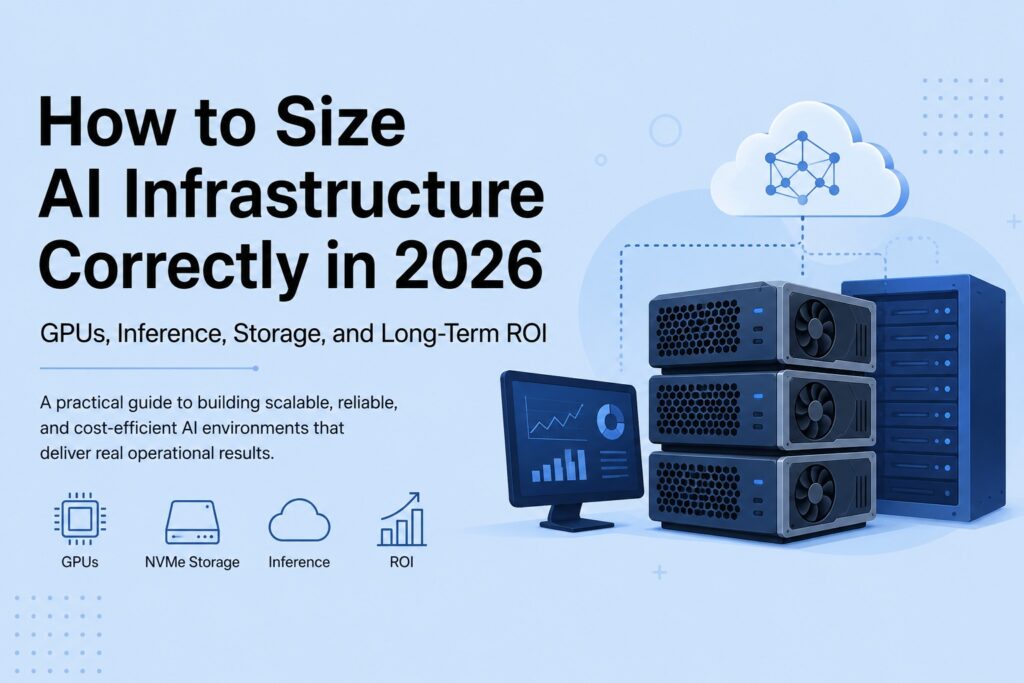
This guide explains how businesses are sizing AI infrastructure correctly in 2026, how modern AI environments behave under production conditions, and why properly aligned dedicated GPU infrastructure often delivers stronger long-term stability than environments designed around theoretical peak capacity alone.
Why AI Infrastructure Sizing Has Become So Difficult
A few years ago, most AI deployments were relatively isolated experiments. Teams tested small models, narrow inference pipelines, or internal tools with limited operational exposure. Infrastructure planning was simpler because the environments themselves remained relatively contained.
That is no longer the case.
Today, AI systems increasingly sit directly inside revenue-generating workflows. They answer customer requests, summarize internal data, automate support operations, analyze transactions, and power application features in real time. Once AI becomes operational infrastructure rather than an isolated experiment, deployment behavior changes dramatically.
An internal assistant supporting a small team can run efficiently almost anywhere. A SaaS platform handling thousands of concurrent AI requests every hour is a completely different environment entirely.
Suddenly, secondary systems begin affecting user experience directly. Storage retrieval delays surface. GPU scheduling becomes uneven during concurrency spikes. API orchestration overhead introduces latency inconsistency. Cold model loading starts creating queue buildup during peak traffic windows.
Most AI environments are not actually underpowered.
They are poorly balanced.
What catches many organizations off guard is how uneven AI growth tends to become after deployment. One department adopts AI aggressively while another barely uses it. Customer-facing inference scales faster than internal tooling. Analytics retention quietly increases storage IOPS requirements. Teams begin running multiple models simultaneously instead of relying on a single deployment strategy.
Infrastructure gradually starts behaving less like traditional hosting and more like utility infrastructure.
That operational shift changes everything.
Some companies spend heavily on enterprise-scale GPU clusters long before production demand truly requires them. Others underestimate future concurrency growth because early testing appears manageable. Months later, inference instability starts appearing during peak traffic periods even though average utilization still looks acceptable on paper.
We have seen environments where vector database retrieval latency became the dominant bottleneck long before GPU utilization crossed 50 percent. In other cases, backend API routing created more slowdown than the GPUs themselves. Benchmark testing looked excellent in isolation. Production traffic told a very different story.
The goal is not simply maximizing compute density.
The real objective is aligning infrastructure capacity with actual workload behavior while preserving flexibility for long-term growth.
Organizations evaluating deployment planning may also want to review:
- Overbuilt or Undersized: The Hidden Cost of Infrastructure Misalignment in 2026
- The Silent Profit Killer: Why Infrastructure Variance Is the Hidden Risk Your Financial Models Ignore in 2026
Training Infrastructure vs Inference Infrastructure
One of the most important sizing decisions involves understanding whether workloads are primarily training-oriented or inference-oriented. Surprisingly, many organizations blur those categories together during early planning discussions.
Training infrastructure is designed around bursts of extremely high GPU utilization. These environments prioritize dense compute, high-speed interconnects, parallelization efficiency, and minimizing total training time.
Inference infrastructure behaves very differently.
Production inference environments prioritize responsiveness, concurrency management, caching efficiency, retrieval speed, predictable latency, and operational consistency throughout the day. In many SaaS deployments, the challenge is not raw GPU horsepower. The challenge is handling thousands of smaller inference requests efficiently without introducing instability under heavier concurrency.
This distinction matters because many organizations accidentally deploy training-oriented environments for operational inference workloads. Costs rise dramatically while real-world customer experience barely improves.
A customer support AI platform, for example, may achieve stronger operational efficiency from multiple balanced RTX 5090 inference servers than from a single oversized enterprise GPU cluster designed primarily for large-scale training operations.
That realization often changes infrastructure planning entirely.
What Actually Determines AI Infrastructure Performance?
GPU selection obviously matters. But many organizations still overestimate how much AI performance depends solely on accelerator hardware.
In production environments, AI infrastructure performance is shaped by several operational layers working together simultaneously.
The Most Common AI Infrastructure Bottlenecks
- Storage retrieval latency
- Vector database throughput
- Memory exhaustion during concurrency spikes
- Uneven GPU scheduling
- API orchestration overhead
- Cold model loading delays
- Backend queue saturation
- Distributed inference synchronization
Interestingly, many operational slowdowns emerge long before GPUs themselves become saturated.
Storage Throughput
Fast NVMe storage has become critically important for modern AI infrastructure. Models constantly load from storage. Embeddings are cached continuously. Vector databases retrieve data in real time. Analytics systems process large datasets throughout the day.
Some businesses discover after deployment that storage latency creates more operational slowdown than GPU saturation itself.
That is becoming increasingly common in inference-heavy environments.
Memory Capacity and Bandwidth
Larger models, retrieval-augmented generation systems, analytics environments, and concurrent inference requests all place substantial pressure on memory resources.
Many organizations initially size RAM around early testing conditions, only to discover later that live concurrency patterns require significantly larger memory pools than anticipated.
Production AI rarely behaves as cleanly as a lab environment.
CPU Performance
Even heavily GPU-oriented inference environments still rely extensively on CPUs for orchestration, preprocessing, networking, scheduling, API handling, compression, and container management.
High-core-count AMD Ryzen and AMD EPYC deployments have become especially popular because they pair efficiently with GPU-dense AI infrastructure while maintaining strong operational balance.
Network Consistency
Networking stability becomes increasingly important once AI systems scale geographically or support distributed workloads.
Customer-facing AI applications often rely on dedicated 10Gbps or 25Gbps connectivity specifically to preserve response consistency during heavier concurrency periods. Even small latency fluctuations become noticeable once inference pipelines scale operationally.
Choosing the Right GPU Infrastructure
There is no universal “best GPU” for AI infrastructure because production environments behave differently depending on workload type, concurrency expectations, model size, operational goals, and scaling strategy.
RTX 4090 and RTX 5090 deployments currently offer some of the strongest performance-per-dollar ratios for many operational inference workloads. These environments perform exceptionally well for internal AI systems, analytics platforms, operational SaaS inference, recommendation engines, and customer-facing AI applications where efficiency matters more than maximum enterprise parallelism.
Larger enterprise deployments handling extensive concurrency, high VRAM requirements, or distributed model training may still benefit from NVIDIA A100 or H100 infrastructure, particularly when organizations require aggressive scaling across multiple nodes.
| AI Workload Type | Recommended Infrastructure | Typical Operational Use |
|---|---|---|
| Internal AI assistants | RTX 4090 + NVMe | Employee knowledge retrieval |
| Customer-facing AI SaaS | RTX 5090 infrastructure | Operational inference pipelines |
| AI analytics platforms | Multi-GPU RTX deployments | Reporting and automation |
| Enterprise AI inference | NVIDIA A100 infrastructure | Large-scale AI operations |
| Distributed model training | H100-class infrastructure | Multi-node training environments |
Businesses evaluating GPU deployments may also want to review:
- ProlimeHost Dedicated GPU Servers
- How to Build a Private AI Server in 2026 Using Dedicated GPU Infrastructure
Why AI Infrastructure Often Fails Operationally
Interestingly, AI infrastructure rarely fails because the GPUs themselves are too slow.
Most operational problems emerge from secondary bottlenecks underestimated during planning.
A company may deploy powerful GPUs but overlook vector database throughput requirements. Another organization may size compute correctly while underestimating concurrency spikes tied to customer onboarding growth. Some teams discover that balancing multiple inference models simultaneously becomes far more difficult once adoption expands across departments.
Operational AI environments rarely resemble clean benchmark testing.
A SaaS analytics platform processing customer interactions may discover that inference demand clusters aggressively during business hours, creating uneven GPU utilization throughout the day. Another deployment may realize backend orchestration becomes the dominant bottleneck long before inference speed itself becomes problematic.
This is exactly why practical sizing matters far more than theoretical peak-capacity calculations.
The strongest AI environments are not necessarily the largest environments.
Usually, they are the most balanced.
The Financial Reality of AI Infrastructure Planning
Eventually, most AI infrastructure conversations become financial conversations.
Public cloud AI environments remain extremely useful for experimentation and short-term elasticity. But once inference demand stabilizes operationally, many organizations begin reevaluating whether continuously variable infrastructure pricing remains sustainable long term.
The problem is often not total spend alone.
It is forecasting stability.
Inference demand fluctuates unexpectedly. API consumption spikes unevenly. Shared cloud environments introduce latency inconsistency. GPU pricing changes. Predicting long-term infrastructure costs becomes increasingly difficult once AI systems become deeply integrated into production workflows.
Dedicated GPU infrastructure changes that equation by converting much of the environment into fixed operational capacity with predictable performance characteristics.
Many organizations eventually discover that predictable performance often creates more financial value than theoretical elasticity.
That distinction becomes increasingly important as AI adoption scales operationally.
Organizations evaluating deployment economics may also want to review:
- Bare Metal vs Cloud AI Cost Performance ROI 2026
Executive Takeaway
The organizations building sustainable AI environments in 2026 are rarely the ones deploying the largest GPU clusters first.
The strongest deployments are increasingly the environments designed around operational balance, workload behavior, concurrency stability, storage throughput, and long-term financial predictability.
AI infrastructure planning is no longer simply about maximizing compute.
It is about minimizing operational instability while preserving scalable growth.
FAQs
How do businesses size AI infrastructure correctly?
Businesses typically size AI infrastructure around actual workload behavior rather than simply maximizing GPU count. Concurrency expectations, inference patterns, storage throughput, orchestration overhead, memory requirements, and long-term operational growth all matter significantly when designing scalable AI environments.
What GPU is best for AI infrastructure in 2026?
RTX 4090 and RTX 5090 infrastructure currently provide excellent performance-per-dollar efficiency for many operational inference workloads. Larger enterprise AI environments may still benefit from NVIDIA A100 or H100 infrastructure when supporting massive concurrency or distributed training requirements.
How much RAM does AI infrastructure need?
Requirements vary substantially depending on workload type and concurrency behavior. Many production AI environments operate efficiently between 128GB and 512GB of DDR5 memory, though larger deployments supporting multiple models or analytics-heavy pipelines may require significantly more.
Is NVMe storage important for AI infrastructure?
Yes. NVMe storage has become critically important for modern AI environments because inference systems continuously load models, cache embeddings, process datasets, and retrieve vector database information in real time. Storage bottlenecks frequently appear before GPU saturation becomes a problem.
Should businesses use cloud AI or dedicated GPU infrastructure?
Cloud environments remain useful for experimentation, rapid scaling, and temporary elasticity. Dedicated GPU infrastructure often becomes more financially predictable once sustained operational workloads stabilize and businesses require long-term consistency in both performance and infrastructure forecasting.
Final Thoughts
AI infrastructure planning in 2026 is no longer about deploying the largest possible GPU environment.
The organizations building sustainable AI operations are increasingly the ones designing infrastructure around workload behavior, operational consistency, and scalable long-term efficiency rather than theoretical maximum performance numbers.
A more useful question is no longer:
“How many GPUs can we deploy?”
Instead, businesses are beginning to ask:
“What infrastructure environment allows us to scale AI operations predictably without introducing instability, performance inconsistency, or financial unpredictability later?”
That distinction matters far more than many organizations initially realize.
AI Infrastructure and Dedicated GPU Servers with ProlimeHost
ProlimeHost provides dedicated GPU infrastructure for AI inference environments, SaaS AI platforms, analytics systems, private AI deployments, model hosting, and operational GPU workloads with enterprise networking, high-speed NVMe storage, and rapid provisioning.
Our infrastructure includes RTX 4090, RTX 5090, and enterprise GPU deployments designed for scalable AI operations and predictable long-term performance.
For businesses evaluating AI infrastructure sizing, AI GPU hosting, dedicated AI servers, private AI infrastructure, or scalable GPU deployments, contact ProlimeHost today.
877-477-9454
sa***@*********st.com
www.prolimehost.com