Executive Summary
Most organizations believe their infrastructure problem is either performance or cost. In reality, the problem is alignment.
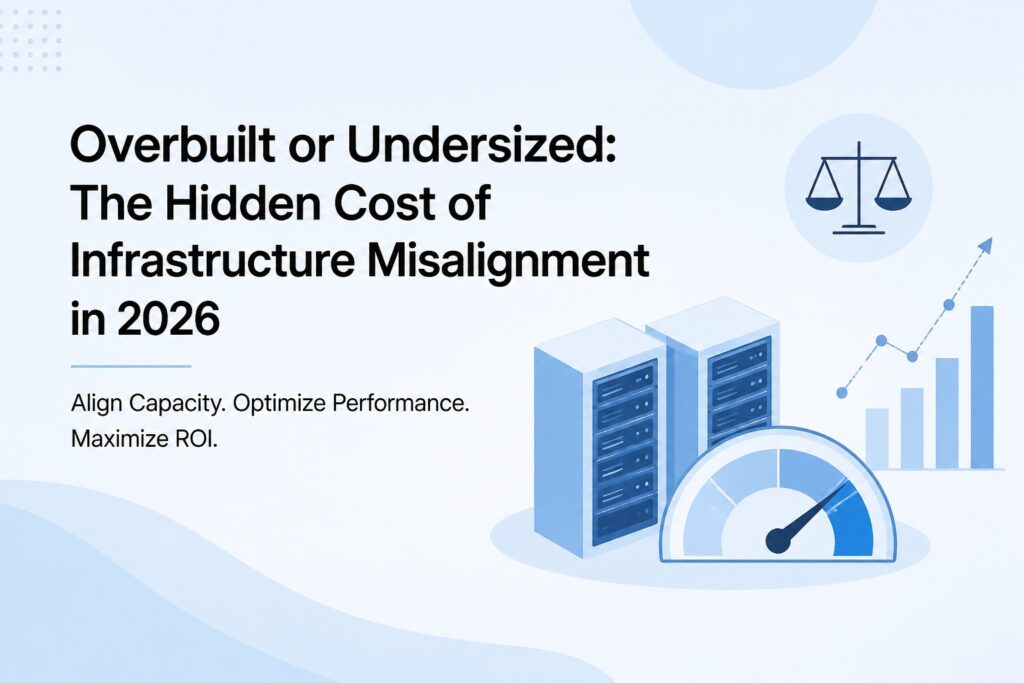
In 2026, the biggest inefficiency in infrastructure is not slow systems or expensive environments. It is the growing gap between what your workloads require and what your infrastructure actually delivers. That gap shows up in two ways: overbuilt environments that quietly drain margin and undersized environments that cap revenue potential.
Both scenarios create the same outcome; distorted ROI, inaccurate financial modeling, and missed growth opportunities.
If your infrastructure is not aligned to your workload, it is not optimized. And if it is not optimized, it is actively working against your business.
The Misalignment Problem Nobody Measures
Infrastructure decisions are often made in isolation from real workload behavior. Engineering teams plan for peak capacity. Finance teams push for cost control. Leadership expects growth. What rarely happens is a continuous reconciliation between these forces. The result is misalignment.
Over time, workloads evolve. AI models scale. SaaS platforms gain users. Data pipelines expand. But infrastructure often stays static or scales inefficiently, creating a widening gap between capacity and actual demand. This is not a technical oversight. It is a financial blind spot.
We explored a similar disconnect in performance variability here:
https://www.prolimehost.com/blogs/the-silent-profit-killer-why-infrastructure-variance-is-the-hidden-risk-your-financial-models-ignore-in-2026/
But misalignment goes one step further. It is not just about inconsistent performance. It is about incorrect capacity altogether.
Overprovisioning: The Illusion of Safety That Erodes Margin
Overbuilt infrastructure feels safe. It ensures performance headroom, reduces risk, and avoids bottlenecks. But that safety comes at a cost. When systems operate at 30–50% utilization, you are not just wasting capacity. You are inflating your cost per unit of output. Every unused cycle, every idle GPU, every underutilized core is a direct hit to margin.
This is especially visible in cloud environments where elasticity encourages over-allocation “just in case.” What looks like flexibility often becomes persistent overpayment. The danger is that this inefficiency rarely shows up in performance metrics. Everything looks stable. Everything appears optimized. But financially, the system is underperforming.
For a deeper look at how cost efficiency ties to output, revisit:
https://www.prolimehost.com/blogs/cost-per-compute-unit-the-only-infrastructure-metric-that-actually-matters/
Because in the end, idle capacity is not neutral, it is expensive.
Underprovisioning: The Silent Cap on Revenue
On the opposite end, undersized infrastructure creates a different kind of risk. Instead of wasted capacity, you get constrained output. Applications slow under load. AI inference queues build up. Data processing pipelines fall behind. User experiences degrade just enough to reduce engagement but not enough to trigger alarms.
This is the same “almost good enough” problem we discussed here:
https://www.prolimehost.com/blogs/the-risk-of-almost-fast-enough/
But viewed through a different lens, it becomes something more serious. Undersized infrastructure does not just reduce performance, it sets a ceiling on revenue. If your system cannot process demand at peak, you are not operating inefficiently. You are leaving money on the table.
And unlike overprovisioning, this loss is often misattributed to market conditions, product issues, or user behavior.
Why Most Financial Models Get This Wrong
Traditional financial models assume infrastructure is either fixed or scales linearly with demand. Neither assumption holds in modern environments.
When infrastructure is misaligned, the relationship between cost and output breaks down. You end up with scenarios where increasing spend does not proportionally increase output, or where stable costs hide declining efficiency. This creates distorted metrics across the board.
EBITDA looks compressed without a clear cause. Unit economics weaken. Forecasts become less reliable. Growth projections miss targets. The root issue is rarely identified because it sits below the surface.
Infrastructure alignment is not being measured, so it is not being managed.
Comparison Chart: Overbuilt vs Undersized vs Right-Sized Infrastructure
| Scenario | Overprovisioned Environment | Underprovisioned Environment | Right-Sized Dedicated Infrastructure |
|---|---|---|---|
| Utilization | 30–50% | 90–100% (strained) | 70–85% (optimized) |
| Cost Efficiency | Low | Misleading | High |
| Performance Behavior | Stable but wasteful | Inconsistent under load | Predictable and controlled |
| Revenue Impact | Margin erosion | Revenue limitation | Maximized throughput |
| Cost Per Output | Elevated | Volatile | Optimized |
| ROI Predictability | Low | Low | High |
The goal is not maximum utilization or maximum capacity. The goal is alignment, where performance, cost, and demand move together.
The Role of Dedicated Infrastructure in Achieving Alignment
Alignment requires control. In multi-tenant or highly abstracted environments, achieving precise alignment is difficult because performance is influenced by external factors such as resource contention and shared workloads.
This is particularly problematic in GPU environments, where contention directly impacts utilization and ROI, as discussed here:
https://www.prolimehost.com/blogs/the-hidden-tax-of-multi-tenant-gpu-environments/
Dedicated infrastructure changes that equation. By eliminating contention and providing consistent performance characteristics, it becomes possible to match infrastructure capacity directly to workload requirements. This creates a stable foundation for accurate forecasting, efficient scaling, and predictable ROI.
Explore ProlimeHost dedicated solutions here:
https://www.prolimehost.com/dedicated-servers/
Because alignment is not just about having resources. It is about having the right resources, in the right configuration, at the right time.
FAQs
What is infrastructure misalignment?
Infrastructure misalignment occurs when your system capacity does not match your workload requirements, leading to either wasted resources or constrained performance.
How does overprovisioning impact ROI?
Overprovisioning increases cost without increasing output, which raises cost per unit of performance and reduces overall margin.
Why is underprovisioning dangerous?
Underprovisioning limits throughput and performance, which can reduce revenue, degrade user experience, and cap growth potential.
How can I determine if my infrastructure is misaligned?
Analyze utilization rates, performance consistency, and cost per output metrics. Misalignment often appears as either low utilization or performance degradation under load.
Why is dedicated infrastructure better for alignment?
Dedicated infrastructure provides consistent, controllable performance, allowing organizations to match capacity precisely to workload needs without interference from shared environments.
Final Thoughts
Most companies are not asking the right question. They ask whether their infrastructure is fast enough. They ask whether it is affordable. Very few ask whether it is correctly aligned. And that is where the real opportunity and risk exists.
Overbuilt systems quietly drain margin. Undersized systems quietly cap growth. Both distort financial performance in ways that are difficult to trace but impossible to ignore over time. In 2026, infrastructure is no longer just a technical decision. It is a financial lever.
And alignment is what determines whether that lever works for you or against you.
Let’s identify where misalignment is impacting your ROI and fix it.
If you are evaluating infrastructure based on cost or performance alone, you are only seeing part of the picture.
The real question is whether your infrastructure is aligned to your workload and your business model.
At ProlimeHost, we help organizations design right-sized, performance-predictable infrastructure that maximizes output while controlling cost.
Contact Information
ProlimeHost
877-477-9454
https://www.prolimehost.com