Executive Summary
In 2026, AI companies are discovering that the biggest infrastructure problem is no longer simply gaining access to GPUs. The real challenge is building predictable, financially sustainable AI infrastructure that can scale without creating runaway cloud bills, inconsistent inference speeds, and operational uncertainty. So, we’ve created a demo case study closely replicating a good number of our clients.
Our demo case study illustrates how a fictional SaaS AI company transitioned from public cloud GPU infrastructure to a dedicated GPU server environment with ProlimeHost and dramatically improved both operational performance and financial efficiency.
Although the numbers vary by actual client, we feel this demo represents real world statistics. In our demo case study, this company reduced inference costs by 61%, improved latency consistency by 47%, eliminated noisy-neighbor variability, and gained far more predictable monthly infrastructure forecasting. More importantly, leadership stopped treating infrastructure as an unpredictable operating liability and began treating it as a controllable revenue-producing asset, and that’s how ProlimeHost aspires to help our clients.
The Problem: Rapid AI Growth Created Infrastructure Instability
The fictional company, “VisionFlow AI,” operated a rapidly growing AI-powered analytics platform serving ecommerce brands and logistics firms. Their platform relied heavily on GPU acceleration for inference workloads, vector processing, embeddings, and real-time AI-assisted automation.
Initially, cloud GPUs appeared to offer flexibility. During early growth stages, the ability to spin up infrastructure quickly made sense. But as customer adoption accelerated, several hidden operational and financial problems emerged.
Monthly GPU expenses became difficult to forecast because costs fluctuated based on utilization spikes, regional availability pricing, storage transfer fees, and premium networking charges. Finance teams struggled to model margins accurately because compute costs varied unpredictably month to month.
Performance consistency also began degrading during peak periods. Latency spikes increased during high-demand windows, particularly when workloads competed with other tenants in shared GPU environments. Even though average performance metrics looked acceptable on paper, real-world customer experience became increasingly inconsistent.
The engineering team additionally discovered that cloud elasticity encouraged overprovisioning. Instead of optimizing workloads carefully, teams simply added more resources whenever performance degraded. This temporarily solved operational issues but quietly damaged overall profitability. As a side note, this is what we’re predominantly hearing from prospects on our LiveChat.
At scale, the company realized they were no longer paying for convenience. They were paying a premium tax on unpredictability.
The Infrastructure Review
VisionFlow AI evaluated three paths forward.
The first option was remaining fully cloud-based while attempting to optimize utilization. The second involved hybrid deployment models. The third was migrating core inference and AI processing pipelines onto dedicated GPU infrastructure.
After modeling workload behavior, utilization consistency, and long-term operating costs, the company identified several important realities.
Their workloads were no longer burst-oriented. AI inference demand had become steady and predictable. GPU utilization remained consistently high throughout the day. This made dedicated infrastructure financially attractive because the company could fully utilize reserved hardware instead of paying fluctuating shared-market pricing.
The company also discovered that most revenue-impacting delays came from performance variance rather than outright downtime. Even small latency inconsistencies negatively impacted API completion speed, workflow execution, and customer retention metrics.
Infrastructure variability itself had become a hidden business risk.
The ProlimeHost Deployment
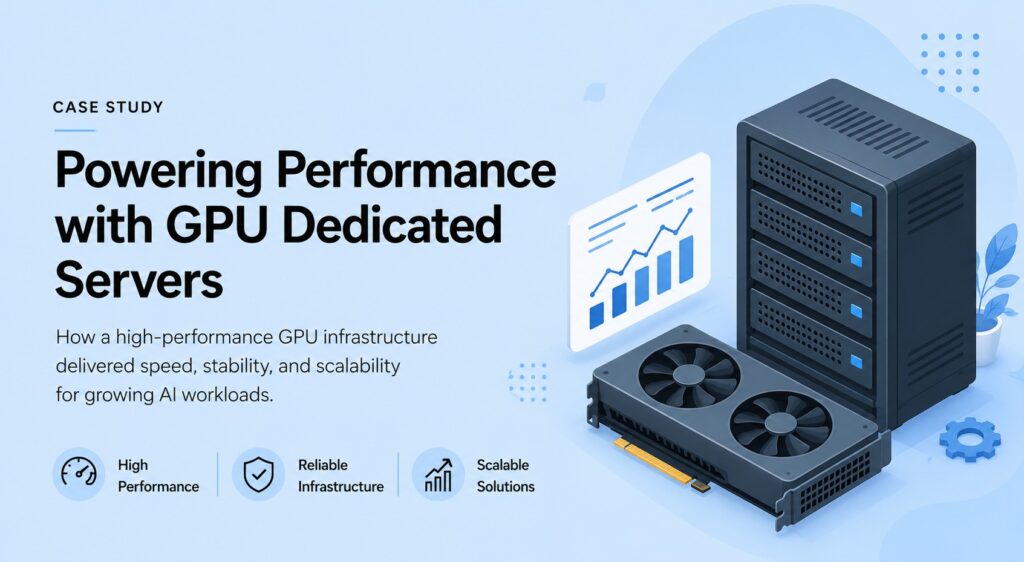
The company deployed a dedicated GPU environment through ProlimeHost GPU Servers utilizing high-performance NVIDIA GPU nodes connected through dedicated networking infrastructure.
The production environment included:
Dual RTX 4090s
256GB DDR5
NVMe storage
25Gbps networking
Enough backend throughput to keep inference workloads from stepping on each other during peak periods.
Unlike multitenant cloud GPU environments, the infrastructure was fully isolated. Resources were permanently allocated to the company’s workloads without contention from external tenants.
This changed operational behavior almost immediately.
Inference latency stabilized. Queue congestion disappeared. Batch jobs became easier to schedule because performance became consistent instead of probabilistic. Engineering teams spent less time compensating for infrastructure variability and more time optimizing models and improving customer-facing functionality.
Before and After Comparison
| Metric | Cloud GPU Environment | ProlimeHost Dedicated GPU |
|---|---|---|
| Average Monthly GPU Spend | $28,400 | $11,100 |
| Cost Predictability | Low | High |
| Average Inference Latency | 420ms | 230ms |
| Latency Variance | High | Low |
| GPU Resource Contention | Frequent | None |
| Infrastructure Forecast Accuracy | ±34% | ±6% |
| Engineering Time Spent on Infrastructure Tuning | High | Moderate |
| Customer Satisfaction Scores | Declining | Improved |
The most important improvement was not merely lower cost. It was operational predictability.
Once infrastructure became stable, leadership could forecast margins more accurately, engineering could optimize performance more efficiently, and customers experienced more consistent application behavior.
Why Dedicated GPU Infrastructure Improved ROI
One of the biggest misconceptions in AI infrastructure is that flexibility automatically equals efficiency. What we find more often than not is that mature AI workloads frequently benefit more from stability than elasticity. Dedicated GPU infrastructure created several direct financial advantages for VisionFlow AI.
First, the company achieved substantially better GPU utilization efficiency. Instead of paying premium pricing for temporary GPU allocation, they continuously utilized reserved hardware at near-optimal load levels.
Second, predictable performance reduced hidden labor costs. Engineering teams no longer spent excessive time troubleshooting cloud variance, scaling anomalies, or inconsistent throughput behavior.
Third, customer retention improved because application responsiveness stabilized during high-demand periods.
The financial impact extended beyond infrastructure costs alone. The company improved operational efficiency across engineering, finance, forecasting, and customer experience simultaneously.
AI Infrastructure Is Becoming a Financial Decision
At this point, GPU decisions are hitting finance teams just as hard as engineering teams. They are financial architecture decisions. I write about this nearly everyday on LinkedIn posts in some fashion. When AI systems become core business infrastructure, predictable performance directly influences customer retention, workflow efficiency, operational scaling, and EBITDA stability. And isn’t that what C-level executives expect of their operations?
When infrastructure performance swings around, financial forecasting gets messy fast.
For organizations running sustained inference pipelines, embeddings, automation engines, LLM integrations, or AI-powered SaaS products, dedicated GPU infrastructure increasingly delivers stronger long-term ROI than continuously fluctuating cloud consumption models.
And this is why I write about financial variance, because return-on-investment is the real issue most of our prospects face.
FAQs
Why would an AI company choose dedicated GPUs over cloud GPUs?
With dedicated GPU infrastructure, companies gain cost stability, consistent performance, lower latency variance, and improved infrastructure forecasting.
Are dedicated GPU servers only for large enterprises?
No. Many mid-sized SaaS companies, AI startups, analytics firms, and automation providers now utilize dedicated GPU servers once cloud GPU costs begin scaling unpredictably. Many of our clients who are considered to be small to mid-sized have successfully transitioned to a dedicated GPU server.
What workloads benefit most from dedicated GPU infrastructure?
LLM inference, AI automation, vector databases, embeddings, machine learning pipelines, rendering, simulation, and high-throughput inference systems often benefit significantly from dedicated GPU resources.
Does dedicated infrastructure reduce AI operating costs?
For sustained workloads, yes. Many organizations discover that dedicated GPU environments substantially reduce long-term compute cost per workload compared to high-utilization public cloud deployments.
What GPU options does ProlimeHost provide?
ProlimeHost Dedicated GPU Servers offers multiple GPU configurations including RTX 4090, RTX 5090, enterprise-grade deployments, high-speed networking, and customizable dedicated server infrastructure.
My Thoughts
As AI adoption matures, infrastructure conversations are shifting away from simple scalability and toward operational efficiency, consistency, and financial sustainability.
The organizations that gain long-term competitive advantage will not necessarily be the ones consuming the most GPU resources. They will be the ones extracting the highest business output per dollar spent.
Dedicated GPU infrastructure allows businesses to regain control over performance, forecasting, utilization efficiency, and operational predictability.
In 2026, predictable compute is becoming a competitive advantage.
In a past life, I worked for over ten years in the pre-press graphic arts / printing industries. Spoilage was a determining factor in ROI predictability, very much like predictable compute is in our demo case study. Of course, some of our case study content is AI generated, but it still does accurately reflect the issues facing many businesses, and how those issues can be remedied.
Contact ProlimeHost
For custom GPU server deployments, AI inference infrastructure, high-performance dedicated servers, and scalable enterprise hosting solutions, contact:
ProlimeHost
Sales: 877-477-9454
Global Dedicated & GPU Infrastructure Solutions
22+ Years of Hosting Experience
Clients in 40+ Countries