Executive Summary
Most infrastructure decisions are framed as technical upgrades driven by traffic. In reality, they are financial decisions driven by performance sensitivity.
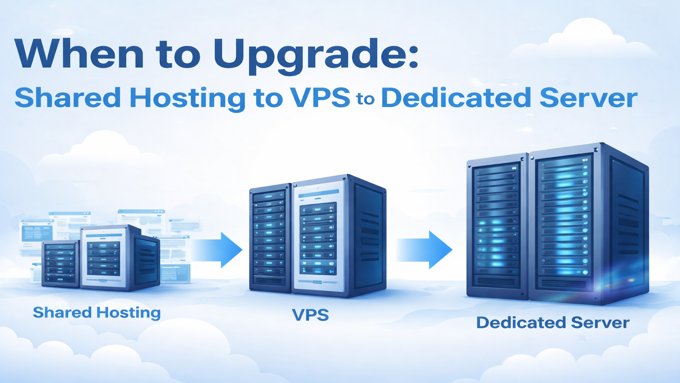
The progression from shared hosting to VPS to dedicated servers is not about how many visitors you have. It is about when infrastructure variability begins to interfere with revenue, user experience, and operational efficiency.
In 2026, the companies that scale efficiently are not the ones that upgrade the fastest. They are the ones that upgrade at the right moment, when the cost of staying where they are exceeds the cost of moving forward.
The Illusion of “Cheap” Infrastructure
Shared hosting is attractive because of its low entry cost. It allows businesses to launch quickly without significant capital allocation. In the early stages, this makes sense. When demand is low and workloads are simple, the tradeoff between cost and performance is acceptable.
But shared environments are built on contention. Resources are distributed across many users, and performance is inherently variable. As long as your application is not sensitive to that variability, the model holds. The shift happens quietly.
Pages begin loading inconsistently. Applications feel slower under modest load. External dependencies and plugins introduce friction. What once felt efficient begins to feel unpredictable.
At that point, the conversation changes. The cost of shared hosting is no longer measured in monthly spend. It is measured in lost conversions, reduced engagement, and diminished user trust.
That is the moment when “cheap” becomes expensive.
The VPS Transition: Control Improves, Variability Remains
Moving to a VPS is the first meaningful step toward control. Resources are more defined. Performance improves. You gain flexibility in configuration and security. For many businesses, this is where infrastructure begins to align with growth.
But a VPS is still a shared system at its core. The illusion of isolation is helpful, but not absolute. CPU contention, noisy neighbor effects, and inconsistent performance under load still exist, just in a more controlled form. This becomes visible as applications mature.
Databases grow. Query complexity increases. Traffic patterns become less predictable. Workloads shift from static delivery to dynamic processing. What worked smoothly at lower scale begins to introduce friction again.
Teams respond by allocating more resources, increasing instance sizes, or optimizing around constraints. Over time, this creates a different kind of inefficiency. You are no longer limited by lack of capacity. You are limited by inconsistency.
And inconsistency is expensive, because it forces overprovisioning, increases engineering overhead, and introduces uncertainty into performance outcomes.
Dedicated Infrastructure: Where Performance Becomes Predictable
The transition to dedicated servers is not about scale alone. It is about removing variability from the equation. When infrastructure is fully allocated to a single workload, performance becomes stable. There are no competing tenants, no hidden contention, and no unpredictable resource behavior. This changes more than just speed. It changes how the business operates.
Applications behave consistently under load. Scaling becomes linear. Capacity planning becomes reliable. Engineering teams spend less time troubleshooting infrastructure and more time building product. From a financial perspective, this is where infrastructure shifts from being a variable cost driver to a controlled asset.
Predictable performance leads to predictable outcomes. And predictable outcomes are what finance teams can model, forecast, and optimize.
Matching Infrastructure to Business Stage
Early-stage applications; brochure sites, low-traffic platforms, or simple content delivery rarely justify anything beyond shared hosting. At this stage, the priority is speed of deployment and cost control.
As the business begins to rely on its digital presence for lead generation, customer acquisition, or transactional activity, VPS becomes the logical step. It introduces stability without requiring full infrastructure commitment.
But once the application becomes revenue-critical (whether through ecommerce, SaaS delivery, APIs, or AI workloads) the tolerance for variability disappears. At that point, dedicated infrastructure is no longer an upgrade. It is a requirement.
Mapping This to Real Infrastructure (ProlimeHost Examples)
The transition becomes clearer when tied to actual configurations.
A growing application moving beyond shared hosting often lands well on a modern VPS or entry dedicated environment equivalent to a single-CPU system. This is where configurations similar to an AMD Ryzen 7700 or early-stage Ryzen platform begin to make sense, offering enough performance headroom for consistent delivery.
As workloads intensify (larger databases, higher concurrency, more complex applications) stepping into a higher-frequency CPU like the Ryzen 9950X with 96GB–192GB DDR5 and NVMe storage creates a meaningful shift. Performance becomes not just faster, but more consistent under sustained load.
For AI-driven workloads, inference pipelines, or GPU-accelerated applications, the equation changes again. Systems equipped with GPUs such as RTX 4090 or RTX 5090 are not simply upgrades, they are multipliers. They compress processing time, increase throughput, and unlock capabilities that CPU-only environments cannot economically support.
At that level, infrastructure is no longer supporting the business. It is driving it.
The Real Upgrade Trigger: Revenue Sensitivity
The most common mistake companies make is waiting for traffic thresholds to justify upgrades. Traffic is a lagging indicator. The real signal is how sensitive your revenue is to performance.
When slower response times reduce conversions, when delays impact customer experience, or when infrastructure limitations slow down deployment cycles, the cost is already being realized.
Upgrading infrastructure at that point is not a cost increase. It is a correction.
Frequently Asked Questions
When should a business leave shared hosting?
When performance variability begins to impact user experience, SEO rankings, or conversion rates. This often happens earlier than expected, especially for dynamic or plugin-heavy sites.
Is VPS enough for most growing businesses?
For a period, yes. VPS provides improved control and stability. But as workloads become more complex or revenue-dependent, its limitations become more visible.
Why not stay on VPS longer and scale vertically?
Because vertical scaling on shared infrastructure introduces diminishing returns. Costs increase, but performance consistency does not improve proportionally.
When is dedicated infrastructure justified financially?
When infrastructure performance directly affects revenue, customer experience, or operational efficiency. At that point, predictability becomes more valuable than incremental cost savings.
Do GPU servers really change ROI that much?
Yes. For AI and compute-heavy workloads, GPUs dramatically reduce processing time and increase output. The ROI comes from faster iteration, higher throughput, and reduced idle time.
Board / Executive Takeaway
Infrastructure decisions should not be evaluated as technical upgrades. They should be evaluated as financial controls. Organizations that remain on variable, shared environments too long introduce hidden volatility into their operations. Those that move to predictable infrastructure at the right time protect margins, improve scalability, and reduce execution risk.
The question is not whether to upgrade. It is whether the business can afford not to.
Why This Matters in 2026
As applications become more compute-intensive and more tightly tied to revenue generation, infrastructure performance is no longer a background concern. It is a primary driver of business outcomes.
The companies that win will not be the ones with the lowest infrastructure cost. They will be the ones with the most predictable infrastructure performance.
Build Infrastructure That Scales With Your Business, Not Against It
At ProlimeHost, we design infrastructure around a simple principle:
Predictable Performance = Predictable ROI
From high-frequency CPU platforms like the Ryzen 9950X to GPU-accelerated environments built for AI and advanced workloads, our focus is on delivering consistent, reliable performance that businesses can actually plan around.
If your current infrastructure is introducing variability into your growth, it is time to rethink the foundation.
Let’s build something more predictable.
📞 877-477-9454
🌐 www.ProlimeHost.com