Executive Summary
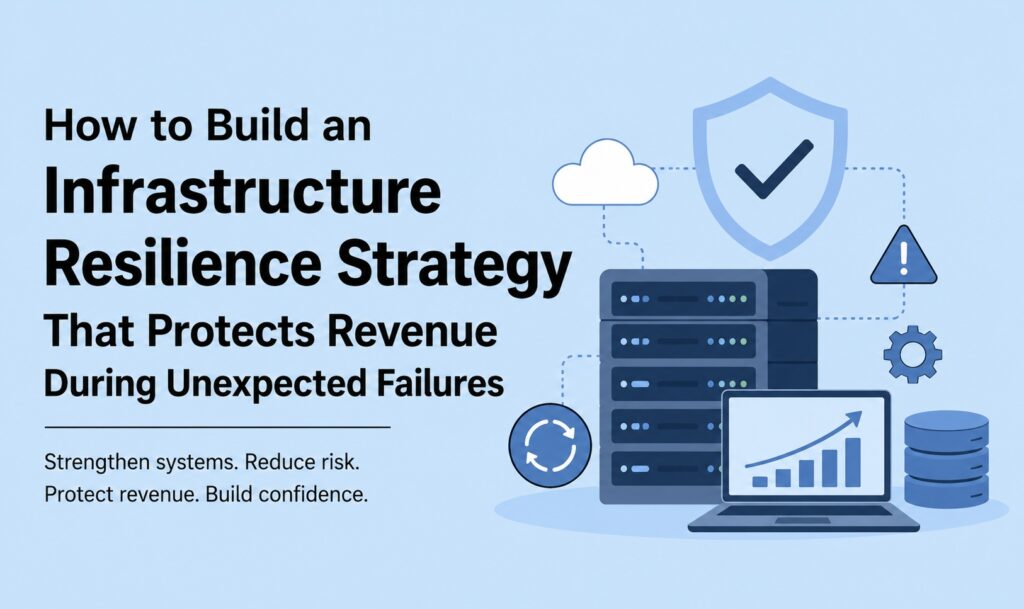
Most organizations believe they have resilient infrastructure because they have backups, redundant hardware, and disaster recovery plans. Yet when an unexpected failure occurs, many still experience prolonged outages, delayed customer transactions, missed service-level agreements, damaged reputations, and significant financial losses. The uncomfortable reality is that redundancy alone rarely guarantees resilience.
A true infrastructure resilience strategy extends far beyond purchasing duplicate hardware or replicating data between locations. It requires designing every layer of the technology environment to continue delivering business value despite equipment failures, software defects, cyber incidents, supply chain disruptions, or unexpected spikes in demand. More importantly, resilience should be measured by how effectively an organization continues generating revenue during disruption—not simply how quickly individual servers return to service.
Organizations that consistently outperform competitors during periods of instability rarely possess dramatically better hardware. Instead, they make deliberate architectural decisions years before failures ever occur. They standardize platforms, forecast capacity accurately, reduce operational complexity, continually test recovery procedures, and align infrastructure investments directly with business priorities. These practices transform resilience from an insurance policy into a competitive advantage.
This guide explains how executives, infrastructure architects, and IT leaders can build a comprehensive infrastructure resilience strategy that protects revenue, strengthens customer confidence, reduces operational risk, and creates a technology foundation capable of supporting long-term business growth.
Why Infrastructure Resilience Has Become an Executive Conversation
There was a time when infrastructure decisions remained almost entirely within the IT department. Servers failed occasionally, replacement hardware arrived within a few days, and customers generally accepted short service interruptions. That environment has largely disappeared. Digital transformation has shifted nearly every revenue-producing activity onto technology platforms, meaning infrastructure failures increasingly become business failures.
Consider what happens during even a relatively short outage. Online orders stop processing. Manufacturing systems may halt production. Financial transactions become delayed. Customer support teams lose access to critical applications. Marketing campaigns continue directing prospects toward unavailable websites. Internal collaboration slows. The infrastructure itself may represent only a small portion of the organization’s investment, yet its failure can interrupt virtually every department responsible for generating revenue.
That reality explains why boards of directors now ask different questions than they did a decade ago. Instead of asking, “How many servers do we own?” executives increasingly ask, “How much revenue depends on those servers?” The distinction may appear subtle, but it fundamentally changes how infrastructure investments are evaluated.
Building resilience therefore becomes less about maximizing uptime percentages and more about minimizing business interruption. A company that maintains 99.95% uptime yet experiences repeated failures during peak revenue periods may actually perform worse than another organization with slightly lower availability but significantly stronger operational continuity.
This shift also explains why organizations increasingly connect resilience planning with broader strategic initiatives. For example, companies developing standardized infrastructure frequently discover that consistency simplifies recovery efforts while reducing operational risk. Readers interested in standardization strategies may find value in our companion guide, How to Build a Server Standardization Strategy, available at https://www.prolimehost.com/blogs/how-to-build-a-server-standardization-strategy/. Likewise, organizations evaluating future growth often benefit from aligning resilience planning with long-term capacity objectives, a topic explored in How to Design Infrastructure for Five Years of Business Growth at https://www.prolimehost.com/blogs/how-to-design-infrastructure-for-five-years-of-business-growth/.
Notice how these subjects naturally reinforce one another. Standardization simplifies resilience. Capacity planning reduces emergency procurement. Governance strengthens operational consistency. None of these initiatives exist independently.
Understanding What Resilience Actually Means
One of the most common misconceptions surrounding infrastructure resilience is the assumption that resiliency and redundancy describe the same capability. They do not.
Redundancy provides additional components that may continue operating after individual failures. Resilience determines whether the overall business continues functioning despite those failures. Those objectives overlap, certainly, but they are not interchangeable.
Imagine two organizations that both operate redundant server clusters. During a regional network disruption, Company A automatically shifts workloads, customers experience only minor delays, and internal operations continue almost normally. Company B owns similar hardware but discovers outdated routing configurations, undocumented dependencies, expired certificates, and recovery procedures that have never been tested. Despite comparable investments, one organization protects revenue while the other struggles through hours or perhaps days of operational disruption.
The difference lies in preparation rather than technology.
That distinction becomes even clearer when evaluating resilience through a financial lens. Every infrastructure decision should answer a relatively straightforward question: “If this component unexpectedly fails tomorrow morning, how much revenue continues flowing without interruption?”
Organizations asking that question consistently begin designing systems differently.
Rather than maximizing hardware specifications alone, they identify business-critical workloads. They separate essential services from lower-priority applications. They invest in automation that accelerates recovery. Documentation becomes operational rather than aspirational. Recovery exercises become routine rather than occasional compliance exercises.
Interestingly, many organizations discover that resilience begins long before purchasing additional equipment. It begins by understanding utilization patterns, infrastructure bottlenecks, and future demand. That philosophy aligns closely with our earlier discussion in How to Forecast Infrastructure Demand 12 Months in Advance, available at https://www.prolimehost.com/blogs/how-to-forecast-infrastructure-demand-12-months-in-advance/, where proactive forecasting reduces many of the emergency situations that often expose resilience weaknesses.
Planning ahead rarely attracts headlines. Recovering gracefully from unexpected failures, however, almost always reflects years of disciplined planning.
Revenue Is the Metric That Matters
Technical teams understandably focus on latency, processor utilization, storage performance, replication intervals, and network throughput. Those metrics remain important because they indicate infrastructure health. Executive leadership, however, ultimately evaluates resilience differently.
Revenue continuity.
That phrase deserves repeating because it reframes the entire discussion. Infrastructure exists to enable business operations, not simply to operate efficiently.
When evaluating resilience initiatives, organizations frequently ask whether purchasing additional servers, expanding storage capacity, or adding another network provider will improve availability. Those questions matter, yet they sometimes overlook a more important consideration. Which investment most effectively protects future revenue?
An additional storage array may provide little benefit if customer authentication remains a single point of failure. Likewise, upgrading processor performance may deliver marginal improvements while leaving critical databases vulnerable to prolonged recovery times.
The strongest resilience strategies therefore begin with business processes rather than infrastructure diagrams. Which applications directly generate revenue? Which systems support customer transactions? Which workloads must recover within minutes instead of hours? Which services can tolerate temporary degradation without significant financial consequences?
Only after those questions receive clear answers should architecture decisions begin taking shape.
Organizations that follow this sequence often discover that resilience investments become easier to justify financially. Rather than requesting budget for “more servers,” infrastructure leaders present compelling business cases demonstrating reduced operational risk, improved customer retention, stronger regulatory compliance, and measurable protection against revenue disruption.
That perspective closely complements another topic we’ve previously explored in How to Build an Infrastructure Business Case That Wins Budget Approval, found at https://www.prolimehost.com/blogs/infrastrcture-business-case/. When resilience is presented as a revenue protection initiative instead of a technology expense, executive conversations tend to change remarkably quickly.
The objective is no longer simply preventing downtime.
The objective becomes protecting the organization’s ability to serve customers regardless of what unexpected events tomorrow may bring.
Building Resilience into the Infrastructure Architecture
Once organizations begin viewing resilience through the lens of revenue protection instead of hardware availability, architectural decisions naturally become more deliberate. Every server, every network path, every storage platform, and every operational process begins serving a broader purpose than simply keeping applications online. They become components within a system intentionally designed to absorb disruption while maintaining business operations.
This is where many infrastructure projects quietly drift off course. An organization purchases enterprise-grade servers, deploys redundant switches, implements clustered storage, and perhaps even contracts with multiple internet providers. On paper, the environment appears exceptionally resilient. Yet beneath that impressive architecture often lie dozens of unnoticed assumptions. Documentation has not been updated in years. Critical scripts exist only on one administrator’s workstation. DNS failover has never actually been tested. Backups complete successfully every evening, but no one has restored an entire production environment in months.
Technology can only be as resilient as the operational discipline surrounding it.
That realization often surprises executive leadership because resilience is frequently perceived as something purchased rather than something continuously maintained. The hardware certainly matters; high-performance processors, enterprise NVMe storage, ECC memory, reliable networking. But without repeatable operational processes, those investments cannot consistently deliver the business continuity executives expect.
Organizations deploying modern dedicated server infrastructure often find that architectural consistency significantly improves operational resilience. Standardized platforms simplify automation, reduce configuration drift, accelerate troubleshooting, and shorten recovery times because every environment behaves predictably. Whether supporting virtualization clusters, SaaS platforms, AI workloads, or enterprise databases, predictable infrastructure almost always proves easier to recover than a collection of unique configurations accumulated over many years.
Businesses evaluating modern dedicated infrastructure can explore ProlimeHost’s enterprise platforms at https://www.prolimehost.com/dedicated-server-hosting/, where scalable bare-metal environments provide the performance and flexibility necessary for resilient production deployments.
The architecture itself, however, should never become the endpoint. It is simply the framework upon which operational resilience is built.
Eliminating Single Points of Business Failure
Ask ten infrastructure engineers to identify single points of failure and most will immediately begin discussing hardware components. They’ll mention power supplies, switches, storage controllers, internet circuits, RAID controllers, or perhaps virtualization hosts. Those are certainly important considerations, but they rarely represent the greatest operational risk.
The most dangerous single points of failure often involve people, processes, or undocumented dependencies.
Consider an authentication service maintained by one administrator who happens to be on vacation during a major outage. Imagine firewall rules that have evolved over eight years without documentation. Or perhaps an application dependency no one remembers until a routine software update unexpectedly breaks customer logins.
Those failures rarely appear on infrastructure diagrams.
They emerge during moments of crisis, when every minute of uncertainty translates directly into lost productivity and declining customer confidence.
Building an effective infrastructure resilience strategy therefore requires organizations to inventory business dependencies with the same rigor traditionally reserved for physical assets. Which applications depend on external APIs? Which internal services support customer authentication? Which databases feed executive reporting? Which workloads rely upon legacy systems that few employees fully understand?
Interestingly, organizations often discover that the infrastructure itself is remarkably resilient while operational knowledge remains surprisingly fragile.
Documentation, cross-training, configuration management, version control, and automated deployment pipelines may not generate the excitement associated with new hardware acquisitions. Yet collectively they contribute more toward organizational resilience than many expensive technology purchases.
Sometimes the greatest resilience improvement costs very little.
Designing for Controlled Failure Rather Than Perfect Availability
There is another subtle shift that distinguishes mature infrastructure organizations from those constantly reacting to emergencies.
They stop trying to prevent every possible failure.
Instead, they design systems that continue functioning despite inevitable failures.
At first glance that philosophy sounds almost pessimistic. In reality, it represents one of the most practical approaches to infrastructure engineering. Hardware eventually fails. Storage devices wear out. Software contains bugs. Internet providers experience outages. Human beings make mistakes.
Planning for perfection is impossible.
Planning for graceful degradation is entirely achievable.
This concept appears throughout modern distributed computing architectures. Rather than assuming uninterrupted operation, resilient platforms expect individual components to disappear temporarily while maintaining acceptable service levels elsewhere. Customers may experience slightly higher latency or reduced functionality, but critical business operations continue.
Notice the distinction.
The objective isn’t preventing disruption altogether.
The objective is preventing disruption from becoming catastrophic.
Organizations embracing this mindset frequently redesign application tiers, introduce intelligent load balancing, distribute workloads geographically, and automate recovery actions long before they become necessary. They rehearse failure scenarios with the same seriousness that pilots practice emergency procedures in flight simulators.
Nobody hopes to lose an engine during flight.
Every professional pilot still trains extensively for that possibility.
Infrastructure resilience deserves the same discipline.
Capacity Buffers Are Insurance Against Uncertainty
One of the recurring themes across our previous infrastructure planning articles is that capacity should never be viewed solely as a cost center. Excess capacity often represents strategic flexibility rather than wasted investment.
That perspective becomes especially important when discussing resilience.
Organizations operating consistently above eighty-five or ninety percent utilization leave themselves remarkably little room to absorb unexpected workload shifts. A failed virtualization host suddenly forces remaining servers beyond safe operating thresholds. Database replication slows. Storage latency increases. User experience deteriorates—not because individual hardware components failed, but because the surrounding environment lacked sufficient operational headroom.
This explains why accurate forecasting remains inseparable from resilience planning.
Infrastructure leaders who continuously analyze utilization trends, seasonal business cycles, customer growth projections, and application behavior rarely find themselves purchasing emergency hardware under pressure. Instead, they expand infrastructure methodically, preserving healthy operating margins that accommodate unexpected events without sacrificing performance.
Readers interested in the financial side of proactive planning may also find our article How to Create Infrastructure KPIs That Matter to Executives valuable: https://www.prolimehost.com/blogs/how-to-create-infrastructure-kpis-that-matter-to-executives/. Executive dashboards should measure resilience indicators alongside utilization metrics because together they provide a far more accurate picture of organizational readiness.
Capacity planning, then, becomes less about maximizing utilization percentages and more about preserving operational flexibility.
That distinction may appear subtle.
Financially, it can be enormous.
Vendor Diversity Without Operational Chaos
For years, conventional wisdom suggested avoiding vendor lock-in at almost any cost. Multi-vendor environments became synonymous with resilience because no single supplier controlled the organization’s future.
There is truth in that philosophy, but it deserves nuance.
Adding additional vendors unquestionably reduces dependency risk. Unfortunately, it can also introduce management complexity, inconsistent support processes, incompatible monitoring platforms, varying firmware lifecycles, and dramatically different operational procedures.
Eventually an organization discovers it has diversified itself into operational confusion.
The objective should therefore be intentional diversity rather than diversity for its own sake.
Critical network connectivity may benefit from multiple carriers. Geographic redundancy may justify separate colocation providers. Backup repositories may intentionally reside on different storage platforms. At the same time, server hardware, management tooling, virtualization platforms, and automation frameworks often benefit from greater consistency because predictable environments accelerate troubleshooting and reduce recovery time.
This balance between flexibility and operational simplicity rarely receives enough attention.
The strongest resilience strategies deliberately standardize where consistency improves recoverability while diversifying only where concentrated business risk genuinely exists.
It’s a balancing act.
Too much standardization can increase dependency.
Too much diversity can increase operational risk.
The answer almost always lies somewhere between those extremes.
Supporting Emerging Workloads Without Compromising Stability
Infrastructure resilience discussions increasingly include artificial intelligence, machine learning, advanced analytics, and GPU-accelerated computing. These workloads introduce entirely new planning considerations because resource demands fluctuate dramatically and hardware availability can change quickly within global supply chains.
Organizations deploying AI infrastructure frequently focus almost exclusively on performance benchmarks. That’s understandable. GPU density, memory bandwidth, storage throughput, and processor capabilities all influence model training times.
Yet resilience deserves equal consideration.
What happens if a GPU server unexpectedly becomes unavailable during a multi-day training cycle? How rapidly can workloads migrate? Are datasets replicated appropriately? Does orchestration automatically recover failed jobs, or must administrators manually restart lengthy processing pipelines?
These questions become increasingly important as AI transitions from experimental research into revenue-generating production services.
Businesses preparing for advanced compute workloads can review ProlimeHost’s GPU infrastructure solutions at https://www.prolimehost.com/gpu-dedicated-servers/, where enterprise GPU platforms support AI, machine learning, rendering, simulation, and high-performance computing environments while providing the operational flexibility necessary for resilient deployments.
Performance wins headlines.
Resilience determines whether those workloads consistently deliver business value.
By now, one pattern should be becoming increasingly clear. Resilience is not created by a single technology purchase, a single architecture diagram, or a single recovery plan tucked away on a shared drive. It emerges from hundreds of deliberate decisions made across infrastructure design, operational governance, financial planning, automation, documentation, monitoring, testing, and executive leadership.
Those disciplines, working together, create something far more valuable than uptime.
They create confidence.
Operational Excellence Is the Foundation of Infrastructure Resilience
By this point, one principle should be becoming increasingly clear: organizations rarely fail because a single piece of hardware unexpectedly stops functioning. Servers fail every day. Storage devices eventually wear out. Network circuits are interrupted by construction projects, software defects emerge after updates, and even enterprise-class components occasionally develop faults that no amount of preventive maintenance could have predicted. None of those realities are particularly surprising. What separates resilient organizations from those that suffer prolonged business disruption is not whether failures occur, but whether the surrounding operational framework has been intentionally designed to absorb those failures without allowing them to cascade into revenue-impacting events. The infrastructure architecture discussed earlier provides the necessary technical foundation, but architecture alone is only part of the equation. Operational discipline—the collection of governance practices, documentation standards, automation processes, monitoring strategies, and executive oversight that surrounds the technology—ultimately determines whether an organization experiences a brief operational inconvenience or a costly interruption that damages customer confidence.
This distinction often surprises executive leadership because operational excellence rarely attracts the same attention as purchasing new hardware or expanding data center capacity. New servers can be photographed. Faster processors produce measurable benchmarks. High-capacity storage arrays arrive with impressive specifications. Documentation reviews, change management improvements, configuration standardization, and recovery exercises rarely generate similar excitement, yet these quieter investments frequently deliver significantly greater long-term value. During a major service interruption, organizations do not simply depend upon processors and memory; they depend upon people making accurate decisions under pressure, supported by processes that have already been refined long before an incident begins. In many respects, operational maturity becomes the invisible infrastructure that supports every physical component within the environment.
This perspective closely mirrors the philosophy discussed in our article, How to Audit Your Infrastructure Before It Becomes a Liability, available at https://www.prolimehost.com/blogs/how-to-audit-your-infrastructure-before-it-becomes-a-liability/. Comprehensive audits reveal operational weaknesses that rarely appear on hardware inventories yet often represent the greatest threat to business continuity. Organizations that regularly evaluate configuration consistency, documentation accuracy, dependency mapping, lifecycle management, and operational readiness almost always recover more efficiently because they have already eliminated many of the unknowns that tend to complicate emergency response efforts.
Documentation Should Be an Operational Tool, Not an Administrative Requirement
Few organizations intentionally neglect documentation. Instead, documentation gradually falls behind reality as environments evolve through dozens, sometimes hundreds, of incremental changes. New virtual machines are deployed, storage volumes are expanded, routing policies are modified, application dependencies shift, firewall rules accumulate, and administrative responsibilities change hands. Individually, these modifications appear relatively minor. Collectively, they transform the production environment into something substantially different from the architecture diagrams and operational procedures that engineers believe they are supporting.
The consequences of outdated documentation rarely become apparent during routine business operations. Administrators familiar with the environment compensate through experience, institutional knowledge, and countless informal practices developed over many years. Unfortunately, those advantages largely disappear during major incidents. Engineers responding to unexpected failures cannot afford to spend valuable time determining whether network diagrams remain accurate, whether recovery procedures still reflect current production systems, or whether application dependencies have changed since the documentation was last updated. Every minute devoted to rediscovering the environment represents another minute during which customers may be unable to place orders, employees may be unable to perform essential work, and revenue-producing systems remain unavailable.
Organizations with mature infrastructure resilience strategies therefore approach documentation differently. Rather than viewing it as a compliance exercise performed once each year, they integrate documentation directly into operational workflows. Every infrastructure change includes corresponding documentation updates. Configuration standards evolve alongside production environments. Recovery procedures are validated during testing exercises rather than merely reviewed during annual audits. Increasingly, organizations automate portions of this process by generating network inventories, virtualization reports, hardware asset lists, and configuration baselines directly from management platforms, significantly reducing the opportunity for documentation to drift away from operational reality. Documentation, in other words, becomes a living component of the infrastructure itself rather than a collection of static files stored on an internal server.
Monitoring Must Evolve from Observation to Prediction
Traditional infrastructure monitoring has served organizations remarkably well for decades by providing visibility into processor utilization, memory consumption, storage performance, network latency, application availability, and countless other operational metrics. Those measurements remain indispensable because they provide early warning that systems may be approaching operational limits. Yet modern resilience requires organizations to move beyond simply observing what is happening toward understanding what is likely to happen next. Reactive monitoring may identify a developing problem before complete failure occurs, but predictive operational intelligence provides the opportunity to prevent that problem from ever affecting customers.
This evolution reflects broader changes in enterprise computing. Infrastructure environments have become increasingly dynamic as virtualization, containerization, cloud integration, artificial intelligence workloads, and globally distributed applications introduce far greater complexity than traditional server deployments. Individual metrics rarely tell the complete story. A gradual increase in storage latency, when viewed independently, may appear insignificant. Combined with seasonal workload patterns, accelerating database growth, increased network utilization, and application response times, however, that same metric may reveal an emerging bottleneck months before customers notice any degradation in service quality.
Organizations that successfully build infrastructure resilience increasingly combine operational telemetry with business intelligence, forecasting models, financial planning, and capacity analytics to create a more comprehensive understanding of organizational health. Instead of asking whether infrastructure remains operational today, they evaluate whether existing trends suggest elevated operational risk six months from now. That subtle shift transforms monitoring from a reactive operational tool into a strategic planning discipline capable of supporting executive decision-making.
This philosophy aligns naturally with our previous article, How to Measure Infrastructure ROI Beyond Uptime, available at https://www.prolimehost.com/blogs/how-to-measure-infrastructure-roi-beyond-uptime/. Availability percentages remain valuable, but they reveal relatively little about infrastructure’s ability to sustain revenue during periods of increasing demand, unexpected failures, or changing business requirements. Predictive operational metrics provide a far richer understanding of resilience because they expose emerging risks while organizations still possess the time and flexibility necessary to address them proactively.
Automation Reduces Operational Risk While Improving Organizational Consistency
As infrastructure environments continue expanding in scale and complexity, one reality becomes increasingly difficult to ignore: human expertise remains essential, but human variability represents one of the greatest sources of operational risk. Even highly experienced administrators occasionally mistype commands, overlook configuration dependencies, apply software updates inconsistently, or introduce unintended changes while responding to urgent business requests. These mistakes are rarely the result of inadequate technical ability. More often, they arise because people are managing environments that have become too large, too dynamic, and too interconnected to administer reliably through entirely manual processes.
Automation addresses this challenge not by replacing skilled engineers, but by allowing those engineers to apply their expertise more consistently across every environment they manage. Infrastructure-as-Code, configuration management platforms, automated provisioning systems, standardized deployment pipelines, policy-driven orchestration, and continuous validation frameworks all contribute toward reducing operational variability. Servers deployed months apart begin with identical configurations. Security baselines remain consistent across geographically distributed environments. Recovery procedures become repeatable because rebuilding infrastructure follows documented automation rather than relying upon individual memory or handwritten notes assembled during stressful situations.
The financial implications of this consistency are often underestimated. Organizations that automate infrastructure deployment frequently experience shorter recovery times, lower operational costs, fewer configuration-related incidents, and significantly improved scalability because expanding capacity no longer requires rebuilding operational processes from the beginning. Automation therefore contributes simultaneously to operational resilience, financial efficiency, and long-term organizational agility. Rather than treating automation as simply another technology initiative, executive leadership should increasingly recognize it as one of the most valuable resilience investments available because it systematically reduces one of the few operational variables that cannot be eliminated entirely, human inconsistency.
Cybersecurity Has Become an Essential Component of Infrastructure Resilience
Only a few years ago, discussions surrounding business continuity, disaster recovery, and infrastructure resilience often proceeded independently from conversations about cybersecurity. That distinction has largely disappeared. Modern organizations operate within an environment where ransomware campaigns, supply chain attacks, credential theft, software vulnerabilities, insider threats, and distributed denial-of-service attacks possess the same potential to interrupt revenue as hardware failures or regional network outages. In many situations, cyber incidents prove even more disruptive because recovery extends well beyond restoring technology. Organizations must also validate data integrity, investigate the scope of compromise, satisfy regulatory obligations, communicate with customers, and rebuild confidence among stakeholders who increasingly expect uninterrupted digital services.
Consequently, resilience strategies must incorporate security architecture from the earliest planning stages rather than treating cybersecurity as an independent operational discipline. Least-privilege administrative models, multi-factor authentication, network segmentation, immutable backup repositories, vulnerability management programs, endpoint protection, continuous monitoring, and rigorous patch management collectively reduce the probability that isolated security events evolve into organization-wide business disruptions. More importantly, these controls strengthen resilience by limiting the operational consequences of incidents that cannot be prevented entirely.
Ultimately, infrastructure resilience should never be viewed as a collection of isolated technical projects. It is the cumulative result of disciplined operational governance, accurate documentation, predictive monitoring, intelligent automation, thoughtful cybersecurity architecture, and executive leadership committed to continuous improvement. When these disciplines mature together, organizations develop something considerably more valuable than reliable technology. They develop the confidence that, regardless of what unexpected challenges tomorrow may introduce, the business will continue serving customers, protecting revenue, and maintaining the trust upon which long-term growth depends.
Measuring Infrastructure Resilience as a Business Investment
For many organizations, the most difficult aspect of building an infrastructure resilience strategy is not designing the technology itself. The greater challenge lies in demonstrating its financial value before a major incident ever occurs. Unlike revenue-generating initiatives that produce immediate sales or marketing campaigns that generate measurable leads within weeks, resilience investments often succeed quietly. When systems continue operating normally despite hardware failures, network interruptions, cyber events, or unexpected demand spikes, executives may wonder whether the additional investment was ever truly necessary. Ironically, that absence of visible disruption usually represents the strongest possible evidence that the strategy is working exactly as intended.
This creates a unique challenge for infrastructure leaders seeking executive approval. Rather than presenting resilience as an insurance policy against hypothetical disasters, successful organizations increasingly frame these investments in terms of measurable business outcomes. They quantify the revenue protected during peak operating periods. They estimate the financial impact of shortened recovery times. They evaluate customer retention improvements resulting from consistently available services. They measure reductions in emergency procurement expenses, overtime labor, contractual penalties, and reputational damage. Suddenly the discussion shifts from purchasing additional servers or expanding network capacity to protecting predictable cash flow, safeguarding customer relationships, and preserving long-term shareholder value.
That perspective also changes how infrastructure projects compete for funding. Instead of requesting budget because existing hardware is approaching end of life, technology leaders demonstrate how proactive modernization reduces operational uncertainty while supporting strategic growth initiatives. Infrastructure becomes a revenue enabler rather than simply an operational expense. The organizations that consistently make this transition rarely struggle to justify technology investments because executive leadership begins evaluating resilience using the same financial principles applied to every other strategic business initiative.
Building a Practical Roadmap for Infrastructure Resilience
Although every organization operates within its own technical, financial, and regulatory environment, the journey toward greater resilience generally follows a remarkably consistent progression. Companies that attempt to solve every operational weakness simultaneously often create unnecessary complexity, while those that build resilience methodically establish a far stronger long-term foundation.
The process typically evolves through four broad stages:
- Assessment and Visibility. Inventory critical business services, identify operational dependencies, document infrastructure accurately, evaluate existing recovery capabilities, and establish baseline resilience metrics.
- Standardization and Automation. Reduce unnecessary variation, implement consistent configuration management, automate repetitive operational processes, strengthen monitoring, and eliminate avoidable single points of failure.
- Validation and Continuous Testing. Perform structured recovery exercises, validate documentation, test backup integrity, evaluate failover procedures, and continuously refine operational playbooks based on lessons learned.
- Executive Governance and Continuous Improvement. Establish resilience KPIs, integrate resilience into strategic planning, regularly review operational risk with executive leadership, and adapt infrastructure as business priorities continue evolving.
These stages rarely exist as isolated projects with clearly defined completion dates. Rather, they represent an ongoing operational discipline that matures alongside the business itself. As organizations expand into new markets, introduce new applications, deploy AI workloads, or acquire additional companies, resilience strategies must evolve accordingly. A framework that adequately supports fifty employees may prove entirely insufficient for an enterprise serving millions of customers across multiple geographic regions. Continuous improvement therefore becomes one of the defining characteristics of mature resilience programs.
Comparing Reactive Infrastructure with Resilient Infrastructure
| Traditional Reactive Infrastructure | Infrastructure Resilience Strategy |
|---|---|
| Responds after failures occur | Anticipates operational risk before failures occur |
| Focuses primarily on restoring hardware | Prioritizes protecting business operations and revenue |
| Recovery procedures are rarely tested | Recovery exercises become routine operational practice |
| Documentation gradually becomes outdated | Documentation evolves continuously with production |
| Infrastructure metrics dominate reporting | Business resilience metrics support executive decisions |
| Capacity expansion follows emergencies | Capacity planning anticipates future demand |
| Cybersecurity and resilience are managed separately | Security architecture becomes part of resilience planning |
| Infrastructure viewed primarily as an expense | Infrastructure viewed as a strategic business asset |
Looking across these two approaches reveals an important pattern. The technical differences certainly matter, but the greatest transformation occurs in organizational thinking. Resilient companies stop asking whether individual servers can survive failure and begin asking whether the business itself can continue operating regardless of which component unexpectedly stops functioning.
That subtle change in perspective often influences hundreds of future technology decisions.
Frequently Asked Questions
Is infrastructure resilience the same as disaster recovery?
Not exactly. Disaster recovery focuses primarily on restoring technology after a significant disruption. Infrastructure resilience, by comparison, seeks to minimize business interruption altogether by designing systems, operational processes, governance, and recovery capabilities that allow critical services to continue functioning despite unexpected failures. Disaster recovery remains an important component of resilience, but it represents only one element of a much broader strategy.
Does building a resilient infrastructure always require duplicate data centers?
Not necessarily. Geographic redundancy can certainly strengthen resilience for many organizations, particularly those supporting mission-critical applications or global customer bases. However, smaller organizations often achieve substantial improvements through better documentation, standardized infrastructure, intelligent automation, regular recovery testing, and proactive capacity planning long before investing in additional facilities. The appropriate strategy depends upon business objectives, regulatory requirements, acceptable recovery times, and financial priorities rather than any universal architectural formula.
How should executives measure resilience?
Availability percentages remain useful, but they should not stand alone. Executive reporting should also evaluate recovery time objectives, business continuity performance, operational risk trends, dependency reduction, customer impact, financial exposure, recovery testing success rates, and projected revenue protected by resilience initiatives. Measuring infrastructure solely through uptime frequently overlooks operational weaknesses that remain hidden until significant disruption occurs.
When should organizations begin investing in resilience?
Earlier than most expect.
Many companies wait until they experience a significant outage before strengthening resilience, yet that approach almost always proves more expensive than proactive planning. Building resilience gradually as infrastructure evolves distributes investment over time, reduces operational disruption, and allows organizations to improve continuously instead of reacting under pressure after business interruptions have already occurred.
Infrastructure Resilience Is Ultimately About Confidence
As technology continues moving closer to the center of every business operation, resilience can no longer be viewed as an engineering objective delegated exclusively to infrastructure teams. It has become an executive responsibility because nearly every customer interaction, financial transaction, operational workflow, and growth initiative now depends upon technology performing predictably regardless of changing circumstances.
Organizations that consistently outperform competitors during periods of disruption rarely possess perfect technology. Perfection has never existed in information technology, and it never will. What distinguishes these organizations is their willingness to acknowledge uncertainty while designing systems capable of adapting to it. They invest before crises occur. They document while systems remain healthy. They automate wherever consistency improves reliability. They measure resilience through business outcomes instead of technical statistics alone. Most importantly, they recognize that protecting customer confidence ultimately protects revenue, and protecting revenue supports every long-term strategic objective the organization hopes to achieve.
Whether your organization is modernizing existing infrastructure, preparing for accelerated growth, supporting demanding AI workloads, or evaluating a transition toward enterprise-class dedicated servers, resilience should become one of the central principles guiding every technology investment. Businesses seeking predictable performance, enterprise hardware, flexible deployment options, and experienced engineering support are encouraged to explore ProlimeHost’s Dedicated Server Hosting at https://www.prolimehost.com/dedicated-server-hosting/ and GPU Dedicated Servers at https://www.prolimehost.com/gpu-dedicated-servers/. Building resilient infrastructure begins with thoughtful planning, but it is strengthened considerably by selecting technology platforms capable of supporting long-term operational success.
About the Author
Steve Bloemer
Director of Sales & Operations
ProlimeHost
Steve Bloemer has worked with organizations ranging from rapidly growing startups to established enterprises, helping them design infrastructure strategies that balance performance, scalability, operational resilience, and financial responsibility. His focus extends beyond server specifications to the broader business outcomes that dependable infrastructure enables, including predictable growth, improved customer experience, reduced operational risk, and stronger executive decision-making.
For infrastructure consulting or dedicated server solutions, contact ProlimeHost at 877-477-9454 or visit https://www.prolimehost.com.