Executive Summary
For years, infrastructure investments have been evaluated using a relatively simple framework. If systems remained available, applications stayed online, and uptime targets were achieved, the investment was generally considered successful. While availability remains important, modern businesses are discovering that uptime alone provides an increasingly incomplete picture of infrastructure value. A server can remain operational 99.99% of the time and still create performance bottlenecks, slow employee productivity, reduce customer satisfaction, limit scalability, and ultimately suppress revenue growth.
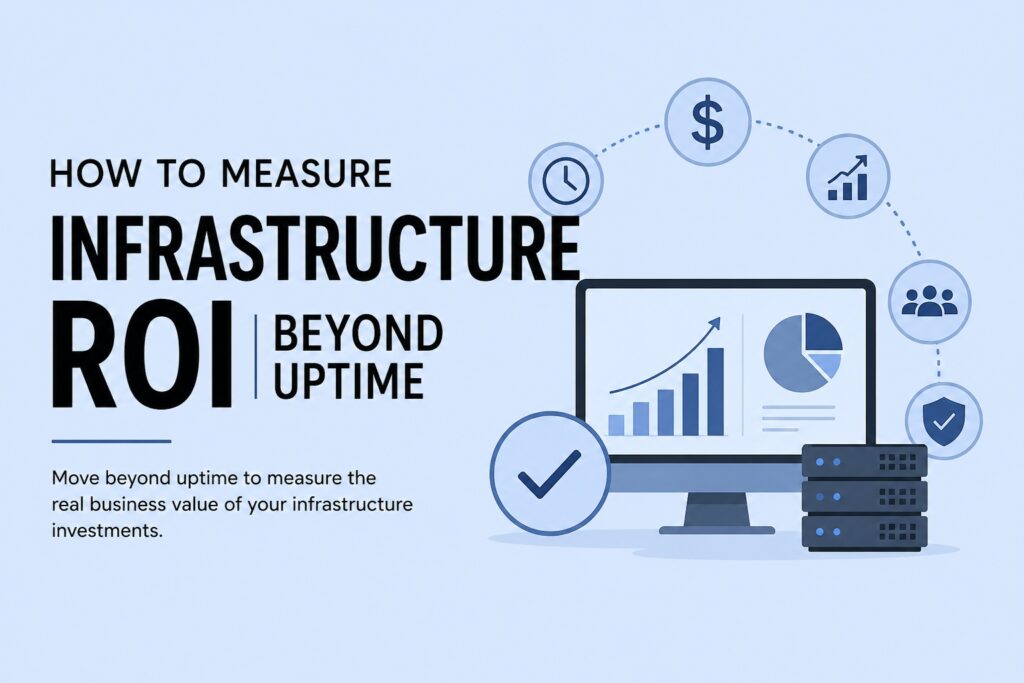
As digital operations become more deeply integrated into nearly every aspect of business, infrastructure decisions deserve the same level of financial scrutiny applied to sales initiatives, acquisitions, marketing investments, and product development. Organizations that continue measuring infrastructure primarily through uptime metrics often overlook the much larger financial impact of performance consistency, operational efficiency, growth enablement, and risk reduction. Measuring infrastructure ROI beyond uptime allows executives to understand not only what their infrastructure costs, but also what it contributes to the business.
The Problem With Measuring Success Through Availability Alone
The widespread focus on uptime is understandable. Twenty years ago, system outages represented one of the largest technology risks organizations faced. If servers crashed, applications became unavailable, employees stopped working, and customers could not transact business. Availability became the standard benchmark because downtime carried obvious and immediate consequences.
Today’s technology environment is very different. Most modern hosting providers can deliver high availability. Achieving 99.9% or even 99.99% uptime is no longer unusual. As a result, uptime has gradually evolved from a competitive advantage into a baseline expectation.
The challenge is that uptime tells us only whether systems are operational. It tells us very little about whether those systems are operating efficiently.
Consider two companies that both maintain 99.99% availability. One delivers consistently low application latency, rapid database performance, predictable transaction processing, and seamless scalability during demand spikes. The other experiences intermittent slowdowns, storage bottlenecks, inconsistent response times, and resource contention during peak business periods. Technically, both environments achieve the same uptime. From a business perspective, however, they are generating vastly different outcomes.
This distinction becomes increasingly important as organizations rely on infrastructure to support revenue-generating websites, SaaS platforms, AI workloads, e-commerce environments, customer portals, analytics systems, and mission-critical business applications. Infrastructure is no longer simply supporting the business. In many cases, it has become the business.
Infrastructure Is a Financial Asset, Not Just a Technical Resource
One of the most significant shifts occurring in enterprise technology is the recognition that infrastructure should be evaluated similarly to any other capital investment. Finance teams do not evaluate sales initiatives based solely on activity. They measure revenue generated. Marketing departments are evaluated on lead generation, conversion rates, and customer acquisition costs. Manufacturing investments are assessed according to productivity improvements and production output.
Infrastructure deserves the same treatment.
The conversation should move beyond monthly hosting expenses, server specifications, or uptime percentages. Those metrics describe infrastructure characteristics, but they do not explain infrastructure value. Executives ultimately care about how technology investments influence revenue, profitability, productivity, customer retention, risk exposure, and long-term growth.
This is why organizations increasingly view infrastructure through the lens of return on investment rather than simply operational cost. The question is no longer whether the infrastructure works. The question is whether the infrastructure creates measurable business value.
The Hidden Productivity Impact of Infrastructure Performance
Perhaps the most overlooked component of infrastructure ROI is employee productivity.
Most organizations carefully track payroll expenses but rarely quantify the productivity losses associated with slow infrastructure. The impact often appears insignificant when viewed at an individual level. A few seconds waiting for applications to load. A delayed database query. A slower report generation process. An extended deployment cycle. A lag during video processing or AI inference.
Individually, these delays appear trivial. Collectively, they can become surprisingly expensive.
Imagine an organization with 100 employees whose workflows depend heavily on technology systems. If each employee loses only ten minutes per day waiting on infrastructure-related delays, the business effectively loses more than 4,000 labor hours annually. Depending on average compensation levels, those lost hours may represent hundreds of thousands of dollars in unrealized productivity.
The infrastructure itself may still be fully operational. Uptime reports may appear flawless. Yet the organization is quietly absorbing a significant productivity tax every single day.
This concept aligns closely with the planning principles discussed in our article on Dedicated Server Capacity Planning for Business Growth. Organizations that proactively align infrastructure capacity with future demand often avoid productivity bottlenecks that become increasingly costly as the business scales.
Revenue Impact Is Often Larger Than Organizations Realize
Infrastructure performance increasingly influences revenue generation in ways that were once difficult to measure.
Website responsiveness affects conversion rates. Application performance influences customer satisfaction. Search response times impact engagement metrics. Transaction speed affects completed purchases. AI response latency shapes user adoption and retention.
Numerous studies have demonstrated that even small performance improvements can produce measurable gains in customer engagement and conversion rates. While the exact impact varies across industries, the underlying principle remains consistent. Faster, more responsive systems create better customer experiences, and better customer experiences tend to generate stronger business outcomes.
This reality has become particularly important for organizations operating e-commerce platforms, SaaS applications, streaming services, financial systems, healthcare portals, and AI-powered products. In these environments, infrastructure performance directly influences customer behavior.
When executives evaluate infrastructure solely through uptime metrics, they often overlook these revenue-generating benefits. A system that enables faster transactions, smoother customer interactions, and greater user satisfaction may produce returns that significantly exceed the infrastructure investment itself.
Infrastructure ROI Includes Scalability
Many businesses make infrastructure decisions based on current requirements rather than future growth.
At first glance, this approach appears financially responsible. Why invest in capacity that may not be needed immediately?
Unfortunately, reactive scaling often proves more expensive than proactive planning.
Organizations that outgrow their infrastructure frequently encounter emergency upgrades, rushed migrations, architectural redesigns, application refactoring projects, and unexpected operational disruptions. These events consume time, capital, and management attention that could otherwise be focused on strategic initiatives.
Infrastructure designed with scalability in mind provides value long before additional resources are actually required. It reduces operational friction, shortens deployment timelines, simplifies expansion efforts, and allows organizations to pursue growth opportunities with greater confidence.
The return on investment is not merely the infrastructure itself. It is the flexibility and business agility the infrastructure enables.
Risk Reduction Is a Form of ROI
When discussing ROI, many organizations focus exclusively on growth and revenue generation. Risk reduction is often treated separately.
That can be a mistake.
Avoiding losses creates value just as surely as generating revenue.
Reliable infrastructure reduces exposure to outages, data loss, security incidents, compliance failures, customer attrition, and reputational damage. While these events may occur infrequently, their financial consequences can be substantial when they do occur.
Our article on How to Calculate the Real Cost of Downtime Before It Happens explores how downtime frequently creates costs that extend far beyond lost transactions. Productivity losses, customer dissatisfaction, emergency remediation expenses, and reputational harm often multiply the financial impact of an outage.
When viewed through this broader lens, investments in infrastructure resiliency, performance consistency, and operational stability become easier to justify. The ROI may not appear in quarterly revenue reports, but it becomes very apparent when a major incident never occurs.
Traditional Infrastructure Metrics Versus ROI-Based Metrics
| Traditional Measurement | ROI-Based Measurement |
|---|---|
| Uptime Percentage | Revenue Generated Per Workload |
| CPU Utilization | Productivity Improvement |
| Storage Capacity | Customer Experience Impact |
| Monthly Hosting Cost | Cost Per Transaction |
| Network Throughput | Revenue Per Infrastructure Dollar |
| Resource Consumption | Business Output Supported |
| Incident Count | Risk Exposure Reduction |
| Server Specifications | Growth Enablement Value |
The difference is subtle but important. Traditional metrics measure infrastructure characteristics. ROI-based metrics measure business outcomes.
Executives rarely make investment decisions based solely on technical specifications. They make decisions based on expected business results.
Infrastructure should be no different.
Dedicated Infrastructure Makes ROI Easier to Measure
One reason many organizations are reevaluating dedicated infrastructure is predictability.
When infrastructure performance fluctuates significantly, measuring ROI becomes difficult. Variable performance introduces uncertainty into productivity calculations, customer experience metrics, and operational forecasting.
Dedicated environments provide a more consistent foundation for evaluating infrastructure performance and business impact. Organizations gain clearer visibility into workload costs, resource utilization, application behavior, and growth requirements.
For businesses seeking predictable performance and long-term value, ProlimeHost’s Dedicated Server Hosting platform provides a stable foundation for measuring and improving infrastructure ROI.
Similarly, organizations deploying AI, machine learning, and high-performance computing workloads often require infrastructure specifically designed to support predictable GPU utilization and accelerated processing. ProlimeHost GPU Dedicated Servers provide dedicated resources that simplify both performance optimization and ROI measurement.
AI Is Changing How Infrastructure ROI Is Measured
Artificial intelligence is forcing organizations to rethink infrastructure economics altogether.
Historically, infrastructure investments supported applications, websites, databases, and internal systems. AI workloads introduce entirely new performance considerations. GPU utilization, model training efficiency, storage throughput, inference latency, and data pipeline performance all contribute to overall business value.
Organizations increasingly evaluate metrics such as cost per training run, cost per inference, revenue per GPU, and model deployment efficiency. Infrastructure decisions now influence how quickly businesses can develop AI products, deploy new capabilities, and respond to market opportunities.
As discussed in our article on How to Choose the Right Storage Architecture for Modern Applications, infrastructure components rarely operate independently. Storage performance, networking capacity, compute resources, and application design all contribute to overall business outcomes.
Likewise, our article on Benchmarking Dedicated Servers in 2026 demonstrates why theoretical hardware specifications often fail to accurately predict real-world business performance.
The Real Question Leadership Should Be Asking
Infrastructure discussions frequently begin with cost.
Perhaps they should begin with value.
What happens when applications respond faster? What happens when customers complete more transactions? What happens when employees spend less time waiting and more time producing? What happens when infrastructure enables growth rather than limiting it?
These outcomes represent the true return on infrastructure investment.
The organizations that outperform their competitors are often not spending less on infrastructure. They are extracting more value from it.
That distinction matters.
Quite a bit, actually.
Frequently Asked Questions
Is uptime still important when measuring infrastructure ROI?
Absolutely. Availability remains a foundational requirement. However, uptime should be viewed as a starting point rather than a complete measure of success. A highly available system that performs poorly can still create substantial business costs.
What is the most overlooked infrastructure ROI metric?
Employee productivity is frequently underestimated. Small performance delays spread across dozens or hundreds of employees can create surprisingly large financial impacts over time.
How often should infrastructure ROI be reviewed?
Most organizations benefit from quarterly reviews. Businesses experiencing rapid growth or deploying AI workloads may find monthly evaluations more useful.
Does spending more on infrastructure automatically improve ROI?
Not at all. Effective ROI measurement focuses on business value generated relative to investment. The objective is not maximizing infrastructure spending. The objective is maximizing business outcomes.
What metrics should CFOs pay attention to?
Revenue enablement, productivity improvements, scalability benefits, risk reduction, customer experience metrics, and operational efficiency often provide a more accurate view of infrastructure value than traditional technical measurements alone.
Conclusion
Infrastructure has evolved from a back-office operational necessity into a strategic business asset. While uptime remains an important measurement, it no longer tells the complete story. Modern organizations must evaluate infrastructure according to the business outcomes it enables, including productivity gains, revenue growth, scalability, operational efficiency, customer satisfaction, and risk reduction.
Companies that adopt this broader perspective often discover that their most valuable infrastructure investments are not necessarily the least expensive. They are the investments that consistently create measurable business value over time.
In an increasingly digital economy, infrastructure ROI is no longer about keeping systems online. It is about helping the business move faster, serve customers better, operate more efficiently, and grow with confidence.
Ready to Improve Infrastructure ROI?
If your organization is evaluating dedicated servers, AI infrastructure, GPU resources, or long-term scalability planning, ProlimeHost can help you build an environment designed around measurable business outcomes rather than simple uptime statistics.
Learn more about our Dedicated Server Hosting solutions at https://www.prolimehost.com/dedicated-server-hosting/ or explore our GPU Dedicated Servers at https://www.prolimehost.com/gpu-dedicated-servers/.
For a personalized consultation, contact ProlimeHost at 877-477-9454 or visit https://www.prolimehost.com.
Author: Steve Bloemer
Director of Sales & Operations
ProlimeHost
877-477-9454
https://www.prolimehost.com