Executive Summary
Infrastructure rarely fails all at once. More often, it deteriorates gradually through aging hardware, growing capacity demands, overlooked security vulnerabilities, undocumented dependencies, and recovery procedures that haven’t been tested in years. The systems continue functioning, customers continue logging in, and revenue continues flowing. Everything appears fine until suddenly it isn’t.
That is precisely why regular infrastructure audits have become essential for modern organizations. An audit is not simply a technical exercise performed by the IT department. It is a business risk assessment that evaluates whether infrastructure is capable of supporting future growth, maintaining operational resilience, and protecting revenue-generating systems from preventable disruptions. Organizations that perform these reviews proactively tend to avoid costly surprises, while those that postpone them often find themselves making expensive emergency decisions under pressure.
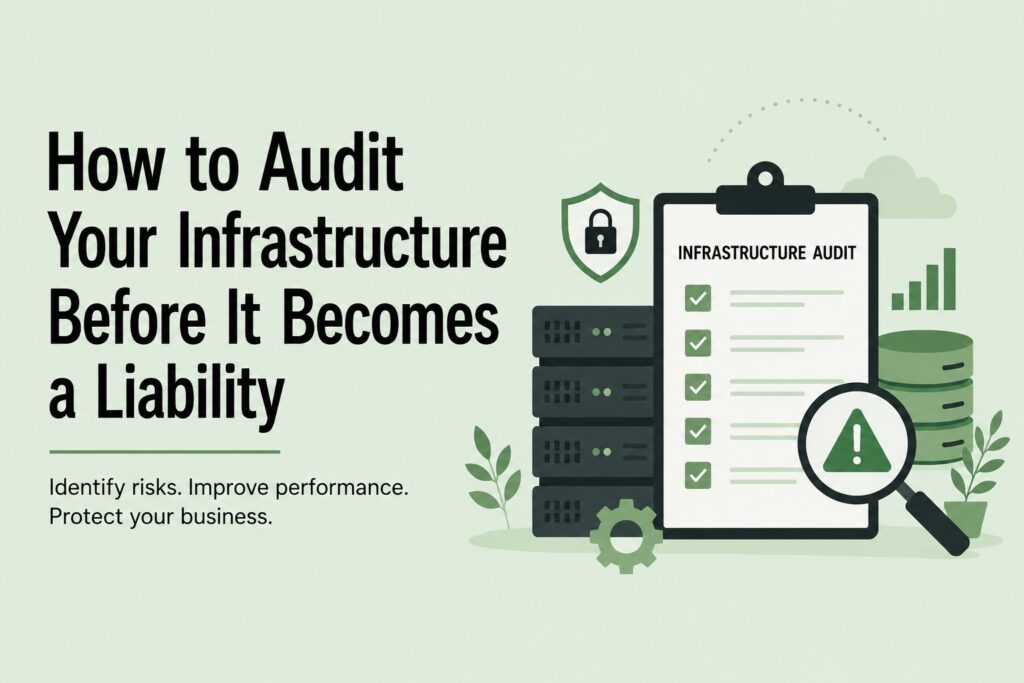
The purpose of an infrastructure audit is straightforward: identify weaknesses before they become liabilities. Whether those liabilities appear as downtime, security incidents, performance bottlenecks, compliance concerns, or escalating operating costs, the outcome is the same. Problems discovered early are usually manageable. Problems discovered during an outage rarely are.
Why Infrastructure Risk Often Goes Unnoticed
One of the greatest challenges in infrastructure management is that deterioration rarely announces itself. Servers do not send warnings that they are becoming financial liabilities. Storage systems do not notify executives that performance is gradually eroding customer experience. Aging hardware continues operating right up until the moment it doesn’t.
This creates a dangerous illusion of stability. If applications remain online and support tickets remain manageable, organizations naturally assume their infrastructure is healthy. Yet beneath the surface, risks may be accumulating. Utilization levels slowly increase. Backup procedures become outdated as environments evolve. Documentation falls behind reality. Access permissions expand over time and are rarely reviewed. New applications are deployed while older dependencies remain forgotten but critical.
Many organizations discover these issues only after an incident forces them into an investigation. Unfortunately, by then the audit becomes reactive rather than proactive.
The reality is that infrastructure should be reviewed with the same discipline applied to financial controls, operational processes, and strategic planning. No responsible organization would wait for an accounting failure before reviewing financial controls. Infrastructure deserves the same level of scrutiny because it increasingly supports every critical business function.
The Hidden Costs of Infrastructure Liabilities
When executives think about infrastructure risk, downtime is usually the first concern that comes to mind. Downtime certainly matters, but it is often only the final symptom of deeper issues that have existed for months or even years.
A server environment operating near capacity may not experience an outage, yet application responsiveness gradually declines. Customer-facing systems become slower. Employees lose productivity. Development teams spend more time troubleshooting than innovating. Revenue opportunities are delayed because infrastructure limitations prevent rapid deployment of new services. These costs rarely appear on invoices, but they affect profitability nonetheless.
We explored similar concepts in our article on How to Measure Infrastructure ROI Beyond Uptime, where infrastructure value extends far beyond simple availability metrics. A server that remains online while delivering inconsistent performance can still create significant business friction. Likewise, our discussion on How to Calculate the Real Cost of Downtime Before It Happens demonstrates that the true financial impact of infrastructure issues often extends far beyond the duration of the outage itself.
Infrastructure liabilities also have a habit of compounding. A storage bottleneck creates application delays. Application delays increase support requests. Support requests consume staff resources. Staff resources become unavailable for strategic initiatives. What began as a technical issue ultimately becomes a business issue.
What a Comprehensive Infrastructure Audit Should Examine
A meaningful audit starts with visibility. Surprisingly, many organizations struggle to produce a complete inventory of their infrastructure assets. Servers, storage platforms, networking equipment, cloud resources, administrative accounts, software dependencies, backup systems, and monitoring tools should all be included in the review. If an organization cannot clearly identify what it owns and depends upon, assessing risk becomes nearly impossible.
Once visibility is established, attention should shift toward performance and capacity. Organizations should evaluate utilization trends over time rather than relying solely on current metrics. A server operating at acceptable levels today may be on a trajectory that creates problems six months from now. Capacity planning is most effective when it anticipates growth rather than reacting to it after performance begins to suffer.
This concept aligns closely with our article on How to Build a Dedicated Server Capacity Plan That Scales With Business Growth, where long-term forecasting becomes just as important as current utilization. Infrastructure audits should determine not only whether systems meet today’s requirements, but whether they will continue supporting tomorrow’s objectives.
Storage architecture deserves equal attention. Many businesses focus heavily on processors and memory while overlooking storage performance. Yet modern applications frequently depend on storage latency, throughput, and redundancy. A review of storage design often reveals opportunities for significant performance improvements without requiring major infrastructure investments. Organizations evaluating these areas may benefit from our article on How to Choose the Right Storage Architecture for Modern Applications.
Security and access controls should also receive careful scrutiny. Administrative privileges, service accounts, remote access policies, patch management practices, and authentication controls all contribute to overall infrastructure risk. In many cases, vulnerabilities originate not from sophisticated attacks but from simple operational oversights that accumulate over time.
Finally, recovery readiness must be assessed honestly. Backups are important, but backups alone do not guarantee recovery. Organizations should verify that recovery procedures are documented, tested, and capable of meeting business requirements. As discussed in How to Build a Dedicated Server Backup Strategy Beyond RAID, the ability to restore data is only one part of a broader disaster recovery strategy.
Comparing Healthy Infrastructure to Emerging Liability
| Audit Area | Healthy Infrastructure Environment | Infrastructure Becoming a Liability |
|---|---|---|
| Hardware Lifecycle | Supported, modern systems with replacement plans | Aging platforms approaching end-of-life |
| Capacity Management | Growth forecasts and utilization tracking | Reactive upgrades after performance issues |
| Storage Architecture | Balanced performance and redundancy | Persistent bottlenecks and growing latency |
| Security Controls | Regular access reviews and patching | Excessive permissions and inconsistent updates |
| Backup & Recovery | Tested recovery procedures | Untested backups and unclear recovery objectives |
| Documentation | Current and maintained records | Missing knowledge and undocumented dependencies |
| Monitoring | Proactive alerting and trend analysis | Reactive troubleshooting after incidents |
Dedicated Infrastructure and Risk Reduction
As organizations mature, many discover that shared environments introduce limitations that complicate auditing and long-term planning. Resource contention, inconsistent performance, and limited visibility can make it difficult to establish reliable performance baselines or predict future capacity requirements.
This is one reason many growing organizations transition to dedicated infrastructure. Solutions such as ProlimeHost’s Dedicated Server Hosting provide greater control over hardware resources, performance consistency, security policies, and long-term planning. When infrastructure becomes a critical business asset rather than a commodity service, visibility and predictability become increasingly valuable.
The same principle applies to AI and machine learning environments. Businesses deploying inference, training, or data-intensive workloads frequently require dedicated GPU resources to ensure consistent performance and eliminate multi-tenant variability. ProlimeHost’s GPU Dedicated Servers are designed specifically for these demanding workloads where performance predictability directly impacts operational outcomes.
Infrastructure Audits as a Business Discipline
The most successful organizations no longer view infrastructure audits as occasional technical projects. They view them as ongoing business disciplines that support operational resilience, financial planning, and strategic growth.
A comprehensive audit creates clarity. It identifies aging assets before they fail. It reveals capacity constraints before they affect customers. It uncovers security weaknesses before they become incidents. Most importantly, it transforms infrastructure decisions from reactive responses into informed strategic choices.
That distinction matters. Organizations that operate reactively often spend more while achieving less. Organizations that plan proactively tend to reduce risk, improve performance, and maintain greater control over costs.
Infrastructure should be enabling growth, not quietly accumulating liabilities in the background.
Board / Audit Committee Takeaway
From a governance perspective, infrastructure audits are not merely operational exercises. They provide visibility into technology risk exposure, recovery readiness, vendor dependencies, and financial liabilities that can directly affect business continuity and shareholder value.
Frequently Asked Questions
How often should an infrastructure audit be performed?
Most organizations benefit from a comprehensive annual review combined with quarterly assessments of capacity, performance, and security metrics. Faster-growing businesses may need more frequent evaluations, especially if customer demand or application workloads are increasing rapidly.
Is an infrastructure audit only useful for large enterprises?
Not at all. Smaller organizations often gain even greater value because they typically operate with fewer resources and less margin for error. Identifying risks early can prevent costly disruptions that have a disproportionate impact on smaller teams.
What is the biggest mistake organizations make during audits?
Probably assuming that current functionality equals future readiness. Systems can appear healthy while underlying risks continue accumulating. A proper audit looks beyond current operations and evaluates long-term sustainability.
Do infrastructure audits always result in expensive upgrades?
Actually, no. Sometimes the most valuable outcome is confirmation that existing infrastructure remains properly sized and configured. Other times the audit identifies operational improvements that cost little but significantly reduce risk.
What’s the difference between monitoring and auditing?
Monitoring tells you what’s happening today. Auditing evaluates whether today’s environment will continue supporting tomorrow’s business requirements. Similar goals, different perspectives.
Conclusion
Most infrastructure problems have usually been sitting there for months. Sometimes years. Organizations just don’t notice them until something forces the issue. They develop quietly through aging hardware, capacity constraints, outdated recovery procedures, security drift, and architectural decisions that no longer align with business requirements. By the time those issues become visible, the costs associated with correcting them are often far greater than the costs of identifying them earlier.
A well-executed infrastructure audit provides something every organization needs but rarely has enough of: visibility. Visibility into performance. Visibility into risk. Visibility into future requirements. Most importantly, visibility into the decisions that should be made before circumstances force those decisions upon the business.
The question is not whether infrastructure risk exists. Every environment contains some level of risk. The question is whether your organization understands where that risk resides and what should be done about it.
Ready to Evaluate Your Infrastructure?
Whether you’re planning future growth, modernizing legacy systems, improving performance predictability, or preparing AI infrastructure for production workloads, ProlimeHost can help design infrastructure solutions aligned with your business objectives.
Learn more about our Dedicated Server Hosting solutions at https://www.prolimehost.com/dedicated-server-hosting/ and our GPU Dedicated Servers at https://www.prolimehost.com/gpu-dedicated-servers/.
For personalized guidance, contact our team today.
Author: Steve Bloemer
Director of Sales & Operations
ProlimeHost
Phone: 877-477-9454
Website: https://www.prolimehost.com