Executive Summary
Most businesses can tell you exactly what they spend on infrastructure every month. They know their hosting costs, software subscriptions, cloud invoices, licensing fees, and support contracts. Ask a different question, however, and the room often goes quiet.
What would one hour of downtime cost your business?
The answer is usually much larger than expected.
Many organizations calculate downtime only after an outage occurs. They total lost sales, estimate the recovery effort, and move on. Unfortunately, by that point the damage has already spread beyond the immediate incident. Customers have become frustrated, employees have lost productivity, projects have been delayed, and future revenue opportunities may have disappeared altogether.
The organizations that consistently avoid these surprises take a different approach. They calculate the financial impact of downtime before it happens. They understand how infrastructure performance influences business performance. They identify risks before those risks become incidents.
Understanding the true cost of downtime transforms infrastructure from a technical discussion into a business strategy discussion. Once leadership understands the financial exposure associated with outages, investments in reliability, capacity planning, redundancy, and disaster recovery become much easier to justify.
The Problem With Traditional Downtime Calculations
Most downtime estimates begin and end with revenue.
An e-commerce company generating $5,000 per hour experiences a two-hour outage. The conclusion seems obvious. Downtime cost $10,000.
But did it?
What about employees who couldn’t access critical systems? What about support teams overwhelmed by customer inquiries? What about abandoned transactions, delayed projects, missed opportunities, and customers who quietly decided never to return?
These costs rarely appear in post-incident reports, yet they often represent the majority of the financial damage.
Think about it for a moment. If a customer encounters a failed checkout process during an outage, do they always come back later? Sometimes. Often they simply purchase from a competitor instead.
The revenue lost during the outage is measurable. The future revenue from that customer may never be measured at all.
This is why the most accurate downtime calculations look far beyond immediate sales losses and examine the broader impact on the organization.
Downtime Is Often the Result of Earlier Infrastructure Decisions
Interestingly, downtime rarely begins at the moment systems fail.
In many cases, the warning signs appear months earlier. Applications become slower. Storage performance begins to degrade. Resource utilization steadily increases. Capacity planning falls behind business growth.
Eventually, what started as a performance issue becomes a service interruption.
This is precisely why proactive infrastructure planning matters. Organizations that regularly evaluate growth trends and resource requirements are far less likely to encounter unexpected outages. Our guide on How to Build a Dedicated Server Capacity Plan That Scales With Business Growth (https://www.prolimehost.com/blogs/dedicated-server-capacity-planning-business-growth/) explores how forecasting future demand can prevent many infrastructure failures before they occur.
Downtime is often viewed as a technical event. More accurately, it is frequently the final stage of a planning problem.
The Five Components of Real Downtime Cost
To calculate downtime accurately, organizations should evaluate five distinct cost categories.
The first is direct revenue loss. This is the easiest number to identify because it represents transactions, subscriptions, bookings, or sales that could not occur while systems were unavailable.
The second category is employee productivity loss. Employees continue receiving compensation even when the systems they depend on become inaccessible. Across multiple departments, lost productivity can quickly exceed direct revenue losses.
Third comes support and remediation costs. Technical teams stop planned work and shift into emergency response mode. Customer service teams handle increased call volumes. Managers become involved. Escalations occur. Every minute spent responding to an outage represents time not spent on revenue-generating initiatives.
The fourth category involves customer confidence. While difficult to measure precisely, reputation damage often creates long-lasting consequences. Customers may forgive a single incident. Repeated disruptions tell a different story.
Finally, organizations must consider customer attrition. Some customers leave after outages and never return. Their future revenue disappears from the pipeline without appearing on any downtime report.
When all five categories are considered together, the actual cost of downtime is often several times higher than initial estimates.
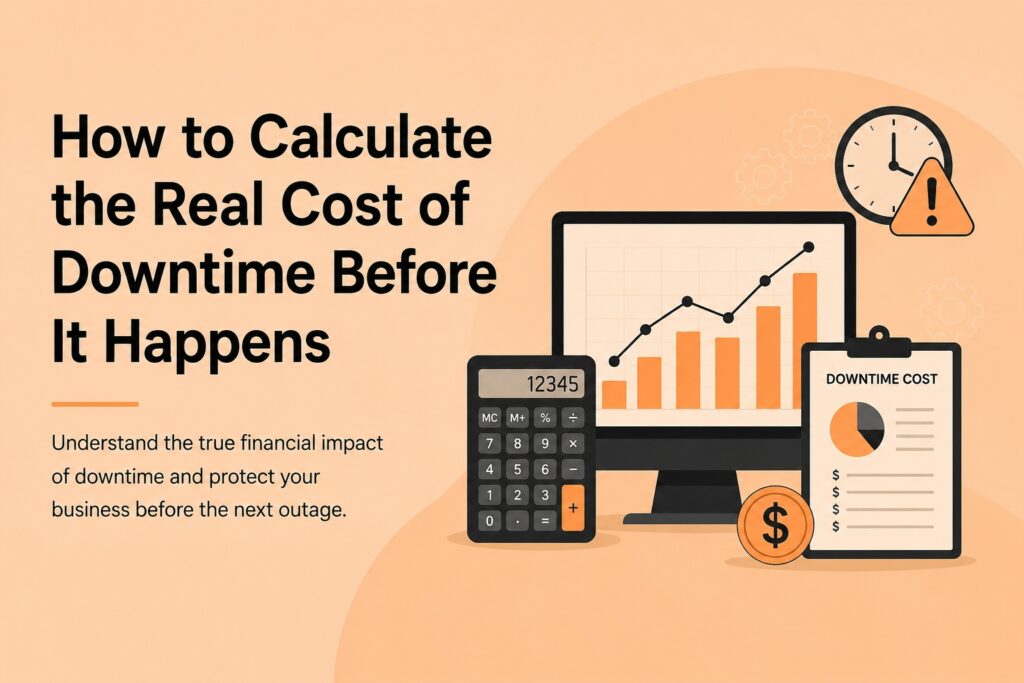
A Practical Downtime Calculation Framework
While every organization operates differently, the following framework provides a useful starting point.
| Cost Category | Estimated Hourly Impact |
|---|---|
| Lost Revenue | $5,000 |
| Employee Productivity | $2,000 |
| Customer Support Costs | $750 |
| Recovery & Remediation | $1,250 |
| Customer Churn Risk | $3,000 |
| Total Estimated Cost Per Hour | $12,000 |
Under this model, a three-hour outage would create an estimated business impact of $36,000.
That figure surprises many executives because it shifts the conversation. Instead of asking whether infrastructure improvements are expensive, the question becomes whether avoiding a $36,000 loss is worth the investment.
Usually, the answer becomes obvious rather quickly.
Why Backup Strategies Matter More Than Most Companies Realize
One of the biggest misconceptions in IT is that RAID equals backup.
It doesn’t.
RAID improves availability and protects against certain hardware failures, but it does not protect against accidental deletion, ransomware, corruption, application errors, or many other causes of downtime.
Organizations that discover this distinction during a crisis often learn it the hard way.
A comprehensive backup strategy dramatically reduces downtime exposure because it shortens recovery times and minimizes data loss. Businesses evaluating their resilience posture should review our article on How to Build a Dedicated Server Backup Strategy Beyond RAID (https://www.prolimehost.com/blogs/how-to-build-a-dedicated-server-backup-strategy-beyond-raid/), which explores why modern recovery planning requires far more than redundant disks.
Recovery speed directly influences downtime cost.
The faster systems can be restored, the lower the financial impact becomes.
The Hidden Role of Storage Performance
Storage architecture rarely receives attention from executive teams until something goes wrong.
Yet storage performance often determines whether applications remain responsive during periods of high demand. Slow databases, overloaded storage arrays, and inefficient data architectures frequently create bottlenecks that impact customer experience long before systems become completely unavailable.
Organizations planning for growth should understand how storage decisions influence uptime, performance, and scalability. Our article on How to Choose the Right Storage Architecture for Modern Applications (https://www.prolimehost.com/blogs/how-to-choose-the-right-storage-architecture-for-modern-applications/) explores how storage infrastructure affects business outcomes far beyond simple capacity requirements.
After all, systems do not have to be completely offline to create downtime-like consequences.
If users abandon an application because it takes too long to respond, the business impact can look remarkably similar.
Downtime During Migrations: A Risk That Can Be Controlled
Many organizations delay infrastructure upgrades because they fear migration-related downtime.
Ironically, postponing necessary improvements often creates greater risk than performing the migration itself.
Modern migration planning allows businesses to move workloads with minimal disruption when proper procedures are followed. Our guide on How to Migrate Cloud to Dedicated Servers Without Downtime (https://www.prolimehost.com/blogs/how-to-migrate-cloud-to-dedicated-servers-2026/) explains how organizations can reduce migration risk while improving performance, predictability, and long-term cost control.
Sometimes the greatest downtime risk comes from maintaining infrastructure that has already outgrown its intended purpose.
Benchmarking Helps Identify Problems Before They Become Outages
Many organizations don’t discover performance limitations until customers begin complaining.
By then, the damage is already underway.
Regular benchmarking helps identify bottlenecks before they evolve into operational disruptions. CPU performance, memory utilization, storage throughput, network latency, and application responsiveness should all be evaluated regularly.
Our article on Benchmarking Dedicated Servers Properly in 2026 (https://www.prolimehost.com/blogs/benchmarking-dedicated-servers-2026/) explains how businesses can establish meaningful performance baselines and detect emerging issues before they affect users.
The most affordable outage is the one that never happens.
Reactive Versus Proactive Infrastructure Strategies
| Factor | Reactive Approach | Proactive Approach |
| Downtime Planning | After outages occur | Before outages occur |
| Capacity Management | Limited forecasting | Continuous evaluation |
| Business Risk Visibility | Unclear | Quantified |
| Emergency Spending | Frequent | Reduced |
| Customer Experience | Variable | Consistent |
| Revenue Protection | Reactive | Strategic |
Organizations that proactively calculate downtime exposure generally make more confident infrastructure decisions because they understand the financial implications of inaction.
Why Dedicated Infrastructure Reduces Downtime Risk
Infrastructure reliability begins with resource availability.
Shared environments can introduce unpredictable performance fluctuations, noisy-neighbor issues, and resource contention. As workloads grow more demanding, organizations often transition to dedicated environments that provide greater control and consistency.
ProlimeHost’s Dedicated Server Hosting platform offers businesses dedicated resources designed for performance-sensitive applications:
For AI, machine learning, rendering, and other high-performance workloads, ProlimeHost’s GPU Dedicated Servers provide isolated compute environments optimized for demanding applications:
The objective isn’t simply achieving uptime.
The objective is creating predictable business outcomes.
Frequently Asked Questions
Is downtime cost really different for every company?
Absolutely. A SaaS platform, online retailer, healthcare provider, and financial institution may all experience very different consequences from the same outage duration.
Should customer churn be included in downtime calculations?
Yes. In fact, it is often one of the largest costs even though it is among the most difficult to measure accurately.
How often should businesses evaluate downtime exposure?
At minimum annually. Fast-growing organizations should review downtime risk much more frequently because infrastructure requirements change rapidly.
Is uptime the only metric that matters?
Not really. A system can remain technically online while performing poorly enough to frustrate users and reduce revenue.
What’s the biggest mistake organizations make?
Honestly? Assuming downtime only affects revenue. Productivity losses, customer confidence, and future business opportunities often represent larger costs than immediate sales losses.
Final Thoughts
The true cost of downtime extends far beyond lost transactions. It affects productivity, customer relationships, brand reputation, future revenue, and organizational momentum. Businesses that understand these costs before outages occur gain a significant advantage because they can make informed decisions about infrastructure investments before those investments become urgent.
The smartest infrastructure strategy is rarely the cheapest one.
It is the strategy that best protects revenue, customer trust, and business continuity.
If you’re evaluating infrastructure reliability, capacity planning, disaster recovery, dedicated hosting, or GPU-powered workloads, the ProlimeHost team can help you design an environment that minimizes risk while supporting long-term growth.
Author: Steve Bloemer
Director of Sales & Operations
ProlimeHost
Contact Information
ProlimeHost
Website: https://www.prolimehost.com
Dedicated Servers: https://www.prolimehost.com/dedicated-server-hosting/
GPU Dedicated Servers: https://www.prolimehost.com/gpu-dedicated-servers/
Sales: 877-477-9454