Executive Summary
Many organizations spend years optimizing applications, improving security, and increasing performance, yet surprisingly few devote the same attention to the overall structure of their infrastructure environment. As businesses grow, servers are added, cloud instances multiply, development environments remain active long after projects conclude, and temporary solutions quietly become permanent fixtures. The result is infrastructure sprawl: a collection of systems that individually serve a purpose but collectively create unnecessary complexity, operational inefficiencies, and escalating costs.
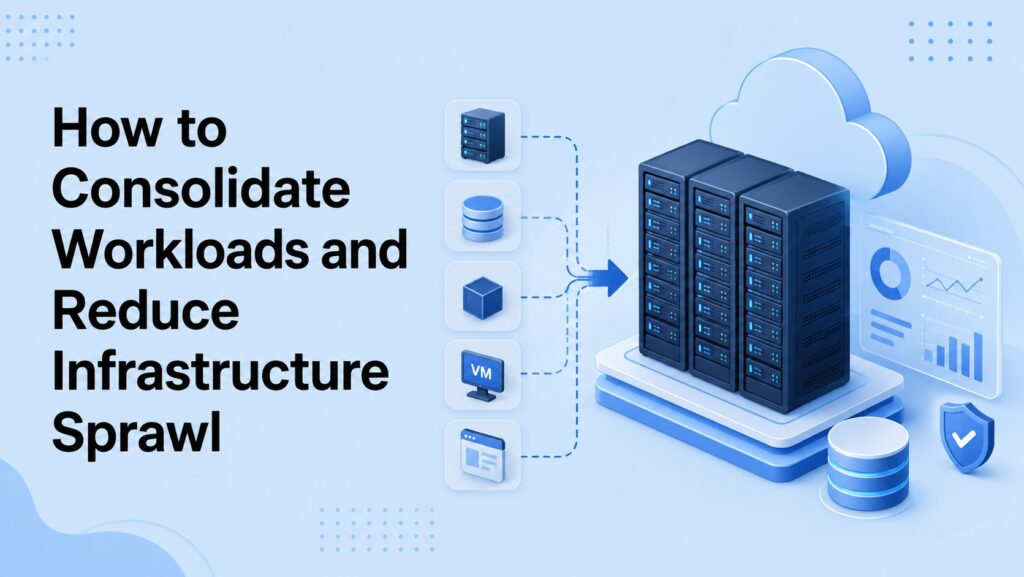
Reducing infrastructure sprawl is not simply a cost-cutting exercise. When approached strategically, workload consolidation can improve performance, strengthen security, simplify management, increase resource utilization, and provide greater financial predictability. Organizations that successfully consolidate workloads often discover that they are not merely reducing server counts. They are creating an infrastructure platform that is easier to manage, easier to scale, and better aligned with business objectives.
The challenge, of course, is knowing where to begin. Consolidating workloads without disrupting operations requires careful planning, accurate performance data, and a clear understanding of future growth requirements. Done correctly, however, consolidation can transform infrastructure from a growing liability into a competitive advantage.
How Infrastructure Sprawl Happens
Very few companies intentionally create infrastructure sprawl. In most cases, it develops gradually through a series of reasonable decisions made over time.
A new customer-facing application requires dedicated resources. A development team requests a testing environment. A department deploys specialized software that receives its own server. An acquisition introduces an entirely separate technology stack. Each decision makes sense at the time, particularly when teams are focused on delivering projects quickly rather than optimizing long-term infrastructure efficiency.
Years later, the environment often looks very different than anyone originally envisioned. Organizations may find themselves supporting multiple hardware generations, overlapping software platforms, isolated storage systems, and workloads running at a fraction of available capacity. Infrastructure becomes fragmented, making it increasingly difficult to forecast expenses, maintain consistent security standards, or efficiently allocate resources.
Perhaps the most significant challenge is that infrastructure sprawl often remains invisible until costs begin rising faster than expected. At that point, leadership starts asking difficult questions. Why are infrastructure expenses increasing despite relatively stable business growth? Why are management requirements expanding? Why does adding new applications seem more complicated than it did several years ago?
The answer is frequently not insufficient infrastructure. It is too much infrastructure operating inefficiently.
The Hidden Cost of Fragmentation
Most organizations evaluate infrastructure costs by examining monthly invoices, hardware purchases, or cloud service bills. While those figures are important, they rarely capture the full financial impact of infrastructure sprawl.
Every additional server introduces management overhead. Every isolated workload requires monitoring, patching, backup protection, security oversight, and operational support. As infrastructure becomes more fragmented, technical teams spend increasing amounts of time maintaining existing systems rather than supporting innovation and growth initiatives.
The impact extends beyond IT departments. Finance teams face greater forecasting uncertainty. Security teams must protect a larger attack surface. Compliance requirements become more difficult to satisfy. Disaster recovery planning becomes increasingly complex as workloads spread across multiple environments.
There is also a performance cost that many organizations overlook. Underutilized systems often coexist alongside overloaded systems because resources cannot be efficiently shared. One server may operate at 15 percent utilization while another struggles under heavy demand. This imbalance creates unnecessary hardware expenditures while simultaneously limiting performance.
Organizations that evaluate the true cost of infrastructure frequently discover similar patterns discussed in our article, “How to Calculate the Cost of Infrastructure Technical Debt.”
Technical debt and infrastructure sprawl often develop together, creating operational challenges that compound over time.
Why Workload Consolidation Matters Now
The economics of modern infrastructure have changed dramatically over the past decade. Today’s enterprise servers deliver significantly more processing power, memory capacity, storage performance, and virtualization capabilities than systems deployed only a few years ago.
This shift creates an opportunity. Organizations can often consolidate multiple workloads onto fewer, more powerful systems without sacrificing performance. In many cases, performance actually improves because newer hardware delivers faster processors, higher-speed storage, and more efficient resource allocation.
At the same time, economic pressures continue to increase. Executive teams are asking technology leaders to accomplish more with existing budgets. Boards and investors want predictable operating costs. Finance departments are examining infrastructure spending with greater scrutiny than ever before.
Against this backdrop, workload consolidation becomes more than a technical initiative. It becomes a business strategy focused on improving operational efficiency and maximizing return on infrastructure investments.
The question is no longer whether consolidation is possible. The question is whether organizations can afford not to pursue it.
Building a Consolidation Strategy That Supports Growth
One of the most common mistakes organizations make is treating consolidation as a purely technical project. Reducing server counts may generate short-term savings, but if future growth requirements are ignored, today’s optimization effort can become tomorrow’s capacity problem.
Successful consolidation begins with understanding where the business is heading rather than simply analyzing current workloads. Revenue growth projections, customer acquisition plans, application roadmaps, and emerging technology initiatives should all influence consolidation decisions.
This is where capacity planning becomes essential. Organizations that accurately forecast future requirements can consolidate aggressively without creating resource constraints. Those that focus only on current utilization often discover they must expand infrastructure again much sooner than expected.
Our article, “How to Build a Dedicated Server Capacity Plan That Scales With Business Growth,” explores this concept in greater detail:
Similarly, organizations evaluating long-term infrastructure investments should review “How to Build an Infrastructure Budget That Survives Growth”:
Together, these planning exercises help ensure that consolidation supports future growth rather than merely reducing today’s costs.
Identifying the Best Candidates for Consolidation
Not every workload belongs on shared infrastructure. Certain applications have compliance requirements, performance sensitivities, or licensing restrictions that justify dedicated resources. The goal is not to consolidate everything. The goal is to consolidate intelligently.
Workloads that often benefit from consolidation include development environments, internal business applications, lightly utilized databases, reporting systems, collaboration platforms, and many virtualized workloads that rarely approach peak resource utilization.
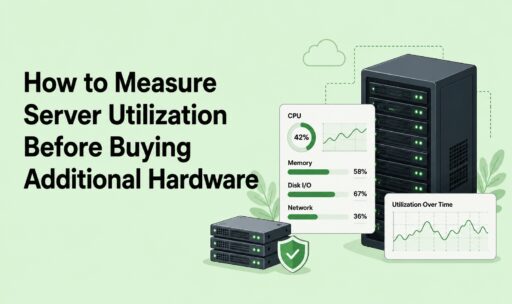
Performance benchmarking plays a critical role in this evaluation process. Without accurate utilization data, organizations risk making decisions based on assumptions rather than facts. A server that appears busy may actually spend most of its time waiting on storage operations. Conversely, a lightly utilized system may support a workload that experiences significant resource spikes during critical business periods.
Organizations seeking greater visibility into infrastructure performance should review:
The insights gained from benchmarking frequently reveal consolidation opportunities that were previously hidden from view.
Storage Architecture Can Make or Break Consolidation Efforts
While processing power often receives the most attention during consolidation projects, storage architecture frequently determines success or failure.
Multiple workloads sharing the same infrastructure also share storage resources. If storage performance is not properly designed, bottlenecks can emerge even when CPU and memory utilization remain low. Databases, analytics platforms, backups, and application workloads can compete for I/O resources in ways that negatively affect performance.
This is why storage planning deserves equal attention during consolidation initiatives. High-performance NVMe storage, proper workload segmentation, and thoughtful capacity planning can dramatically improve consolidated environment performance while avoiding unexpected bottlenecks.
Organizations evaluating storage strategies should also review:
Storage may not always receive boardroom attention, but it often determines whether consolidation delivers the expected business outcomes.
Dedicated Servers as a Consolidation Platform
As organizations evaluate consolidation opportunities, many discover that modern dedicated servers provide an ideal balance between performance, control, and cost efficiency.
Unlike fragmented environments consisting of numerous aging systems, modern dedicated servers offer significant processing density, large memory capacities, high-performance NVMe storage, and predictable resource allocation. This allows multiple workloads to operate efficiently while maintaining consistent performance.
Organizations looking to modernize infrastructure while reducing sprawl frequently deploy consolidated environments on ProlimeHost Dedicated Servers:
For organizations supporting AI applications, machine learning workloads, rendering environments, and accelerated analytics platforms, GPU-enabled infrastructure can provide even greater consolidation opportunities:
The objective is not simply to operate fewer servers. It is to generate more business value from every server deployed.
Comparison Chart: Fragmented vs Consolidated Infrastructure
| Infrastructure Factor | Fragmented Environment | Consolidated Environment |
|---|---|---|
| Server Count | High | Lower |
| Resource Utilization | Inconsistent | Optimized |
| Administrative Overhead | High | Reduced |
| Security Management | Complex | Simplified |
| Capacity Forecasting | Difficult | Predictable |
| Disaster Recovery Planning | More Complex | Easier to Manage |
| Operating Costs | Higher | Lower |
| Performance Visibility | Limited | Improved |
| Scalability | Reactive | Strategic |
Frequently Asked Questions
Is workload consolidation primarily about reducing costs?
Cost savings are certainly a benefit, but they are rarely the most valuable outcome. Most organizations find that improved operational efficiency, stronger security management, and simplified infrastructure governance deliver even greater long-term value.
How much server reduction should we expect?
There is no universal answer. Some organizations achieve modest reductions while others eliminate half of their server footprint. The determining factors are workload utilization, hardware age, performance requirements, and overall infrastructure architecture.
Can consolidation improve performance?
Absolutely. In fact, it often does. Consolidating workloads onto newer hardware frequently provides faster processors, higher-speed storage, and more efficient resource allocation than fragmented legacy environments.
Should cloud workloads be included in consolidation efforts?
Usually, yes. Although every environment is unique, cloud instances are often among the first areas where resource inefficiencies emerge. Reviewing cloud utilization alongside on-premises infrastructure provides a more complete view of consolidation opportunities.
How often should organizations review infrastructure sprawl?
There isn’t a perfect answer. Annual reviews are generally a good starting point, though rapidly growing organizations may benefit from semi-annual assessments. Waiting until costs become problematic usually means opportunities were missed months, if not years, earlier.
Conclusion
Infrastructure sprawl is rarely the result of poor decisions. More often, it is the accumulation of good decisions made independently over time. The challenge is that what worked for individual projects may no longer serve the broader needs of the organization.
By taking a strategic approach to workload consolidation, organizations can reduce operational complexity, improve infrastructure utilization, strengthen security, and create a more predictable cost structure. Perhaps most importantly, they can position infrastructure as an asset that supports growth rather than a collection of systems that continually demands additional resources.
In an era where efficiency matters as much as innovation, simplifying infrastructure is no longer just an IT initiative. It is a business imperative.
My Thoughts
If your organization is struggling with infrastructure sprawl, rising operational costs, or underutilized resources, ProlimeHost can help evaluate your environment and identify opportunities for consolidation, modernization, and long-term growth.
Learn more about our Dedicated Server solutions:
Explore GPU Dedicated Servers:
Or contact our team today to discuss your infrastructure goals.
ProlimeHost
877-477-9454
Author
Steve Bloemer is Director of Sales & Operations at ProlimeHost and has worked in the hosting and infrastructure industry since 2000. He helps organizations evaluate dedicated server, GPU infrastructure, cloud migration, and long-term capacity planning strategies with a focus on performance, scalability, and cost predictability.
Today, Steve works with organizations ranging from startups and SaaS providers to established enterprises seeking practical infrastructure solutions that align with both technical requirements and business objectives. His experience spans dedicated hosting, infrastructure modernization, disaster recovery planning, performance optimization, budgeting, and growth forecasting.