Executive Summary
One of the most common infrastructure mistakes organizations make is waiting until performance problems appear before planning for growth. A website begins slowing down, application response times increase, databases become sluggish, or users start submitting support tickets. Only then does the discussion turn toward upgrading servers or expanding capacity.
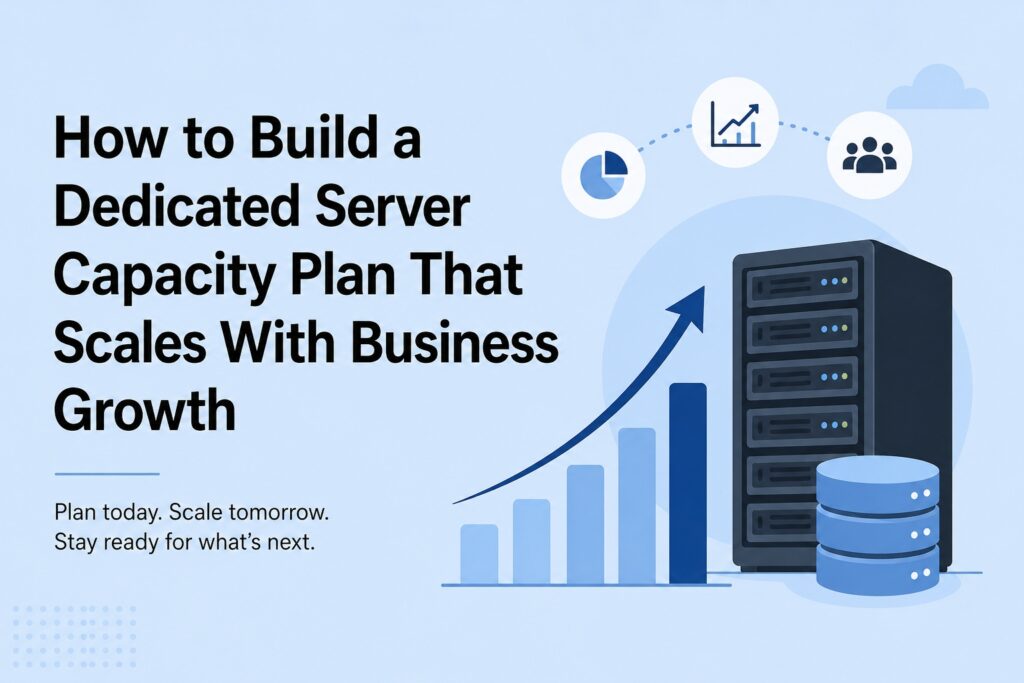
The reality is that successful organizations rarely scale by reacting. They scale by anticipating. Just as businesses forecast sales, staffing requirements, inventory levels, and operating expenses, they should also forecast infrastructure demand. A dedicated server capacity plan provides a roadmap for growth, helping organizations understand when additional resources will be needed, where bottlenecks are likely to emerge, and how infrastructure investments can support long-term business objectives without unnecessary spending.
Building a capacity plan is not simply about purchasing larger servers. It is about creating a framework that aligns technology decisions with business growth. When done correctly, capacity planning reduces risk, improves performance consistency, and allows organizations to expand confidently without constantly scrambling to keep pace with demand.
Why Capacity Planning Often Gets Overlooked
Most businesses begin with infrastructure that comfortably supports their initial workload. Applications perform well, websites respond quickly, and resource utilization appears healthy. Because everything is working as expected, infrastructure planning often receives little attention. After all, why fix something that is not broken?
The challenge is that infrastructure rarely fails all at once. Capacity-related problems usually develop gradually. A server that operated at 25% utilization a year ago may now regularly peak above 70%. Database storage may continue growing month after month while performance slowly declines. Customer traffic may increase steadily until network congestion begins affecting response times during busy periods. These changes often happen slowly enough that they are overlooked until users begin noticing the consequences.
What makes the situation particularly difficult is that business growth rarely follows a predictable path. Some organizations experience steady expansion over several years, while others encounter sudden spikes caused by successful marketing campaigns, product launches, seasonal demand, or unexpected market opportunities. Without a capacity planning process in place, infrastructure becomes reactive rather than strategic.
Capacity Planning Starts With Business Forecasting
Many IT teams approach capacity planning from the wrong direction. The conversation often begins with hardware specifications rather than business objectives. Questions such as how many CPU cores are needed, how much memory should be installed, or how much storage capacity should be purchased dominate the discussion.
While those questions matter, they are not the starting point.
A more effective approach begins by understanding where the business expects to be six months, one year, or even three years from now. How many additional customers are expected? How much data will be generated? Will new applications be deployed? Are AI initiatives being planned? Is geographic expansion likely? These business objectives ultimately determine infrastructure requirements far more accurately than technical assumptions alone.
Infrastructure exists to support business operations. When capacity planning begins with business forecasting, technology investments become easier to justify and significantly more effective. Instead of guessing future requirements, organizations can build infrastructure strategies that directly support projected growth.
Establishing a Baseline Before Forecasting Growth
Before any organization can determine where it needs to go, it must first understand where it currently stands.
This sounds obvious, yet many businesses lack detailed visibility into resource utilization across their infrastructure. They may know whether a server is functioning properly, but they often do not know how quickly storage consumption is increasing, whether memory utilization has changed over the past year, or how network traffic trends compare to previous quarters.
Effective capacity planning begins by establishing a baseline across key infrastructure components. CPU utilization, memory consumption, storage growth, storage latency, network throughput, application response times, and database performance should all be measured consistently over time. Historical trends provide the foundation upon which accurate forecasts can be built.
Organizations are often surprised by what these measurements reveal. Storage growth may be occurring much faster than anticipated. Backup windows may be expanding. Certain applications may consume significantly more resources than others. Sometimes the bottleneck everyone assumes exists turns out not to be the problem at all.
Understanding That Growth Creates Different Types of Demand
Not all growth affects infrastructure in the same way.
A company that stores large amounts of data may face storage challenges long before compute resources become constrained. A virtualization platform may encounter memory limitations despite having abundant CPU capacity. An AI environment may require dramatic increases in storage throughput while traditional server metrics remain relatively stable.
This is one reason capacity planning can be difficult. There is no universal formula that applies equally to every workload. Organizations must understand the specific characteristics of their applications and services.
For example, an e-commerce platform preparing for holiday traffic may focus heavily on network capacity and database performance. A software-as-a-service provider might prioritize compute scalability and application responsiveness. Meanwhile, organizations deploying machine learning models often discover that storage architecture becomes just as important as processing power.
Growth creates demand, but the type of demand varies considerably depending on the business model and workload characteristics.
Building Multiple Growth Scenarios
One of the most effective techniques in capacity planning is developing multiple growth scenarios rather than relying on a single forecast.
Business projections are rarely perfect. Markets change. Customer acquisition rates fluctuate. New opportunities emerge unexpectedly. Capacity plans built around only one prediction can quickly become obsolete when circumstances change.
A more practical approach involves creating conservative, expected, and aggressive growth models. This allows organizations to evaluate how infrastructure requirements would evolve under different business conditions and prepare accordingly.
| Growth Scenario | Expected Business Growth | Infrastructure Impact |
|---|---|---|
| Conservative | 10% Annual Growth | Minor resource expansion |
| Expected | 25% Annual Growth | Additional compute, memory, and storage |
| Aggressive | 50%+ Annual Growth | New servers, network upgrades, expanded architecture |
This approach transforms capacity planning from a guessing exercise into a risk management strategy. Leadership gains visibility into future requirements while maintaining flexibility to adapt as conditions change.
Identifying Bottlenecks Before They Become Problems
Every infrastructure environment has a weakest link.
Sometimes it is storage latency. Sometimes it is memory utilization. In other environments, network throughput becomes the limiting factor. The purpose of capacity planning is not simply to add more resources. It is to identify potential constraints before they impact customers, employees, or revenue.
This requires looking beyond average utilization metrics. Average numbers can be deceptive. A server that averages 40% CPU utilization may still experience frequent periods of saturation during peak demand. Likewise, network traffic may appear manageable overall while regularly exceeding comfortable thresholds during specific business cycles.
The organizations that scale most effectively are those that identify bottlenecks months before they become visible to end users. By addressing constraints proactively, they avoid the disruption and urgency that often accompany reactive upgrades.
Capacity Planning Is Also a Financial Strategy
Capacity planning is frequently viewed as a technical exercise, but its financial implications are equally important.
Underprovisioning infrastructure can result in lost productivity, customer dissatisfaction, and missed revenue opportunities. Overprovisioning, however, creates its own problems by tying up capital in resources that may never be fully utilized. Finding the right balance requires thoughtful analysis and ongoing evaluation.
This concept aligns closely with our recent articles on infrastructure ROI and cloud cost forecasting. The objective is not to maximize infrastructure spending or minimize spending. The objective is to maximize business value.
A well-designed capacity plan allows organizations to invest in infrastructure at the appropriate time, reducing both operational risk and financial waste. It transforms infrastructure from a reactive expense into a strategic asset that supports long-term growth.
Capacity Planning Should Be Continuous
One of the biggest misconceptions about capacity planning is that it is a project with a defined beginning and end.
In reality, capacity planning is an ongoing process. Infrastructure requirements evolve alongside the business. New applications are introduced. Customer behavior changes. Data volumes increase. Technologies mature. What was sufficient six months ago may no longer be appropriate today.
Organizations that review capacity metrics quarterly are generally better positioned to adapt to changing conditions than those that only evaluate infrastructure when problems arise. Regular reviews provide visibility into emerging trends and create opportunities to make adjustments before urgent action becomes necessary.
The goal is not perfection. Forecasts will never be flawless. The goal is maintaining enough visibility and flexibility to make informed decisions as circumstances evolve.
My Thoughts
Business growth should never be viewed as an infrastructure problem. It should be viewed as an opportunity. The challenge is ensuring that technology remains aligned with that growth every step of the way.
A dedicated server capacity plan provides the structure needed to achieve that alignment. By understanding current utilization, forecasting future demand, evaluating multiple growth scenarios, and identifying bottlenecks early, organizations can scale with confidence while maintaining predictable performance and cost control.
The companies that consistently outperform their competitors are often not those with the largest infrastructure budgets. More often, they are the ones that plan ahead. They understand their workloads, anticipate future requirements, and make infrastructure decisions based on data rather than assumptions.
In an increasingly competitive digital landscape, capacity planning is no longer just an IT responsibility. It is a business advantage.
Frequently Asked Questions
How far into the future should capacity planning extend?
Most organizations benefit from forecasting at least 12 to 24 months ahead. Longer forecasting horizons can be useful, but accuracy tends to decrease as projections move further into the future. Quarterly reviews help keep plans aligned with actual business conditions.
What is the most common capacity planning mistake?
Oddly enough, it is assuming that current performance guarantees future performance. Many businesses continue operating successfully right up until a resource constraint suddenly impacts users. Capacity planning is most valuable before problems appear.
How often should infrastructure capacity be reviewed?
Quarterly reviews are generally sufficient for many organizations. Businesses experiencing rapid growth, launching new services, or supporting AI workloads may benefit from monthly evaluations.
Is capacity planning only important for large enterprises?
Not at all. Smaller organizations often have less room for error because they typically operate with tighter budgets and fewer resources. Capacity planning can help prevent both overspending and unexpected performance issues.
Does capacity planning help reduce infrastructure costs?
In many cases, yes. Effective planning helps organizations purchase resources when they are needed rather than after problems emerge or long before they provide value. That balance can significantly improve infrastructure ROI.
Ready to Build Infrastructure That Grows With Your Business?
Whether you are planning for the next quarter or the next several years, ProlimeHost can help design dedicated server solutions that align with your growth objectives, performance requirements, and budget expectations.
Learn more about our Dedicated Servers:
Read related articles:
Contact ProlimeHost today:
Website: https://www.prolimehost.com
Phone: 877-477-9454
Sales: sa***@*********st.com
Author
Steve Bloemer
Director of Sales & Operations
ProlimeHost
Steve has spent more than a decade helping businesses deploy and scale dedicated server infrastructure, virtualization platforms, AI environments, and enterprise hosting solutions. His focus is helping organizations align technology investments with business growth while maintaining predictable performance, reliability, and long-term value.