Executive Summary
Many organizations buy additional servers for the wrong reason. Performance slows, users begin to complain, dashboards start showing occasional spikes, and the immediate reaction is to order more hardware. While that response feels logical, it is often expensive and unnecessary. In many environments, the real problem is not insufficient infrastructure capacity but a lack of visibility into how existing resources are actually being used.
Accurately measuring server utilization allows IT leaders to distinguish between genuine capacity shortages and operational inefficiencies. It provides the data needed to determine whether workloads should be optimized, consolidated, redistributed, or expanded. More importantly, it helps organizations avoid purchasing infrastructure that may sit partially idle for years. Before approving the next hardware budget request, businesses should first understand exactly how their servers are performing today and whether additional investment will truly solve the problem.
Why Utilization Should Be Measured Before Hardware Purchases
Technology teams often face pressure to resolve performance concerns quickly. When applications become sluggish or response times increase, management naturally asks whether more hardware is needed. Yet the answer is rarely that simple. A server showing occasional periods of high utilization may still have substantial unused capacity throughout the day. Likewise, a server operating comfortably at moderate utilization levels can experience performance issues caused by storage bottlenecks, poorly optimized applications, or inefficient database queries rather than resource exhaustion.
This distinction matters because infrastructure purchases are rarely isolated expenses. New hardware introduces acquisition costs, deployment costs, support requirements, software licensing considerations, monitoring overhead, and eventually replacement costs. Every additional server becomes part of a growing infrastructure footprint that must be maintained over time. Organizations that measure utilization carefully before expanding tend to make more informed decisions and often discover opportunities to increase efficiency without increasing spending.
The challenge is that utilization data is frequently misunderstood. Looking at a single dashboard or reviewing a weekly utilization average does not tell the entire story. Meaningful capacity planning requires a broader perspective that examines trends, peaks, growth rates, and workload behavior over time.
The Hidden Cost of Buying Capacity Too Early
One of the least discussed infrastructure expenses is overprovisioning. Purchasing hardware months or years before it is truly needed ties up capital that could be invested elsewhere in the business. For organizations focused on profitability and growth, unused infrastructure represents opportunity cost.
Consider a company that purchases three additional servers because utilization occasionally exceeds 80 percent during monthly reporting cycles. After deployment, the organization discovers that average utilization remains below 40 percent for most of the year. The hardware is technically available, but the investment is not producing meaningful business value.
This situation occurs more often than many executives realize. Industry research from organizations such as the Uptime Institute and Gartner has repeatedly highlighted the challenges of underutilized infrastructure and inaccurate capacity forecasting. Businesses frequently underestimate how much additional performance can be gained through optimization before expansion becomes necessary.
The goal is not to avoid buying hardware. The goal is to buy hardware at the right time and for the right reason.
Understanding the Four Metrics That Drive Capacity Decisions
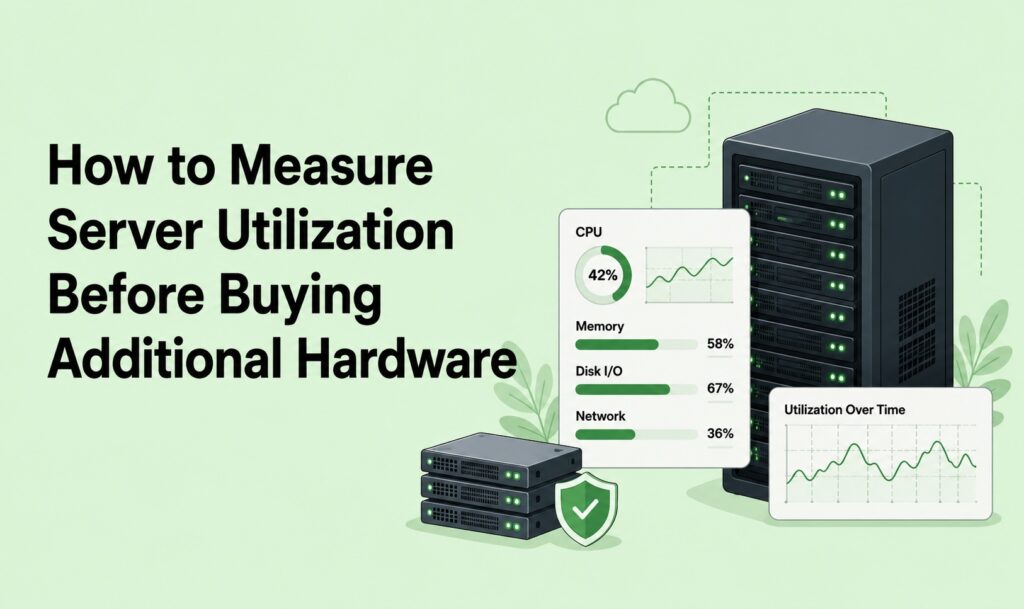
When evaluating server utilization, four areas deserve the majority of attention: CPU, memory, storage, and network performance. Looking at only one of these metrics often leads to misleading conclusions because modern applications consume resources differently depending on workload type.
CPU utilization is typically the first metric administrators examine. High processor usage can certainly indicate a need for additional capacity, but average utilization numbers alone rarely tell the whole story. A server averaging 35 percent CPU utilization may still experience severe performance issues if specific processes regularly consume available resources during peak business hours. What matters is not only average consumption but also sustained peaks, workload distribution across cores, and utilization patterns throughout the day.
Memory utilization deserves equal attention. Applications that exhaust available memory frequently begin swapping data to disk, which can create dramatic performance degradation long before CPU resources become constrained. In many environments, memory shortages generate user complaints while processor metrics appear perfectly healthy. Without examining both metrics together, troubleshooting efforts can head in the wrong direction.
Storage performance creates another common blind spot. Many organizations assume that storage capacity and storage performance are interchangeable. They are not. A system may have ample free space while simultaneously suffering from high latency, excessive queue depths, or insufficient IOPS. These conditions often manifest as slow application performance even though CPU and memory utilization remain relatively low. Businesses interested in improving storage efficiency may benefit from reviewing our article on choosing the right storage architecture: https://www.prolimehost.com/blogs/how-to-choose-the-right-storage-architecture-for-modern-applications/
Finally, network utilization should never be ignored. Increasingly distributed workforces, cloud integrations, AI workloads, backups, and large-scale data transfers place significant demands on network infrastructure. What appears to be a server problem may actually originate from network congestion, bandwidth limitations, or latency issues elsewhere in the environment.
Why Average Utilization Numbers Can Be Misleading
One of the biggest mistakes in capacity planning is relying too heavily on averages. Averages make reports look clean and easy to understand, but they can conceal critical information that affects user experience.
Imagine a server operating at 25 percent utilization for most of the day while reaching 95 percent utilization during a two-hour business-critical processing window. Monthly averages might suggest plenty of available capacity. Users experiencing those overloaded periods would likely disagree. The average tells one story while actual workload behavior tells another.
This is why experienced infrastructure teams focus heavily on trend analysis. They examine utilization patterns across weeks and months rather than relying on isolated snapshots. They look for recurring peaks, sustained growth trends, seasonal fluctuations, and workload shifts. Capacity planning becomes significantly more accurate when viewed as a long-term forecasting exercise rather than a moment-in-time measurement.
Organizations seeking a structured approach to infrastructure evaluation may also find value in our article on auditing infrastructure before it becomes a liability:
Similarly, our guide on calculating infrastructure technical debt explores how aging systems can affect long-term performance and planning decisions:
Server Utilization Decision Matrix
| Average Utilization | Infrastructure Condition | Recommended Action |
|---|---|---|
| Below 40% | Significant excess capacity | Focus on optimization and consolidation |
| 40% to 60% | Healthy utilization range | Continue monitoring growth trends |
| 60% to 75% | Increasing demand | Begin forecasting future requirements |
| 75% to 85% | Capacity pressure emerging | Evaluate upgrade scenarios |
| Above 85% sustained | Potential performance risk | Plan expansion strategy |
While these thresholds provide useful guidance, every environment behaves differently. A heavily transactional database workload will have different performance characteristics than a virtualization cluster, AI platform, or content delivery environment.
Using Utilization Data to Improve Infrastructure ROI
The most effective infrastructure decisions connect technical metrics to business outcomes. Executives rarely care whether CPU utilization increased from 52 percent to 61 percent. They care whether the business can support growth, maintain service levels, reduce risk, and improve profitability.
This is where utilization reporting becomes particularly valuable. Historical utilization data helps quantify future capacity requirements and supports budget requests with measurable evidence. Instead of saying, “We think we need more servers,” IT leaders can demonstrate actual growth patterns, forecast resource consumption, and explain the operational risks associated with delaying expansion.
Organizations that adopt this approach generally achieve better budgeting accuracy and stronger alignment between infrastructure spending and business objectives. It transforms technology investments from reactive purchases into strategic decisions.
For a deeper look at measuring business value from infrastructure investments, readers may also enjoy:
When Additional Hardware Actually Makes Sense
There are certainly situations where buying additional hardware is the correct decision. Consistently high utilization across multiple resource categories, accelerating growth trends, recurring performance complaints tied directly to resource exhaustion, and business forecasts showing sustained workload expansion all support a strong case for infrastructure investment.
The key difference is that these decisions are supported by evidence rather than assumptions.
When organizations reach this stage, selecting the right platform becomes equally important. Modern workloads increasingly require flexible, high-performance infrastructure capable of supporting growth without creating new bottlenecks. Businesses evaluating expansion options can explore ProlimeHost’s Dedicated Server Hosting solutions at https://www.prolimehost.com/dedicated-server-hosting/ and GPU Dedicated Servers at https://www.prolimehost.com/gpu-dedicated-servers/.
For additional best practices, the capacity planning resources available from The Linux Foundation and Red Hat Insights Documentation provide valuable technical guidance for organizations building long-term infrastructure strategies.
FAQs
What utilization percentage indicates that I need additional servers?
There isn’t a magical number. Many organizations start evaluating expansion once sustained utilization approaches 75 to 80 percent, but workload characteristics matter just as much as the percentage itself. A brief spike is very different from sustained resource pressure.
Should CPU utilization be the primary metric?
Not necessarily. It often receives the most attention because it is easy to visualize, but memory shortages and storage latency frequently cause performance problems before CPU resources become constrained. That’s one reason infrastructure troubleshooting occasionally becomes frustrating. The obvious metric isn’t always the culprit.
How far back should utilization data be analyzed?
Three to six months is usually a reasonable starting point. Larger organizations often examine twelve months of historical data to account for seasonal demand fluctuations and business growth patterns.
Can workload consolidation reduce hardware spending?
Quite often, yes. Some organizations discover that better workload placement, virtualization strategies, or application optimization can delay hardware purchases significantly. Others find that consolidation eliminates the need for additional purchases altogether.
What is the biggest mistake companies make?
Probably relying on averages without investigating peak demand periods. Averages make dashboards look neat. Real-world workloads are rarely neat.
Conclusion
Buying additional hardware should be the result of careful analysis, not an automatic reaction to performance concerns. Organizations that consistently measure server utilization, monitor long-term trends, evaluate workload behavior, and connect infrastructure metrics to business outcomes make better investment decisions and avoid unnecessary spending.
Before purchasing another server, take the time to understand how existing resources are being used. The data may confirm that expansion is necessary. Then again, it may reveal opportunities for optimization that deliver the same results at a fraction of the cost.
Either way, informed decisions almost always outperform assumptions.
My Thoughts
If you are evaluating server performance, forecasting growth, or determining whether additional hardware is truly necessary, ProlimeHost can help. Our team specializes in high-performance infrastructure solutions, capacity planning guidance, and scalable hosting platforms designed for modern business workloads.
Phone: 877-477-9454
Dedicated Servers: https://www.prolimehost.com/dedicated-server-hosting/
GPU Servers: https://www.prolimehost.com/gpu-dedicated-servers/
Website: https://www.prolimehost.com
About the Author
Steve Bloemer is Director of Sales & Operations at ProlimeHost and has spent decades helping organizations evaluate technology investments, infrastructure performance, and long-term growth strategies. His experience spans dedicated hosting, enterprise infrastructure planning, business operations, commercial aviation, and technology consulting.
Steve regularly works with executives, IT managers, SaaS providers, and growing businesses to align infrastructure decisions with measurable operational and financial objectives while avoiding costly overprovisioning and unnecessary complexity.