Executive Summary
Many organizations spend enormous amounts of time measuring infrastructure, yet surprisingly few measure the metrics that truly influence business growth. Dashboards overflow with CPU utilization percentages, memory consumption charts, network throughput statistics, and uptime reports. While those metrics certainly have value, executives rarely make strategic decisions based on server utilization graphs. They make decisions based on growth forecasts, customer experience, operational risk, productivity, revenue generation, and competitive positioning.
That disconnect creates a problem. Technology teams often believe infrastructure is performing well because systems remain online, while business leaders experience a completely different reality. Applications become sluggish during peak periods. Customer transactions take longer to complete. Employees lose productivity waiting for systems to respond. Revenue opportunities are delayed. Yet technically, everything appears healthy.
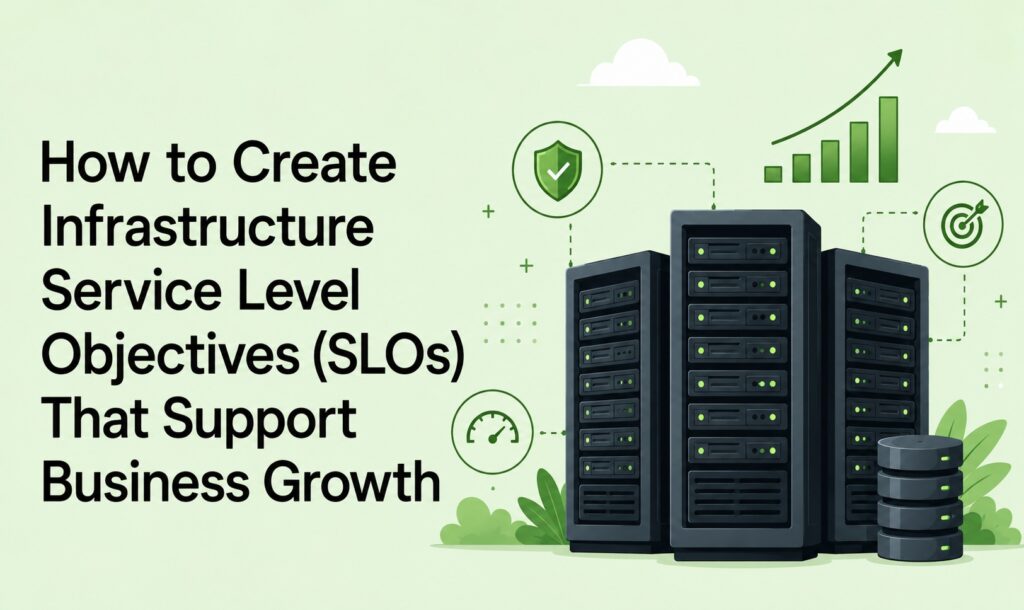
This is where Infrastructure Service Level Objectives (SLOs) become powerful. Rather than focusing solely on infrastructure activity, SLOs establish measurable performance objectives that directly support business outcomes. They create a common language between executives, finance teams, operations leaders, and IT departments. More importantly, they transform infrastructure from a collection of technical assets into a strategic platform designed to support growth.
Organizations that build meaningful SLOs often discover something interesting. Their infrastructure discussions become less about hardware and software, and more about business performance, customer satisfaction, scalability, and risk management. That shift may sound subtle, but it fundamentally changes how technology investments are evaluated.
Why Most Infrastructure Metrics Fail Leadership Teams
Technology professionals naturally gravitate toward technical measurements. After all, those metrics are readily available and relatively easy to track. The challenge is that many of these measurements provide limited insight into whether infrastructure is helping or hindering business objectives.
Consider a company preparing for a major expansion. Executive leadership expects customer volume to increase by 40 percent over the next twelve months. The IT department proudly reports average CPU utilization remains below 60 percent and network uptime exceeds 99.99 percent. On the surface, everything appears under control.
Then growth arrives.
Applications begin slowing during peak transaction periods. Customer support requests increase. Internal teams report delays. Revenue-producing activities take longer to complete. The infrastructure technically remains available, yet the organization struggles to capitalize on its growth opportunities.
The issue wasn’t uptime. The issue wasn’t utilization. The issue was that infrastructure performance had never been measured against the business outcomes that mattered most.
This challenge appears frequently in organizations of every size. Whether supporting an e-commerce platform, SaaS application, healthcare system, financial services environment, or manufacturing operation, the metrics that executives care about rarely align with traditional infrastructure measurements. Leadership teams want to understand whether technology supports growth, reduces risk, improves efficiency, and strengthens competitive positioning. Infrastructure SLOs provide a framework for answering those questions.
As discussed in our article on https://www.prolimehost.com/blogs/how-to-measure-infrastructure-roi-beyond-uptime/, the true value of infrastructure is not found in availability statistics alone. It is found in the outcomes infrastructure enables.
How Service Level Objectives Connect Technology to Business Growth
At its core, an SLO is a measurable performance target that defines how a service should perform from the perspective of users and business stakeholders. While Service Level Agreements often focus on contractual obligations, SLOs focus on operational excellence and continuous improvement.
The distinction matters because businesses do not grow simply because servers remain online. Businesses grow because customers can complete transactions efficiently, employees can work productively, applications can scale reliably, and leadership teams can forecast performance with confidence.
Suppose an organization establishes an objective that 95 percent of customer transactions must complete within two seconds. Suddenly, infrastructure conversations become tied directly to customer experience. Or perhaps leadership defines a recovery objective requiring critical systems to return to service within fifteen minutes following an outage. Now disaster recovery planning becomes linked to operational resilience and revenue protection.
The most effective SLOs bridge the gap between technical operations and business strategy. They create measurable standards that support forecasting, budgeting, risk management, customer retention, and growth initiatives.
In many ways, creating SLOs resembles the work involved in building a long-term infrastructure strategy. Our article on https://www.prolimehost.com/blogs/how-to-build-an-infrastructure-budget-that-survives-growth/ explores a similar principle. Infrastructure decisions become significantly easier when they are connected to clearly defined business objectives rather than isolated technical metrics.
The Five Infrastructure SLO Categories Every Organization Should Measure
Although every environment is unique, most successful SLO frameworks focus on five core performance categories.
The first is availability. This remains important because systems must be accessible when users need them. However, availability should be measured from the user’s perspective rather than solely from a server monitoring perspective.
The second category is latency. Users rarely care how much CPU capacity remains available. They care how quickly applications respond. A highly available application that responds slowly can be just as damaging as an unavailable application.
Third comes throughput. Organizations experiencing growth must ensure infrastructure can process increasing transaction volumes without introducing bottlenecks. Throughput objectives help determine whether systems can scale effectively during periods of increased demand.
Recovery performance represents the fourth category. Outages occasionally occur despite best efforts. Recovery objectives establish acceptable timeframes for restoring operations and minimizing business disruption.
Finally, organizations should measure reliability and consistency. Consistent performance often matters more than peak performance. Users value predictability. So do finance teams attempting to forecast operational requirements.
When combined, these categories provide a balanced framework that aligns infrastructure performance with business expectations.
Infrastructure SLO Comparison Chart
| Infrastructure Area | Traditional Metric | SLO-Oriented Metric | Business Outcome |
|---|---|---|---|
| Availability | Server Uptime | User Service Availability | Customer Satisfaction |
| Applications | CPU Utilization | Response Time Targets | User Experience |
| Storage | Capacity Usage | Storage Latency Objectives | Productivity |
| Databases | Query Volume | Query Completion Time | Transaction Efficiency |
| Recovery | Backup Success | Recovery Time Objective (RTO) | Business Continuity |
| Growth Planning | Hardware Capacity | Demand Forecast Readiness | Scalability |
| Networks | Bandwidth Utilization | End-User Performance | Operational Efficiency |
Notice how the focus shifts from infrastructure activity to business impact. That’s really the entire point.
Why Infrastructure Variance Is Often More Dangerous Than Downtime
Most organizations fear downtime, and understandably so. Downtime is visible. It generates alerts, support tickets, customer complaints, and executive attention.
Variance is different.
Infrastructure variance occurs when performance becomes inconsistent. One day an application responds instantly. The next day response times increase dramatically. Users experience intermittent delays. Transactions fluctuate. Productivity becomes unpredictable.
Because systems remain operational, variance often escapes immediate attention. Yet over time, it can create significant business consequences.
Customer confidence erodes. Employees develop inefficient workarounds. Growth projections become less reliable. Financial forecasting becomes more difficult.
This concept parallels several themes discussed in our articles on https://www.prolimehost.com/blogs/how-to-calculate-cost-infrastructure-technical-debt/, https://www.prolimehost.com/blogs/how-to-consolidate-workloads-and-reduce-infrastructure-sprawl/, and https://www.prolimehost.com/blogs/dedicated-server-refresh-strategy/. In each case, unmanaged infrastructure complexity introduces uncertainty, and uncertainty eventually becomes expensive.
Well-designed SLOs help organizations identify and reduce variance before it begins affecting customers or revenue.
Building SLOs That Executives Actually Care About
One mistake technology teams frequently make is building objectives that only technical teams understand. Leadership does not need dozens of performance measurements. Leadership needs clarity.
A Chief Financial Officer wants to know whether infrastructure investments support revenue growth and operational efficiency. A Chief Executive Officer wants confidence that technology will support expansion plans. Board members want assurance that risk is being managed responsibly.
Effective SLOs answer those concerns.
Instead of measuring hundreds of technical variables, organizations should focus on objectives that directly influence customer experience, operational continuity, scalability, and financial performance. The best SLOs are simple enough to explain during an executive meeting yet detailed enough to guide operational decisions.
Oddly enough, the hardest part isn’t measuring performance. The hardest part is deciding what matters most.
How Dedicated Infrastructure Helps Organizations Achieve SLO Targets
Infrastructure objectives are only as achievable as the platforms supporting them. Organizations operating highly variable environments often struggle to meet performance targets consistently because they lack direct control over critical resources.
Dedicated infrastructure offers greater predictability. Organizations gain control over compute resources, storage performance, networking configurations, and capacity planning. This predictability simplifies forecasting and improves the likelihood of achieving established service objectives.
Businesses evaluating infrastructure platforms may benefit from reviewing ProlimeHost’s Dedicated Server Hosting solutions at https://www.prolimehost.com/dedicated-server-hosting/ and GPU Dedicated Servers at https://www.prolimehost.com/gpu-dedicated-servers/. For organizations establishing formal SLO frameworks, infrastructure consistency often becomes just as important as raw performance.
That isn’t to suggest every workload requires dedicated infrastructure. However, organizations pursuing aggressive growth targets frequently discover that predictable performance creates measurable business advantages.
Additional Resources
Organizations interested in developing mature SLO programs may find the following resources valuable:
Google’s Site Reliability Engineering Handbook:
https://sre.google/sre-book/service-level-objectives/
NIST Cybersecurity Framework:
https://www.nist.gov/cyberframework
Uptime Institute:
https://uptimeinstitute.com
AWS Well-Architected Reliability Pillar:
https://aws.amazon.com/architecture/well-architected/
Microsoft Azure Well-Architected Framework:
https://learn.microsoft.com/en-us/azure/well-architected/
IBM Infrastructure Insights:
https://www.ibm.com/topics/it-infrastructure
Cloud Native Computing Foundation:
https://www.cncf.io
These resources provide additional guidance on reliability engineering, infrastructure governance, operational resilience, and performance management.
Frequently Asked Questions
Isn’t an SLO just another version of an SLA?
Not really. They are related, but they serve different purposes. An SLA usually represents a commitment made to customers, while an SLO acts as an internal target used to guide operations and performance improvement efforts. Think of the SLO as the operational framework that helps organizations consistently achieve their SLA commitments.
How many SLOs should a company start with?
Honestly, fewer than most people think. A surprising number of organizations attempt to track dozens of objectives and end up paying attention to none of them. Starting with five to ten meaningful objectives tied directly to business outcomes usually produces better results.
Are SLOs only useful for large enterprises?
Not at all. Smaller organizations may benefit even more because limited resources force prioritization. Clear objectives help ensure infrastructure spending aligns with actual business requirements rather than assumptions.
How often should objectives be reviewed?
Quarterly reviews work well for most organizations, although fast-growing businesses may benefit from monthly evaluations. If business priorities change, infrastructure objectives should evolve alongside them.
Conclusion
The organizations that grow most effectively are rarely the ones with the largest infrastructure budgets. More often, they are the organizations that understand exactly what their infrastructure must deliver and establish measurable objectives to support those outcomes.
Infrastructure Service Level Objectives provide a practical framework for aligning technology investments with business growth. They help organizations move beyond basic uptime metrics and focus instead on performance, consistency, scalability, resilience, and customer experience.
At the end of the day, infrastructure exists to support business success. SLOs simply provide a way to measure whether that is actually happening.
My Thoughts
If your organization is evaluating infrastructure performance, scalability planning, or long-term growth strategies, ProlimeHost can help you design solutions that support measurable performance objectives and predictable business outcomes.
Contact ProlimeHost today to discuss dedicated server and GPU infrastructure solutions designed for reliability, performance, and growth.
ProlimeHost
Website: https://www.prolimehost.com
Sales: 877-477-9454
Email: sa***@*********st.com
Author
Steve Bloemer
Director of Sales & Operations, ProlimeHost
Steve Bloemer has spent decades helping organizations align technology investments with operational and financial objectives. His experience spans enterprise hosting, dedicated infrastructure, business continuity planning, capacity management, performance optimization, and strategic growth initiatives.
Through the ProlimeHost blog, Steve provides practical insights for executives, finance leaders, and technology professionals seeking to improve infrastructure performance while supporting long-term business growth.