Executive Summary
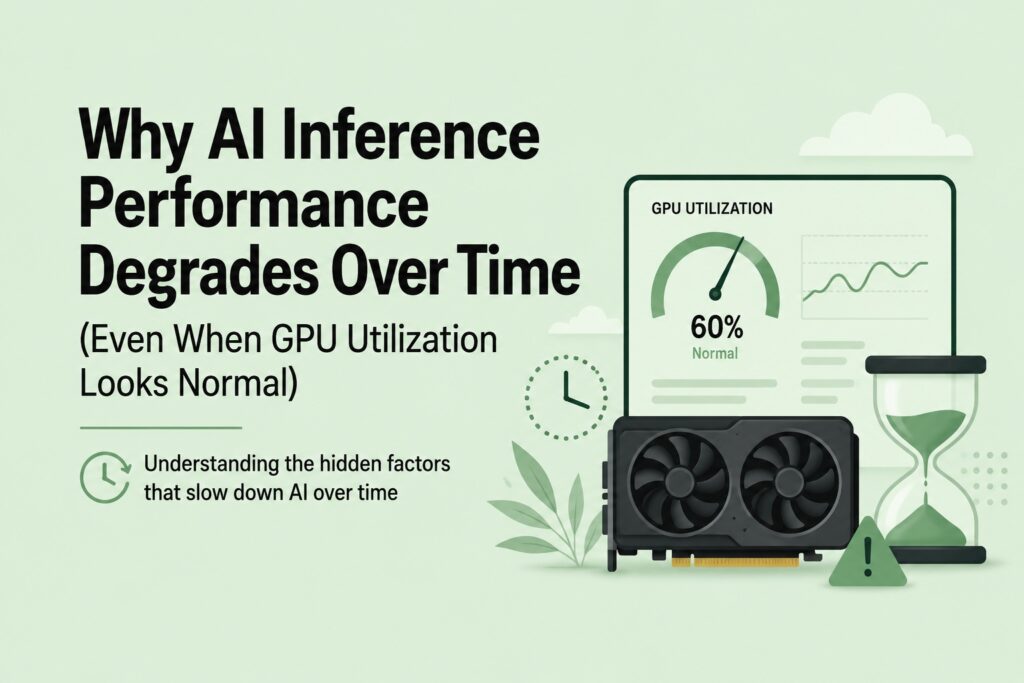
Many organizations deploying AI infrastructure in 2026 eventually encounter a frustrating and surprisingly common problem. Their inference environments begin slowing down even though monitoring dashboards still appear healthy. GPU utilization looks acceptable, no major outages exist, and hardware metrics may even suggest there is additional capacity available. Yet users begin noticing slower response times, inconsistent latency, longer inference queues, and unpredictable application behavior.
At first, the issue often feels temporary. Teams may assume the model itself requires tuning or that a recent workload spike created a short-lived bottleneck. But over time, it becomes clear the degradation is persistent. Something deeper is happening inside the infrastructure environment.
The reality is that modern AI inference performance depends on far more than GPU utilization percentages. In production AI environments, storage throughput, orchestration complexity, thermal consistency, memory allocation efficiency, networking behavior, retrieval systems, and concurrency patterns all interact continuously. Small inefficiencies that appear harmless individually can compound gradually over weeks or months until the overall environment becomes noticeably less responsive.
This operational drift has become one of the defining infrastructure challenges of large-scale AI deployment. Organizations are increasingly discovering that maintaining predictable inference performance is not simply about acquiring more GPUs. It is about building infrastructure environments capable of sustaining consistency under continuously evolving workloads.
At ProlimeHost, we work with businesses deploying AI infrastructure for SaaS platforms, internal enterprise automation, analytics, inference APIs, retrieval-augmented generation, and private AI environments. One pattern appears repeatedly across nearly every successful long-term deployment: stable infrastructure behavior matters just as much as raw compute power.
The Problem Usually Starts Quietly
One of the reasons AI inference degradation becomes so difficult to diagnose is because it rarely begins with catastrophic failure. Most environments continue operating normally from a technical standpoint. Applications remain online. GPUs remain active. Utilization graphs may even appear healthy enough that infrastructure teams initially dismiss user complaints.
But users experience something different from what dashboards display.
Responses begin taking slightly longer. Latency becomes less predictable throughout the day. Some inference requests complete instantly while others stall unexpectedly. Retrieval operations feel inconsistent. Queue depth expands during concurrency spikes that previously caused no issues at all.
This creates a dangerous disconnect between infrastructure metrics and real-world application experience.
Traditional infrastructure environments often fail in relatively obvious ways. Storage arrays saturate visibly. CPU exhaustion becomes apparent quickly. Network outages trigger immediate alarms. AI inference environments behave differently because the bottlenecks frequently emerge from interactions between systems rather than from a single obvious hardware limitation.
That distinction matters enormously.
A GPU cluster can remain technically healthy while the systems feeding data into the inference pipeline slowly become less efficient over time. The GPUs themselves may not even be the root problem. Instead, the degradation may originate from orchestration layers, memory fragmentation, retrieval pipelines, caching systems, or growing storage latency that quietly introduces operational drag across the environment.
The result is a system that appears stable on paper while becoming increasingly inconsistent in practice.
AI Workloads Rarely Stay Static for Long
Many infrastructure planning discussions still assume workloads remain relatively stable once production deployment begins. In reality, AI environments evolve continuously after launch.
A company may initially deploy lightweight inference models supporting limited internal usage. Within months, however, teams often begin expanding context windows, adding retrieval augmentation, introducing multimodal workloads, onboarding new departments, deploying larger models, or increasing concurrent user sessions dramatically. The infrastructure environment gradually begins handling workloads that barely resemble the original deployment assumptions.
This evolution changes infrastructure behavior in ways many organizations underestimate.
Longer prompts increase memory pressure. Expanded context windows create larger token processing requirements. Retrieval pipelines generate additional storage activity. Vector databases scale rapidly as embeddings accumulate. More users introduce uneven concurrency spikes that stress orchestration systems differently throughout the day.
None of these changes necessarily break the infrastructure immediately. Instead, they create compounding inefficiencies that slowly erode consistency.
That is why many organizations discover their inference environments degrade operationally even while GPU utilization appears relatively unchanged. The surrounding systems have become less efficient, and the workload itself has evolved beyond the assumptions used during the initial deployment phase.
Our article on How to Size AI Infrastructure Correctly in 2026 explores this challenge in greater detail, particularly how organizations often underestimate the operational evolution that occurs after production AI adoption accelerates internally.
GPU Utilization Does Not Measure Infrastructure Health
One of the largest misconceptions in AI infrastructure planning is the assumption that healthy GPU utilization automatically indicates healthy inference performance.
In reality, utilization metrics reveal only a fraction of what determines real-world responsiveness.
A GPU operating at moderate utilization levels may still deliver poor inference consistency if the surrounding infrastructure introduces delays elsewhere in the pipeline. Storage latency, memory allocation inefficiencies, orchestration overhead, and network congestion can all reduce effective throughput without dramatically altering GPU utilization graphs.
This creates situations where infrastructure teams continue seeing “normal” utilization percentages while users experience worsening latency.
Consider retrieval-augmented generation environments as an example. The GPU may spend part of its operational cycle waiting for data retrieval systems, vector databases, cached embeddings, or orchestration layers to deliver information efficiently. From a utilization standpoint, nothing appears critically wrong. From a user experience standpoint, however, response times become increasingly inconsistent.
The same problem appears in environments where model loading behavior becomes fragmented over time. Continuous model updates, orchestration adjustments, container movement, and inference batching can slowly reduce memory efficiency without causing outright hardware failure.
The GPUs remain operational.
The environment simply becomes less smooth.
And that gradual loss of smoothness is where inference degradation often begins.
Storage Performance Has Become Far More Important Than Many Teams Expected
A few years ago, many organizations still viewed AI infrastructure primarily through the lens of GPU acquisition. Today, mature AI operators increasingly recognize that storage architecture plays a massive role in long-term inference consistency.
Modern AI environments depend heavily on fast and predictable access to embeddings, retrieval databases, cached prompts, session history, temporary inference states, fine-tuned model weights, orchestration metadata, and distributed datasets. As workloads scale, storage systems begin influencing inference responsiveness much more aggressively than many early AI adopters anticipated.
Even relatively small increases in storage latency can ripple through an inference pipeline.
The GPU waits slightly longer for data. Queue depth expands modestly. Retrieval chains slow down under concurrency bursts. Orchestration systems begin compensating for uneven timing. Eventually, users experience noticeably inconsistent responses despite the GPUs themselves remaining technically healthy.
This explains why enterprise AI infrastructure increasingly prioritizes high-performance NVMe architectures, low-latency private networking, and predictable storage throughput. The infrastructure feeding the GPUs often determines inference consistency just as much as the GPUs themselves.
Many deployments now emphasize enterprise NVMe storage performance and private backend networking specifically because organizations are discovering that inconsistent data delivery pipelines quietly undermine AI responsiveness over time.
Orchestration Complexity Gradually Creates Operational Drag
As AI environments mature, infrastructure complexity almost always expands alongside them.
Teams introduce additional monitoring systems, autoscaling policies, orchestration agents, telemetry tools, routing logic, inference gateways, and containerized services. Individually, these additions usually improve visibility or scalability. Collectively, however, they can create substantial operational overhead that slowly consumes more system resources than originally expected.
This overhead rarely becomes obvious during short-term benchmarking.
Production AI environments operate continuously. Over time, orchestration systems generate additional CPU load, memory usage, storage activity, and network chatter that gradually influences inference responsiveness. What initially feels like operational flexibility can eventually introduce enough background overhead to affect consistency during high-concurrency periods.
Ironically, some environments optimized aggressively for elasticity become harder to stabilize operationally under long-term production conditions.
This is one reason many organizations are reevaluating whether highly fragmented cloud-native AI infrastructure always produces the most predictable operational behavior. In some cases, simpler dedicated infrastructure environments provide better long-term consistency because fewer orchestration layers compete for system resources.
Our article on How to Benchmark Dedicated Servers Properly Before Deployment discusses why many traditional benchmark methodologies fail to expose these operational realities during short-duration testing.
Thermal Stability Matters More Than Most People Realize
Thermal behavior is another frequently overlooked factor in long-term inference consistency.
Most enterprise-grade GPU hardware prevents catastrophic overheating effectively, which leads many teams to assume thermal conditions no longer matter operationally. But sustained AI inference environments expose a different issue. The concern is not necessarily outright overheating. It is subtle thermal fluctuation over extended periods of continuous load.
AI workloads rarely behave like short benchmark tests. Production environments operate for days, weeks, and months under persistent demand. During these sustained operations, temperature variability can influence boost behavior, power efficiency, memory stability, and overall throughput consistency in ways that may never appear during short-duration performance testing.
Dense GPU environments become especially vulnerable to this effect.
Organizations often discover their environments perform exceptionally well during initial validation testing yet gradually lose consistency under long-term production workloads. The infrastructure remains online, but inference responsiveness becomes more erratic over time as thermal conditions fluctuate under sustained operational pressure.
This is why mature AI operators increasingly evaluate infrastructure as an endurance environment rather than a benchmark environment. Peak synthetic performance matters far less than stable behavior over extended production workloads.
The Financial Risk Is Increasingly About Variance
Many infrastructure discussions still revolve primarily around uptime. But for AI deployments, the larger operational threat is increasingly variance rather than outright outages.
An inference platform that responds in 300 milliseconds one moment and 2.5 seconds the next creates operational instability even if the infrastructure technically never goes offline.
That instability affects customer trust, employee productivity, automation reliability, and user adoption rates. AI systems depend heavily on perceived responsiveness. Once users begin experiencing unpredictable latency, confidence in the platform often declines rapidly even if average system performance still appears acceptable statistically.
The problem becomes even more serious for SaaS providers, customer-facing AI applications, and enterprise automation environments where inference consistency directly affects revenue-producing workflows.
| Infrastructure Condition | Short-Term Appearance | Long-Term Business Impact |
|---|---|---|
| GPU utilization appears stable | Environment looks healthy | User experience gradually deteriorates |
| Retrieval latency increases slightly | Minor performance variation | Queue buildup becomes inconsistent |
| Memory fragmentation accumulates | GPUs remain operational | Throughput stability declines |
| Shared GPU contention rises | No obvious outage occurs | Customer experience becomes unpredictable |
| Orchestration complexity expands | Scaling appears flexible | Operational overhead compounds |
| Thermal fluctuation develops | Infrastructure stays online | Sustained latency variance increases |
Organizations increasingly recognize that infrastructure predictability itself has become a competitive advantage.
Why Dedicated AI Infrastructure Continues Gaining Momentum
As AI adoption matures, many organizations are shifting their priorities away from simple GPU availability and toward long-term operational consistency.
They want predictable inference latency. They want stable throughput. They want isolated environments without noisy-neighbor interference. They want infrastructure behavior that remains consistent six months into deployment rather than environments that perform well only during early testing.
This shift explains why dedicated GPU infrastructure adoption continues accelerating across enterprise AI deployments in 2026.
At ProlimeHost, many AI customers increasingly prioritize isolated GPU environments, enterprise NVMe architectures, low-latency networking, private backend infrastructure, and predictable operational performance over theoretical burst scalability.
The industry conversation itself is evolving.
Organizations are beginning to realize that successful AI infrastructure is not merely about maximizing benchmark numbers. It is about sustaining reliable inference performance under evolving real-world production conditions.
That difference becomes more important every month.
FAQs
Why does AI inference slow down even if GPUs are not maxed out?
Because GPUs represent only one portion of the inference pipeline. Storage latency, orchestration overhead, retrieval systems, memory allocation inefficiencies, and concurrency spikes can all degrade responsiveness even when utilization percentages appear healthy.
Can retrieval-augmented generation increase inference latency?
Absolutely. RAG environments depend heavily on storage systems, vector databases, embeddings, and retrieval operations. As these systems scale, they can introduce latency that impacts overall inference responsiveness even when GPUs remain available.
Is shared cloud GPU infrastructure part of the problem?
Sometimes, yes. Shared multi-tenant environments may introduce noisy-neighbor behavior, inconsistent storage performance, or fluctuating network conditions that gradually affect inference stability.
Not every deployment encounters this immediately. Many only notice it once production workloads become larger and more unpredictable.
Why do inference problems seem gradual instead of sudden?
Because AI environments evolve continuously. Models become larger, workloads become more concurrent, retrieval systems expand, orchestration layers grow, and infrastructure assumptions slowly drift away from the original deployment design.
Most inference degradation happens incrementally.
That is part of what makes it difficult to diagnose early.
What should organizations monitor besides GPU utilization?
Teams increasingly monitor storage latency, queue depth, token throughput consistency, orchestration overhead, retrieval timing, thermal stability, and concurrency behavior alongside traditional GPU metrics.
Those measurements often reveal problems much earlier than utilization graphs alone.
Final Thoughts
AI inference degradation rarely arrives as a dramatic infrastructure collapse. More often, it emerges slowly through operational drift that accumulates across interconnected systems over time. The GPUs may remain healthy. Dashboards may still look reassuring. Yet the environment gradually becomes less predictable, less responsive, and harder to stabilize under production workloads.
Organizations that recognize this early are increasingly focusing on infrastructure consistency rather than purely theoretical compute capacity. They are prioritizing stable storage performance, predictable networking behavior, isolated GPU environments, and operational simplicity capable of sustaining long-term inference reliability.
Because in modern AI infrastructure, predictability is rapidly becoming just as important as performance itself.
Learn More About ProlimeHost AI Infrastructure
Explore enterprise AI infrastructure solutions from ProlimeHost:
For custom AI infrastructure consultations:
ProlimeHost
877-477-9454
Sa***@*********st.com
https://www.prolimehost.com
Steve Bloemer
Director of Sales & Operations
Steve Bloemer works closely with organizations deploying dedicated GPU and enterprise server infrastructure for AI, SaaS, analytics, rendering, and high-performance business workloads worldwide.