Executive Summary
For the past several years, the AI infrastructure conversation centered almost entirely around GPUs. Organizations raced to secure accelerator inventory while cloud providers struggled to keep up with demand, and most infrastructure planning discussions eventually boiled down to one central assumption: more GPUs would solve most performance problems. During the early stages of enterprise AI adoption, that logic made sense. Compute scarcity was real, deployment timelines were aggressive, and many organizations simply wanted functional AI environments online as quickly as possible.
In 2026, however, AI infrastructure bottlenecks are becoming far more complicated than raw compute limitations alone.
Across enterprise environments, companies are increasingly discovering that adding GPUs does not automatically improve AI responsiveness, inference consistency, or workload scalability. In many cases, organizations deploy additional accelerators only to find that latency problems remain, retrieval pipelines still slow down under concurrency spikes, and overall user experience continues degrading despite apparently healthy utilization metrics. The issue often turns out not to be insufficient compute capacity. It is inefficient data movement underneath the AI stack itself.
At ProlimeHost, we increasingly work with organizations that initially believe they need larger GPU clusters when the actual bottleneck involves storage throughput, inconsistent I/O behavior, overloaded retrieval systems, or poorly optimized data pipelines. Modern AI environments continuously move enormous amounts of information between vector databases, embeddings, model checkpoints, inference layers, analytics systems, caches, and orchestration platforms simultaneously. As workloads mature, storage architecture begins influencing overall AI performance almost as heavily as the accelerators themselves.
That shift is quietly redefining how AI infrastructure needs to be designed moving forward.
The Industry Spent Years Focusing Almost Exclusively on GPUs
The industry’s fixation on GPU count did not happen by accident. During the initial enterprise AI expansion cycle, organizations faced genuine inventory shortages while demand for NVIDIA hardware surged globally. Companies building early AI environments often had little choice but to prioritize securing compute resources before worrying about long-term optimization. Under those conditions, infrastructure strategy became centered around acquisition rather than efficiency.
What many organizations underestimated was how dramatically AI workloads would evolve once they entered production environments.
A small proof-of-concept chatbot behaves very differently from an enterprise AI platform simultaneously processing customer support automation, document retrieval, recommendation engines, analytics pipelines, voice transcription, and real-time inference requests across multiple departments. As concurrency increases and datasets grow, infrastructure stress begins appearing in areas many teams did not originally anticipate. Retrieval latency starts fluctuating. Queue depth increases unpredictably. Inference response times become inconsistent even though GPU dashboards continue reporting healthy utilization levels.
This is where storage architecture starts becoming impossible to ignore.
Modern AI environments are fundamentally data movement systems as much as they are compute systems. Large language models continuously retrieve embeddings, access vector indexes, load checkpoints, stream inference outputs, process telemetry data, and interact with distributed caching layers simultaneously. Every stage depends on storage responsiveness remaining stable under sustained load conditions. Even small latency inconsistencies can compound downstream, eventually creating noticeable degradation in user-facing AI responsiveness.
One of the more misleading aspects of AI infrastructure monitoring in 2026 is that GPU utilization metrics alone often fail to reveal these problems clearly. An environment can appear computationally healthy while storage bottlenecks quietly create retrieval delays, inconsistent inference timing, and degraded application performance underneath the surface.
Why AI Infrastructure Is Becoming a Storage Performance Problem
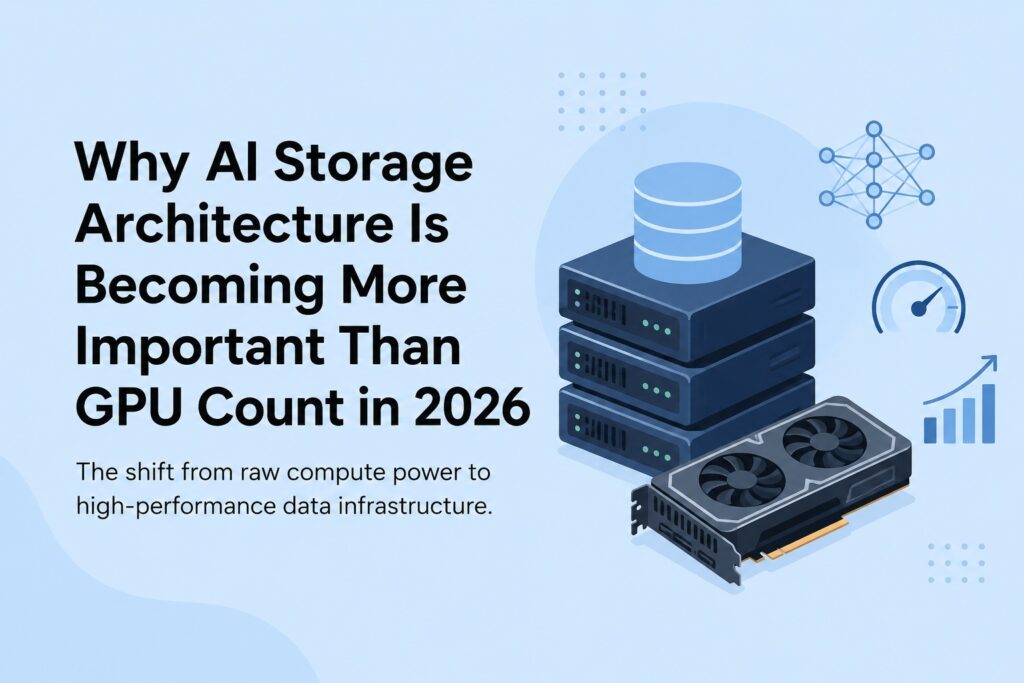
As AI workloads mature, storage architecture increasingly determines whether expensive accelerator environments operate efficiently or waste substantial compute capacity waiting on delayed data access. That distinction matters far more than many organizations initially expected.
For example, a GPU cluster processing inference workloads at scale may theoretically possess enormous computational power, but if embeddings, datasets, or retrieval systems cannot deliver information consistently fast enough, accelerators begin sitting idle between operations. Those inefficiencies compound quickly in production environments handling thousands of simultaneous requests.
This becomes especially important in retrieval-augmented generation environments, vector database operations, and large-scale inference pipelines where latency sensitivity directly affects customer experience. A few milliseconds of inconsistent retrieval performance may not sound catastrophic in isolation, but under concurrency those delays stack rapidly throughout the infrastructure pipeline. Eventually, users begin experiencing slower responses, inconsistent outputs, or degraded application fluidity despite infrastructure dashboards appearing relatively normal.
The financial implications are significant as well.
Organizations frequently respond to performance inconsistency by deploying additional GPUs under the assumption that compute scarcity is the primary problem. In reality, many environments already possess adequate accelerator capacity but lack sufficiently optimized storage throughput to sustain efficient data movement at scale. This creates a situation where infrastructure costs rise aggressively while actual operational efficiency improves only marginally.
That pattern is becoming increasingly common across AI deployments transitioning from experimentation into production-scale operational dependency.
Why NVMe Storage Architecture Matters More Than Ever
Enterprise NVMe infrastructure is no longer simply about achieving impressive benchmark numbers. In AI environments, storage consistency under sustained concurrency matters just as heavily as peak throughput itself.
There is an enormous operational difference between storage that performs well during isolated testing and storage capable of maintaining low-latency responsiveness during continuous inference operations involving simultaneous retrieval, caching, logging, checkpoint access, and analytics processing. Many AI workloads generate unpredictable I/O behavior patterns that traditional storage environments were never optimized to handle efficiently.
This is one reason dedicated AI infrastructure is regaining attention among organizations prioritizing predictable performance.
In heavily shared cloud environments, storage contention, noisy neighbors, oversubscribed backend resources, and inconsistent caching behavior can introduce performance variance that becomes difficult to diagnose cleanly. AI workloads tend to amplify those inconsistencies because modern inference pipelines are highly sensitive to retrieval timing fluctuations. A delay introduced at the storage layer often propagates throughout the entire workload chain.
At ProlimeHost, we increasingly help organizations architect AI environments around balanced infrastructure design rather than simply maximizing accelerator counts. In many deployments, improving storage topology, NVMe throughput consistency, caching efficiency, and private backend networking creates larger real-world performance improvements than adding additional GPUs alone.
That realization surprises many teams initially because the industry spent years framing AI infrastructure almost entirely around compute acquisition. In practice, sustainable AI scalability now depends heavily on how efficiently the surrounding infrastructure moves and delivers data.
Comparison Chart: GPU-Centric Infrastructure vs Storage-Aware AI Architecture
| Infrastructure Focus | GPU-Centric Planning | Storage-Aware AI Architecture |
|---|---|---|
| Primary Goal | Maximize GPU count | Balance compute and data movement |
| Common Bottleneck | Hidden retrieval delays | Bottlenecks identified proactively |
| Inference Consistency | Variable under load | More stable latency |
| Storage Strategy | Secondary concern | Core infrastructure priority |
| GPU Efficiency | Often underutilized | Better sustained utilization |
| Scaling Costs | Can rise unpredictably | Easier to forecast |
| AI User Experience | Inconsistent under concurrency | More predictable |
| Long-Term ROI | Frequently inefficient | More sustainable |
Why This Matters So Much in 2026
Two years ago, many AI environments remained experimental enough that occasional performance inconsistency did not immediately threaten business operations. That is no longer true for many organizations today.
AI systems increasingly sit directly inside revenue-generating workflows. They power customer support automation, recommendation engines, SaaS platforms, analytics systems, internal search environments, healthcare processing pipelines, fraud analysis, and operational forecasting tools. Once AI becomes operationally embedded, infrastructure inconsistency stops being a purely technical inconvenience and starts becoming a business performance problem.
This is where infrastructure predictability begins mattering far more than theoretical maximum scalability.
Organizations are gradually recognizing that stable latency, consistent retrieval behavior, predictable throughput, and balanced storage architecture often create more sustainable long-term AI environments than simply deploying increasingly larger GPU clusters without optimizing the surrounding infrastructure layers.
The conversation around AI infrastructure is becoming more mature now. Compute power still matters enormously, of course, but the organizations gaining operational advantages moving forward will likely be the ones optimizing the full infrastructure pipeline rather than focusing exclusively on accelerator counts alone.
FAQs
Does adding more GPUs automatically improve AI performance?
Not always. Many AI environments become constrained by storage throughput, retrieval latency, vector database responsiveness, or orchestration inefficiencies before GPU compute itself becomes fully saturated.
Why can AI inference latency increase even when GPU utilization looks healthy?
GPU utilization metrics do not necessarily reveal storage bottlenecks, retrieval delays, caching inefficiencies, or backend data movement problems. AI responsiveness depends heavily on the entire infrastructure pipeline operating consistently.
Is NVMe storage necessary for enterprise AI workloads?
For many modern AI deployments, yes. Workloads involving embeddings, vector databases, retrieval-augmented generation, analytics processing, and large-scale inference pipelines often benefit substantially from enterprise NVMe infrastructure designed for sustained concurrency.
Are dedicated AI servers better than public cloud environments?
It depends on workload behavior and operational goals. Dedicated AI infrastructure often provides more predictable performance consistency, lower latency variance, and better long-term ROI for stable production workloads, while cloud infrastructure may provide greater elasticity for rapidly changing demand patterns.
Some organizations ultimately end up using both. The important part is understanding where performance variability actually originates before continuing to scale infrastructure reactively.
ProlimeHost AI Infrastructure & Dedicated Server Solutions
What types of AI servers does ProlimeHost offer?
ProlimeHost GPU Dedicated Servers include solutions optimized for AI inference, machine learning, rendering, analytics, and enterprise GPU workloads. Configurations range from single-GPU deployments to larger enterprise-ready environments with high-core-count CPUs, NVMe storage, and high-bandwidth networking.
Does ProlimeHost offer NVMe storage optimized for AI workloads?
Yes. Many ProlimeHost Dedicated Servers support enterprise-grade NVMe storage configurations specifically designed for low-latency workloads, vector databases, AI inference pipelines, and high-throughput data processing environments.
Can ProlimeHost help architect private AI infrastructure?
Yes. ProlimeHost AI Infrastructure Solutions regularly assists organizations building private AI environments that prioritize predictable performance, lower latency variance, security, compliance control, and long-term infrastructure ROI.
Does ProlimeHost provide high-bandwidth networking for AI environments?
Yes. ProlimeHost infrastructure supports high-performance networking options suitable for AI clusters, distributed inference environments, large-scale storage replication, and data-intensive workloads requiring consistent throughput.
Which ProlimeHost server configurations are commonly used for AI workloads?
Organizations frequently deploy high-core-count AMD EPYC and Ryzen platforms alongside GPU configurations and enterprise NVMe storage through ProlimeHost Dedicated Server Solutions depending on workload requirements, concurrency levels, and storage throughput demands.
Can ProlimeHost support scalable AI deployments as workloads grow?
Yes. ProlimeHost offers scalable infrastructure solutions allowing organizations to expand compute, storage, memory, and networking capacity as AI environments evolve from proof-of-concept deployments into production-scale operational platforms.
Final Thoughts
The AI infrastructure discussion is evolving rapidly in 2026. GPU count remains important, but the industry is gradually realizing that accelerator performance alone does not determine real-world AI responsiveness anymore. Storage architecture, retrieval efficiency, latency consistency, caching strategy, and data movement optimization are becoming equally important components of sustainable AI scalability.
Organizations that recognize this shift early will likely build more efficient, predictable, and financially sustainable AI environments moving forward.
To learn more about enterprise AI hosting, dedicated GPU servers, and high-performance infrastructure solutions, visit ProlimeHost or contact our team directly at 877-477-9454.
Related Reading
- How to Size AI Infrastructure Correctly in 2026
- How to Benchmark Dedicated Servers Properly Before Deployment
- How to Build a Private AI Server Infrastructure
- NVIDIA Enterprise AI Infrastructure
Author: Steve Bloemer, Director of Sales & Operations at ProlimeHost