Executive Summary
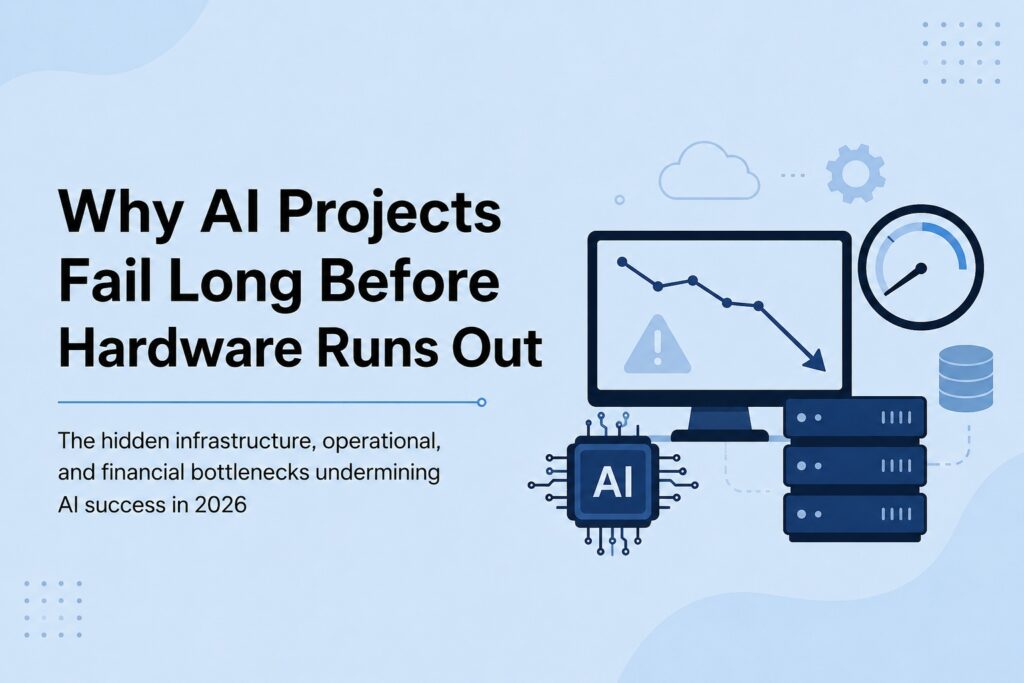
One of the biggest misconceptions surrounding enterprise AI in 2026 is the belief that infrastructure failure only happens when GPUs hit 100% utilization or storage arrays run out of space. In reality, many AI projects begin failing quietly months earlier, often while dashboards still appear healthy and capacity reports continue showing available headroom.
The problem usually is not weak hardware. It is not necessarily outdated GPUs either. In many cases, organizations actually invest heavily into powerful compute environments only to discover that operational instability starts developing around the infrastructure long before physical hardware limits are reached. Latency begins drifting inconsistently between workloads. Storage pipelines struggle to feed concurrent inference requests efficiently. Internal departments start competing for resources unexpectedly. Finance teams lose visibility into predictable cost forecasting. Eventually confidence in the AI initiative itself starts weakening.
This creates a dangerous situation because the infrastructure may technically remain online while the broader AI strategy begins deteriorating operationally underneath the surface. Customer experience becomes less predictable. Development slows. Internal adoption weakens. Leadership starts questioning long-term ROI even though the GPUs themselves may still show relatively normal utilization.
At ProlimeHost, we increasingly work with organizations discovering that successful AI infrastructure is no longer simply about maximizing compute density. Long-term success depends far more on maintaining operational consistency as workloads evolve unpredictably over time. That distinction is becoming one of the defining infrastructure conversations of 2026.
The Failure Usually Starts Outside the GPUs
Early-stage AI deployments almost always look smoother than what follows later. A proof-of-concept chatbot performs well during testing. Internal retrieval systems respond quickly. Small-scale inference pipelines appear stable. GPU utilization remains comfortably below critical thresholds. Leadership teams see positive demonstrations and naturally assume scaling will behave similarly once adoption expands.
But production environments rarely scale cleanly.
As AI tools spread across departments, entirely different workload patterns begin colliding inside the same infrastructure ecosystem. Customer service teams introduce AI-driven automation. Marketing departments deploy generative content pipelines. Developers expand internal copilots. Analytics environments begin processing increasingly complex inference requests simultaneously. Voice transcription, recommendation systems, vector databases, and retrieval workflows all start competing for resources in ways that initial forecasting models rarely anticipate accurately.
This is where infrastructure behavior changes.
AI workloads do not scale linearly the way many traditional applications once did. Usage spikes emerge unevenly. Concurrent requests fluctuate unpredictably. Storage access patterns evolve rapidly. Some departments suddenly consume far more inference capacity than expected while others begin generating large background processing loads that quietly affect shared performance elsewhere.
The environment may still appear technically functional, yet operational consistency starts weakening in subtle ways. Inference requests occasionally take longer than expected. Training jobs begin interfering with production workloads. Internal teams start noticing unpredictable response behavior at certain times of day. Engineering groups compensate manually through temporary fixes and resource overprovisioning. Over time those small adjustments compound into operational complexity that becomes increasingly difficult to manage efficiently.
Ironically, many organizations initially respond by purchasing additional GPUs. Yet additional compute alone rarely resolves architectural inefficiencies. In some cases it actually magnifies them because the surrounding infrastructure layers cannot scale proportionally alongside the new hardware capacity.
A cluster with powerful GPUs can still deliver poor real-world performance if storage pipelines, orchestration systems, and network layers cannot feed those GPUs consistently under concurrent load.
The Hidden Operational Damage of Infrastructure Variance
One of the least discussed problems in enterprise AI environments today is not downtime itself. It is infrastructure variance.
Downtime is obvious. Everyone notices it immediately. Monitoring systems trigger alerts. Executives escalate the issue. Engineering teams respond aggressively because the problem is visible and measurable.
Variance behaves differently. It creeps in gradually and often avoids triggering traditional alarms altogether.
Inference response times begin fluctuating inconsistently throughout the day. Some requests complete instantly while others lag unpredictably despite similar workloads. Internal users experience occasional slowdowns that are difficult to reproduce consistently. Storage throughput drifts unevenly during peak concurrency periods. Container orchestration layers start introducing subtle latency penalties as environments become more complex.
Individually, these issues may appear minor. Collectively, they slowly erode organizational confidence in the AI platform itself.
This creates operational side effects that many businesses underestimate initially. Developers begin overallocating resources defensively because performance predictability weakens. Operations teams introduce workaround layers to stabilize workloads manually. Finance departments lose visibility into accurate long-term infrastructure forecasting because utilization patterns become increasingly inconsistent. Internal adoption slows because departments stop trusting predictable AI performance across mission-critical workflows.
Eventually the infrastructure remains online, but the AI initiative itself begins failing organizationally.
This is one reason many enterprises are reevaluating heavily shared cloud GPU environments in favor of more predictable dedicated infrastructure models where workload isolation and operational consistency are easier to maintain.
Our recent article explores this issue further:
The Hidden Cost of Shared GPU Environments for Enterprise AI Workloads
Why AI Scaling Rarely Behaves Rationally
Traditional infrastructure forecasting models assume growth behaves somewhat predictably. AI adoption almost never does.
A department expected to consume modest inference capacity suddenly launches customer-facing AI automation. Development teams duplicate environments repeatedly for experimentation. Internal copilots gain unexpected popularity among employees. Retrieval-augmented generation pipelines start consuming dramatically more storage bandwidth than anticipated. Meanwhile leadership still expects “elastic” infrastructure environments to absorb all scaling complexity automatically.
Unfortunately, elasticity introduces its own operational tradeoffs.
Shared infrastructure environments often create inconsistent neighbor contention, fluctuating throughput, and unpredictable latency behavior under sustained load. Costs become harder to forecast accurately over time. GPU availability tightens during broader industry demand spikes. Workloads migrate dynamically in ways that complicate operational consistency even further.
This is precisely why many organizations eventually begin evaluating dedicated GPU server infrastructure for production AI operations. Predictability becomes strategically valuable once AI environments move beyond experimentation and start affecting customer experience, analytics workflows, internal operations, and revenue generation directly.
What initially appears less “flexible” on paper often becomes far more stable operationally in practice.
AI Projects Often Fail Financially Before They Fail Technically
This is where many infrastructure conversations become uncomfortable.
A surprising number of AI initiatives do not collapse because the technology itself stops functioning. They fail because leadership loses confidence in the financial predictability surrounding the environment. Costs fluctuate unpredictably. Performance becomes inconsistent between departments. Capacity planning shifts from strategic forecasting into reactive crisis management. Customer experience begins varying unevenly. Operational overhead expands quietly month after month.
At that point the conversation inside executive meetings changes dramatically.
Leadership no longer asks whether the GPUs are powerful enough. Instead they begin asking whether the organization can reliably forecast operational stability six or twelve months ahead. That is a fundamentally different business discussion, and frankly, one many infrastructure providers avoid addressing openly.
AI infrastructure decisions increasingly resemble financial risk management decisions rather than simple hardware purchases. Businesses are not merely evaluating benchmark performance anymore. They are evaluating operational consistency, forecast stability, workload isolation, and long-term ROI visibility.
That shift is reshaping enterprise AI purchasing decisions very quickly.
Dedicated Infrastructure vs Shared AI Environments
| Infrastructure Factor | Shared GPU Environment | Dedicated AI Infrastructure |
|---|---|---|
| Performance Consistency | Variable | Predictable |
| Resource Contention | Common | Minimal |
| Cost Forecasting | Difficult | More Stable |
| Latency Stability | Inconsistent Under Load | Consistent |
| Workload Isolation | Limited | Full Isolation |
| Scaling Control | Provider Dependent | Customer Controlled |
| Long-Term ROI Visibility | Unpredictable | Easier to Forecast |
| Compliance Flexibility | Limited | Greater Control |
Organizations evaluating long-term AI deployment strategies increasingly recognize that infrastructure consistency directly impacts business confidence, not merely technical performance.
Storage, Networking, and Orchestration Usually Become the Real Bottlenecks
One of the more surprising realities emerging across enterprise AI deployments in 2026 is that GPU utilization frequently remains below critical thresholds even while overall application performance visibly degrades.
The reason is simple: GPUs represent only one layer of the infrastructure ecosystem.
AI environments depend heavily on storage throughput consistency, dataset retrieval latency, inter-node communication efficiency, orchestration overhead, and network stability. When any of those surrounding systems drift unpredictably under concurrent load, the entire AI environment starts losing operational efficiency regardless of how powerful the GPUs themselves may be.
This becomes especially noticeable in large inference deployments where response consistency matters more than isolated benchmark scores. Customers rarely care whether a GPU cluster performs well synthetically in a controlled benchmark environment. They care whether applications respond consistently during real-world production traffic.
That distinction changes infrastructure priorities significantly.
Our recent article on infrastructure sizing explores this challenge further:
How to Size AI Infrastructure Correctly in 2026
Likewise, storage architecture itself is becoming increasingly important for enterprise AI performance:
Why AI Storage Architecture Is Becoming More Important Than GPU Count
Predictability Is Becoming the Real Competitive Advantage
For years, infrastructure discussions focused almost entirely on peak performance metrics. Today many enterprise buyers are prioritizing something different entirely: operational consistency.
The ability to forecast costs accurately. The ability to maintain stable inference latency during adoption spikes. The ability to isolate workloads cleanly while preserving predictable customer experience. The ability to scale intentionally instead of reactively.
Predictable infrastructure may sound less exciting than conversations centered around raw GPU counts or theoretical benchmark numbers, yet operationally it becomes far more valuable once AI systems begin influencing revenue generation, customer interactions, analytics processing, and internal business operations directly.
Infrastructure variance quietly erodes confidence over time. Predictability compounds trust instead.
That difference is becoming one of the defining infrastructure realities shaping enterprise AI strategy in 2026.
FAQs
Why do AI projects fail even when GPU utilization appears healthy?
Because many AI bottlenecks originate outside the GPUs themselves. Storage latency, orchestration overhead, networking inconsistency, and workload contention often begin degrading operational performance first.
Is adding more GPUs enough to fix AI performance issues?
Not usually. Additional GPUs can actually expose deeper infrastructure inefficiencies if storage, networking, and orchestration layers cannot scale proportionally alongside compute resources.
Why are enterprises shifting toward dedicated GPU servers?
Many organizations want greater control over workload isolation, latency consistency, compliance requirements, and predictable long-term infrastructure forecasting.
Does cloud AI infrastructure still make sense?
Absolutely. Cloud environments remain extremely useful for experimentation, burst workloads, and temporary deployments. Problems usually emerge when unpredictable scaling requirements collide with shared infrastructure variance over extended operational periods.
And honestly, some organizations simply outgrow the economics.
What matters more today: GPU count or infrastructure architecture?
Increasingly, architecture.
A smaller but properly optimized AI environment often outperforms larger clusters suffering from storage bottlenecks, orchestration inefficiencies, or unstable network behavior. That surprises more companies than it probably should.
Can ProlimeHost help with dedicated AI infrastructure?
Yes. ProlimeHost Dedicated GPU Servers and Dedicated Server Solutions are designed for organizations requiring predictable AI infrastructure performance, enterprise-grade hardware, scalable networking, and stable long-term operational environments.
Final Thoughts
AI infrastructure failures rarely happen suddenly. Most begin quietly through accumulating operational inconsistencies that gradually weaken organizational confidence over time.
A little more latency here. Slightly less forecasting visibility there. Small increases in workload contention. Minor reductions in response consistency. Individually these issues may appear manageable. Collectively they compound into operational hesitation that eventually slows adoption, weakens ROI confidence, and undermines broader AI strategy momentum.
Meanwhile the GPUs themselves may still appear perfectly healthy.
That is precisely what makes the problem so dangerous.
In 2026, successful AI infrastructure is no longer simply about maximizing hardware utilization. It is about building environments stable enough to preserve operational trust as workloads evolve unpredictably over time. That shift is fundamentally changing how enterprises evaluate infrastructure decisions moving forward.
To learn more about scalable dedicated AI hosting solutions, visit ProlimeHost or contact the team directly at 877-477-9454.
Author: Steve Bloemer
Director of Sales & Operations at ProlimeHost
Steve Bloemer has worked in the hosting and infrastructure industry for more than two decades, helping businesses deploy scalable dedicated server, GPU, and enterprise hosting environments across the United States and internationally. His work focuses heavily on AI infrastructure, enterprise hosting strategy, performance optimization, and the financial realities surrounding modern compute environments.
At ProlimeHost, Steve works directly with organizations deploying private AI clusters, large-scale inference environments, SaaS platforms, analytics systems, and high-performance dedicated infrastructure requiring predictable uptime, low latency, and scalable GPU resources.
His writing frequently explores the intersection of infrastructure performance, operational risk, financial forecasting, and long-term ROI for enterprise technology teams navigating rapidly evolving AI workloads.