Executive Summary
Cloud infrastructure transformed the way organizations deploy applications, scale workloads, and experiment with emerging technologies. For AI development especially, the public cloud initially appeared to solve nearly every operational challenge at once. Companies could deploy GPU resources rapidly, expand infrastructure on demand, and avoid major upfront hardware investments while moving quickly into production.
But AI workloads rarely stay predictable for long.
As machine learning environments mature, infrastructure behavior becomes harder to forecast financially. GPU utilization patterns fluctuate unexpectedly, inference demand grows unevenly, and storage requirements expand faster than many organizations initially anticipate. What once looked like flexible operational spending gradually evolves into a budgeting problem that becomes increasingly difficult to model accurately quarter after quarter.
This is why many enterprises are beginning to reevaluate infrastructure predictability itself as a strategic advantage. While public cloud platforms still provide enormous flexibility for burst workloads and experimentation, persistent AI operations often require greater stability around performance, latency, and operational forecasting than consumption-based environments naturally provide.
That shift is one reason organizations are increasingly exploring Dedicated GPU Servers and enterprise Dedicated Hosting solutions designed around predictable long-term operational costs and consistent infrastructure performance.
The Forecasting Problem Starts Quietly
One of the most deceptive aspects of AI infrastructure planning is that cloud forecasting problems rarely appear dramatic at the beginning. Early-stage projects are often relatively small and operationally manageable. A development team launches a few inference models, tests APIs, scales resources conservatively, and initially sees cloud invoices that appear reasonable enough to support future projections.
Then the workloads begin evolving.
AI systems behave differently than traditional SaaS applications because the infrastructure underneath them changes continuously over time. Models become larger. Context windows expand. User expectations increase. Datasets grow rapidly, retraining cycles become more frequent, and inference pipelines consume resources unevenly throughout the day.
Infrastructure that looked financially efficient six months earlier may suddenly become operationally expensive without any obvious architectural failure taking place.
That is where forecasting begins breaking down.
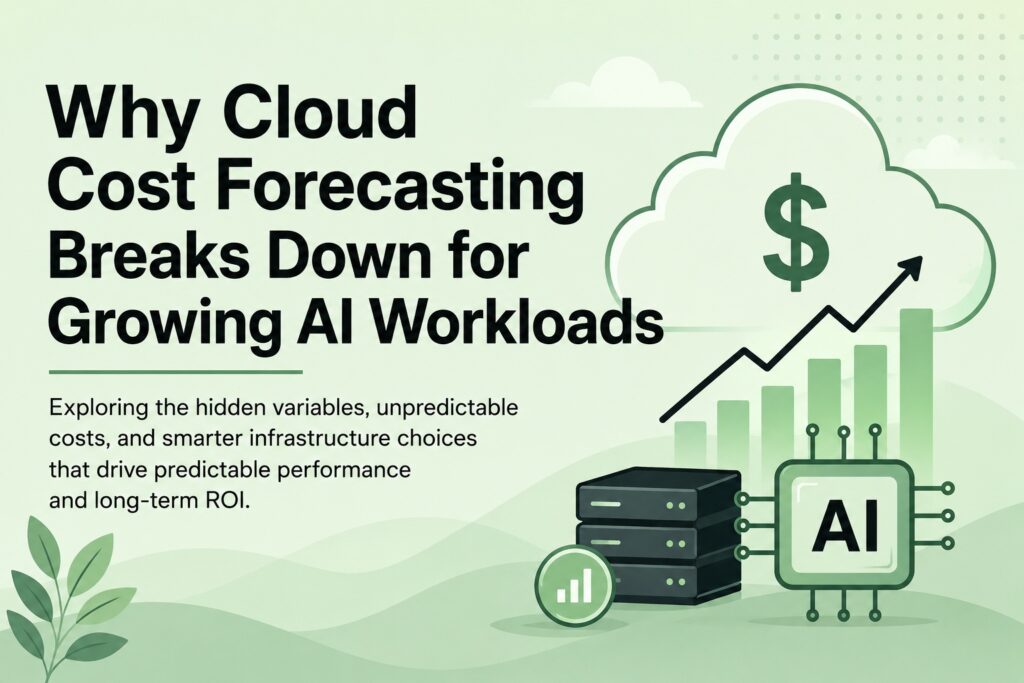
A finance department may expect infrastructure costs to increase proportionally with customer growth, but AI workloads rarely scale in clean linear patterns. GPU reservation pricing changes based on market demand. Autoscaling introduces hidden idle overhead. Cross-region replication expands quietly behind the scenes. Temporary inference spikes create larger-than-expected compute consumption that permanently alters baseline monthly spending.
Eventually organizations realize they are no longer forecasting infrastructure with precision. They are forecasting variance.
And variance creates problems that spread much further than infrastructure alone.
Why AI Infrastructure Variance Becomes a Business Risk
Most infrastructure conversations still revolve around uptime percentages, yet many enterprise organizations are beginning to discover that operational variance creates a larger long-term financial problem than downtime itself.
Downtime is visible. Variance spreads slowly across everything.
When infrastructure costs fluctuate unpredictably, forecasting accuracy declines. When GPU availability shifts in multitenant environments, latency consistency changes as well. A slight increase in inference response time may not look serious on paper, yet small delays can influence customer engagement, conversion behavior, retention rates, and application responsiveness in ways that compound over time.
This becomes especially important for organizations operating customer-facing AI platforms where infrastructure performance directly affects user experience.
At the same time, finance departments are attempting to reconcile invoices influenced by dozens of unpredictable variables including GPU reservation competition, storage expansion, autoscaling overhead, retraining cycles, and bandwidth consumption across geographically distributed workloads. In many cases, infrastructure spending begins growing faster than revenue itself, not because organizations are necessarily wasting resources, but because AI systems naturally evolve toward higher operational complexity as they mature.
That creates a difficult situation for leadership teams. Infrastructure stops behaving like a predictable operational expense and starts behaving more like a fluctuating market variable.
Oddly enough, many companies discover that “infinite elasticity” sounds far more attractive during growth presentations than it feels during quarterly financial reviews.
Why Dedicated Infrastructure Is Returning to the Conversation
Over the last several years, dedicated infrastructure was frequently portrayed as less agile than public cloud environments. The industry narrative heavily favored cloud-first deployment strategies, particularly for organizations prioritizing rapid growth and deployment flexibility. For many workloads, that approach absolutely made sense.
Now the conversation is becoming more nuanced.
Organizations operating persistent AI environments are increasingly recognizing that mature infrastructure planning requires balancing scalability with predictability. Continuous inference pipelines, AI analytics platforms, rendering workloads, and customer-facing machine learning systems often benefit from infrastructure environments where performance characteristics remain stable instead of fluctuating dynamically under multitenant conditions.
The differences become more noticeable once organizations compare how persistent AI workloads behave operationally across cloud and dedicated infrastructure models.
| Infrastructure Factor | Public Cloud AI Environments | Dedicated AI Infrastructure |
|---|---|---|
| Monthly Cost Predictability | Variable billing tied to workload fluctuations | Stable monthly operational forecasting |
| GPU Resource Availability | Shared allocation and reservation competition | Dedicated access to assigned hardware |
| Performance Consistency | Can fluctuate under multitenant load conditions | Consistent workload performance |
| Long-Term ROI Forecasting | Increasingly difficult as workloads mature | Easier long-term operational modeling |
| Cross-Region Data Costs | Frequently expands unpredictably | More controlled networking expenses |
| Latency Stability | Variable during peak shared usage periods | Predictable low-latency performance |
| Infrastructure Variance | Higher operational unpredictability | Lower performance and financial variance |
| Best Fit | Experimental or burst-heavy workloads | Persistent enterprise AI operations |
This does not mean public cloud infrastructure suddenly loses value. Cloud environments still excel for rapid deployment, proof-of-concept development, temporary scaling events, and short-duration experimentation. The forecasting challenges typically emerge later, after AI systems become operationally critical and infrastructure spending begins influencing profitability discussions at the executive level.
That is where dedicated infrastructure starts looking less like “traditional hosting” and more like a strategic operational decision.
Organizations running persistent AI workloads increasingly prioritize predictable monthly costs, stable GPU availability, reduced noisy-neighbor interference, and consistent latency behavior because those factors directly affect long-term operational planning. Once AI services become tied to customer retention, recurring revenue, and business continuity, infrastructure consistency starts becoming financially valuable in ways many organizations do not fully appreciate during early growth phases.
At ProlimeHost, many enterprise clients deploying AI inference clusters and analytics environments prioritize infrastructure predictability because stable performance often translates directly into more predictable business outcomes. Finance teams gain cleaner forecasting models, engineering departments spend less time compensating for cloud variability, and leadership gains greater confidence in long-term operational ROI planning.
The irony is difficult to ignore. Many businesses initially moved toward cloud infrastructure seeking flexibility, yet eventually return to dedicated infrastructure seeking control.
And once AI workloads mature, control becomes extremely valuable.
AI Growth Changes Infrastructure Economics
One of the least discussed realities surrounding enterprise AI deployment is that successful AI platforms eventually begin changing the economics of the infrastructure supporting them. During early development stages, organizations are primarily focused on innovation speed and deployment flexibility. Cost efficiency often becomes secondary to rapid experimentation.
That mindset shifts quickly once workloads become persistent.
As AI services mature, infrastructure decisions begin influencing margins, forecasting accuracy, and long-term operational stability. Leadership teams start asking more difficult questions. Why are compute expenses growing faster than customer adoption? Why does latency fluctuate despite increased spending? Why are engineering teams spending so much time managing cloud reservation strategies instead of building products?
These questions are becoming increasingly common across the industry because AI systems naturally create infrastructure pressure that traditional SaaS forecasting models were never designed to handle particularly well.
This is one reason hybrid infrastructure strategies are becoming more common in 2026. Some workloads remain in public cloud environments where flexibility matters most. Others move toward dedicated infrastructure environments optimized for long-term predictability and operational consistency.
The shift is not ideological. It is financial.
Related Reading
Organizations evaluating AI infrastructure predictability may also find these ProlimeHost articles useful:
Why AI Projects Fail Long Before Hardware Runs Out
The Hidden Cost of Shared GPU Environments for Enterprise AI Workloads
How to Size AI Infrastructure Correctly in 2026
For broader industry analysis surrounding AI operational economics and infrastructure forecasting, organizations may also review research by the IMF.
FAQs
Is cloud infrastructure always more expensive for AI workloads?
Not necessarily. Smaller workloads or highly burst-oriented deployments may still benefit substantially from cloud flexibility. Problems typically emerge once workloads become persistent, GPU-intensive, and difficult to forecast consistently over time.
Why are AI workloads harder to forecast than traditional SaaS applications?
Because AI systems consume infrastructure differently. GPU demand fluctuates unpredictably, inference requests vary unevenly, retraining cycles consume compute resources irregularly, and storage growth often accelerates much faster than expected.
Traditional SaaS forecasting models were not really designed around that level of infrastructure variability.
Are dedicated GPU servers better for inference workloads?
For many persistent inference environments, yes. Dedicated infrastructure often provides more stable performance characteristics, predictable monthly operational costs, and reduced multitenant interference compared to heavily shared environments.
Though honestly, workload benchmarking should still happen before any major migration decision.
What industries experience the most AI infrastructure forecasting challenges?
Healthcare AI, SaaS platforms, analytics providers, rendering pipelines, financial services, and customer-facing AI automation platforms frequently encounter these issues because they rely heavily on continuous low-latency inference operations.
Does infrastructure variance affect customer experience directly?
Absolutely.
Even relatively small latency increases can influence how users interact with AI applications, especially in environments where responsiveness affects engagement, conversions, or productivity outcomes. Customers may never see infrastructure invoices, but they definitely notice slower systems.
Final Thoughts
The future of AI infrastructure planning will not revolve exclusively around raw compute power. Increasingly, it will revolve around predictability.
As workloads mature, infrastructure decisions become financial decisions. Performance consistency becomes a revenue discussion. Operational variance becomes a forecasting problem that affects engineering, finance, customer retention, and long-term business planning simultaneously.
Cloud infrastructure will absolutely remain critical for modern AI development. The flexibility is real. The scalability is real. But many organizations are beginning to realize that mature AI operations often require a different balance between scalability and operational control than they originally anticipated.
That realization is driving renewed interest in predictable infrastructure environments designed around stable performance, cleaner forecasting, and long-term operational consistency.
To learn more about scalable AI infrastructure solutions built around predictable operational performance, visit ProlimeHost, explore Dedicated GPU Servers, or review Enterprise Dedicated Hosting solutions designed for enterprise AI growth.
You can also contact ProlimeHost directly at 877-477-9454 to discuss dedicated infrastructure solutions optimized for AI, SaaS, analytics, rendering, and enterprise-scale workloads.
Author: Steve Bloemer, Director of Sales & Operations at ProlimeHost