The AI Infrastructure Decision That Actually Impacts Profitability
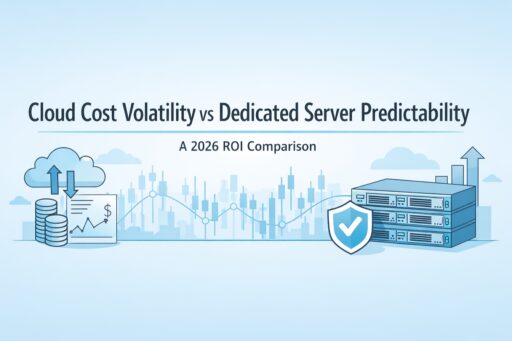
The conversation around AI infrastructure has shifted. What used to be a technical decision is now a financial one, and increasingly, a board-level discussion. The choice between cloud and bare metal is no longer about convenience or speed to deploy. It is about cost predictability, performance consistency, and ultimately, return on investment.
As AI workloads scale, especially in training and inference environments, the gap between cloud pricing models and dedicated infrastructure economics becomes impossible to ignore. What looks flexible at low utilization becomes financially unstable at scale. What looks expensive upfront begins to outperform on a per-unit basis.
This is where the distinction between cloud infrastructure and bare metal dedicated GPU servers becomes critical.
Cloud vs Bare Metal: Cost and Performance Comparison (2026)
When evaluating AI infrastructure, the most useful comparison is not theoretical, it is operational. The table below reflects how cloud and dedicated environments behave under sustained AI workloads.
| Metric | Cloud Infrastructure | Bare Metal (ProlimeHost Dedicated GPU) |
|---|---|---|
| Cost Structure | Variable, usage-based, fluctuates monthly | Fixed monthly cost with predictable billing |
| Performance | Shared environment, subject to contention | Fully dedicated resources, consistent output |
| Cost Per Output | Increases over time as workloads stabilize | Decreases as utilization increases |
| Scalability | Instant but costly at scale | Planned scaling with controlled cost growth |
| Data Transfer Fees | Egress fees can materially impact cost | No hidden transfer fees in most configurations |
| Resource Availability | Dependent on region and demand | Reserved capacity, always available |
| GPU Utilization Efficiency | Often reduced due to shared overhead | Near 100% utilization potential |
| Financial Predictability | Low, difficult to forecast accurately | High, aligns with budgeting and forecasting |
| ROI Profile | Strong at low usage, weak at scale | Improves significantly at sustained workloads |
Why This Comparison Matters
What this table highlights is a shift in how infrastructure should be evaluated. The question is no longer “what does it cost per month,” but rather “what does it cost to produce meaningful output.”
The Illusion of Flexibility in Cloud AI Infrastructure
Cloud platforms like AWS and Google Cloud position themselves around elasticity. The promise is simple: scale up when needed, scale down when not. In practice, AI workloads rarely behave this way.
Training cycles run continuously. Inference workloads demand consistent uptime. Data pipelines require predictable throughput. The result is that “elastic” usage becomes persistent usage, and persistent usage is where cloud pricing begins to break financial models.
Costs fluctuate based on demand, region, congestion, and hidden variables like data egress. What finance teams expect to be variable often becomes unpredictable. This unpredictability is not just a billing issue; it is a forecasting problem.
Bare Metal: Where Performance Becomes Predictable ROI
Bare metal infrastructure, particularly dedicated GPU servers, operates on a fundamentally different economic model. Instead of paying for abstraction layers and shared environments, organizations are investing in fixed performance capacity.
With providers like ProlimeHost, that capacity is not just fixed, it is engineered for consistency. Enterprise-grade hardware, optimized storage, and high-throughput networking eliminate the variability that often undermines AI workloads in multi-tenant environments.
The financial implication is straightforward. When performance is predictable, output becomes measurable. When output is measurable, cost per unit; whether that is per training cycle, per inference, or per million requests becomes controllable.
This is where bare metal shifts from an IT decision to a financial lever.
Cost Per Output: The Metric That Changes the Conversation
Traditional infrastructure comparisons focus on monthly cost. That framing is incomplete. A more accurate lens is cost per output, which reflects how much usable work is produced per dollar spent. In AI environments, this might mean cost per training epoch, cost per inference batch, or cost per million API requests.
Cloud environments often appear cost-effective at low utilization, but as workloads stabilize, inefficiencies compound. Shared resources, throttling, and I/O contention reduce effective throughput while costs remain elevated.
Dedicated GPU servers invert this relationship. With no noisy neighbors and full hardware allocation, workloads run at maximum efficiency. The same dollar produces more output.
Over time, this difference compounds into a measurable ROI advantage.
When the Shift from Cloud to Bare Metal Happens
The transition point is not theoretical. It typically occurs when workloads become continuous rather than intermittent.
Organizations running consistent AI inference pipelines, training large models, or deploying production-level AI applications often find that cloud costs escalate faster than expected. At that point, the question is no longer whether cloud is convenient, but whether it is financially sustainable.
Bare metal becomes the logical next step, not because it is cheaper in isolation, but because it delivers predictable performance aligned with predictable cost.
Why This Matters for Finance Leaders in 2026
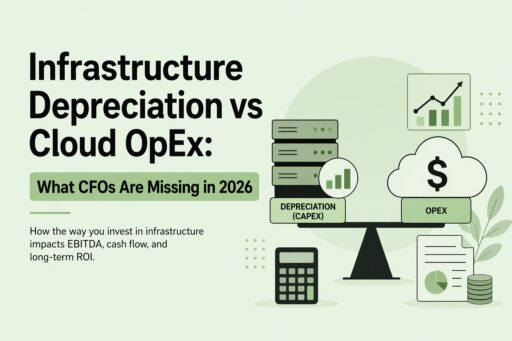
Infrastructure decisions now sit at the intersection of performance and financial strategy. Variability in infrastructure cost directly impacts EBITDA, forecasting accuracy, and valuation models. Cloud introduces variability. Bare metal reduces it.
For CFOs and finance leaders, this is not about technology preference. It is about eliminating uncertainty in one of the most critical cost centers supporting modern revenue generation.
Conclusion: Infrastructure Is Now a Financial Strategy
The debate between cloud and bare metal is no longer about which is better. It is about which aligns with your financial model.
For AI workloads operating at scale, the answer is increasingly clear. Predictable performance drives predictable output. Predictable output drives predictable ROI.
And predictable ROI is what infrastructure decisions are ultimately judged against.
FAQs
Is cloud or bare metal better for AI workloads?
Cloud is effective for short-term or highly variable workloads, but bare metal is typically more cost-efficient and performance-stable for sustained AI operations.
When should a company move from cloud to dedicated servers?
The shift usually happens when workloads become continuous and cloud costs begin to exceed predictable monthly infrastructure investments.
Do dedicated GPU servers outperform cloud GPUs?
Yes, in most sustained workloads. Dedicated GPUs eliminate resource contention and deliver consistent, full-capacity performance.
How does bare metal improve ROI?
By providing fixed, predictable performance, bare metal increases output per dollar, reducing cost per compute unit over time.
My Thoughts
If your AI infrastructure costs are becoming harder to predict, or if performance variability is starting to impact output, it may be time to evaluate a different approach.
ProlimeHost delivers enterprise-grade dedicated and GPU servers designed for predictable performance and measurable ROI.
Explore your options or speak directly with our team to model your cost per output and identify where bare metal begins to outperform cloud.
Contact ProlimeHost today at 877-477-9454 or visit https://www.prolimehost.com to get started.