Executive Summary
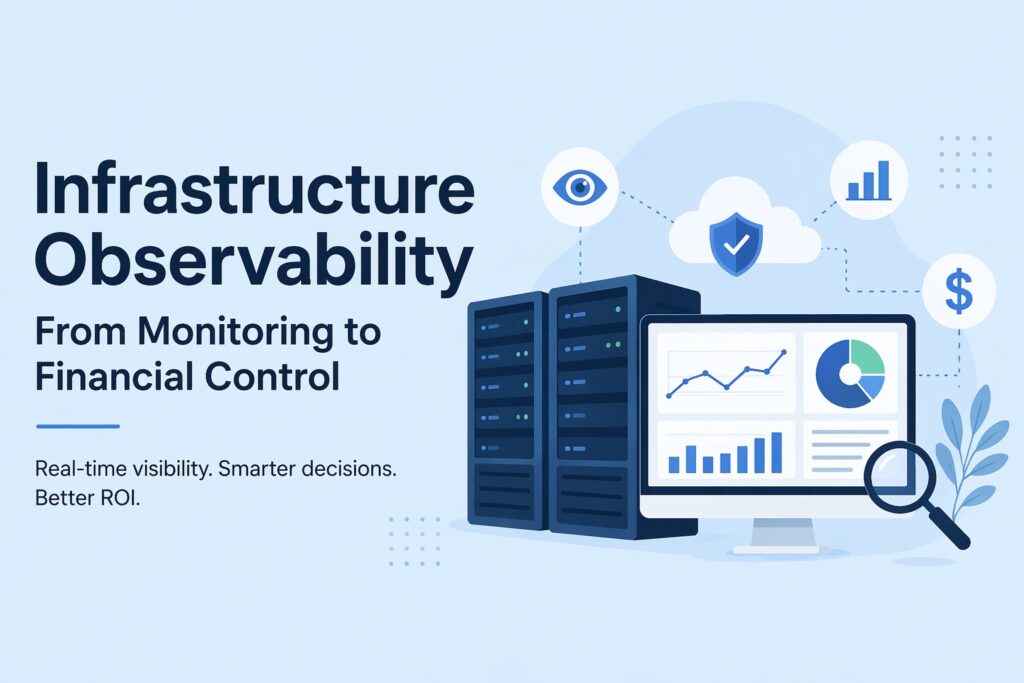
Infrastructure observability has traditionally been viewed as a technical function; something used by engineering teams to track uptime, performance, and system health. In 2026, that definition is outdated.
Infrastructure observability is the ability to understand system performance, resource usage, and cost behavior in real time using metrics, logs, and traces.
Observability has become a financial control system, providing real-time insight into how infrastructure decisions translate into cost, performance, and ultimately ROI. Organizations that lack visibility into their infrastructure are not just operating inefficiently, they are operating without a clear understanding of how costs are generated or controlled.
As frameworks influenced by Financial Accounting Standards Board continue to emphasize transparency and predictability, infrastructure visibility is becoming part of financial governance, not just technical oversight.
From Monitoring to Financial Visibility
Traditional monitoring answers a simple question: is the system running? Observability answers a much more important one: what is this system costing us, and why?
In cloud environments, where billing is tied to usage across compute, storage, and network layers, a lack of visibility creates blind spots. Costs accumulate across services, often disconnected from the workloads that generated them. This disconnect makes it difficult to align infrastructure spend with business outcomes.
In contrast, environments that prioritize observable infrastructure performance and cost alignment allow organizations to directly correlate usage with output. This is where infrastructure begins to function as a measurable financial asset rather than an opaque expense.
Why Observability Impacts ROI
Return on investment in infrastructure is not just about raw performance. It is about efficiency per unit of output. Without observability, inefficiencies remain hidden. Idle resources, underutilized GPUs, and unnecessary data movement all contribute to cost without delivering proportional value.
With observability, these inefficiencies become visible and therefore correctable. Organizations can track:
Cost per workload, performance per dollar, and resource utilization trends over time. This visibility transforms infrastructure from a cost center into a controlled, optimizable system.
Infrastructure Observability vs Cloud Cost Blind Spots
Cloud platforms provide extensive metrics, but visibility does not always translate into clarity. The complexity of billing models from providers like Amazon Web Services often results in fragmented cost attribution. Teams may understand individual service costs but struggle to connect them to specific workloads or outcomes. This creates a paradox: more data, but less actionable insight.
Dedicated infrastructure simplifies this relationship. With fixed-cost environments and direct access to system resources, performance metrics align more closely with cost structures.
The result is not just better visibility, it is actionable financial insight.
How Dedicated Infrastructure Improves Visibility and Control
Dedicated infrastructure provides a foundation for clear, consistent observability. Because resources are not shared, performance metrics reflect actual workload behavior rather than external factors. This allows organizations to accurately measure throughput, utilization, and efficiency.
Cost becomes easier to model. Instead of tracking dozens of variable billing components, organizations operate within a known cost structure.
This clarity enables more precise forecasting, better capacity planning, and stronger alignment between infrastructure investment and business output.
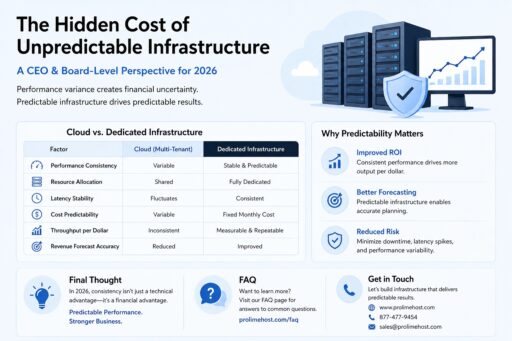
Comparison: Observability in Cloud vs Dedicated Environments
The following comparison outlines the difference between infrastructure monitoring vs observability, focusing on performance visibility, cost control, and financial impact.
Monitoring tells you something is wrong. Observability explains why and how it impacts performance, cost, and system behavior.
| Metric | Cloud Infrastructure | Dedicated Infrastructure |
|---|---|---|
| Cost Visibility | Fragmented across services | Unified and predictable |
| Billing Complexity | High, usage-based | Low, fixed-cost |
| Performance Attribution | Indirect, multi-tenant | Direct, single-tenant |
| Cost per Workload Tracking | Difficult to isolate | Clearly measurable |
| Forecasting Accuracy | Variable | High |
| Resource Utilization Insight | Partial, abstracted | Full system visibility |
| ROI Measurement | Inconsistent | Precise and repeatable |
Why This Matters in 2026
Infrastructure decisions are increasingly evaluated through a financial lens. Organizations are no longer judged solely on growth, but on the predictability and efficiency of that growth. Infrastructure observability plays a central role in this shift.
Without visibility, costs cannot be controlled. Without control, forecasts cannot be trusted.
In 2026, infrastructure observability is not just about knowing what is happening, it is about knowing what it means financially.
FAQs
What is infrastructure observability?
Infrastructure observability is the ability to monitor, measure, and analyze system performance, resource usage, and cost in real time to understand how infrastructure behaves and impacts business outcomes.
How does observability improve ROI?
By identifying inefficiencies such as idle resources and unnecessary workloads, observability allows organizations to optimize performance and reduce waste, improving cost per unit of output.
Why is cloud cost visibility difficult?
Cloud environments distribute costs across multiple services and billing categories, making it difficult to attribute expenses directly to specific workloads.
Is observability only for engineering teams?
No. In 2026, observability is increasingly used by finance and operations teams to improve forecasting, cost control, and strategic planning.
Board-Level Takeaway
Infrastructure observability has evolved into a financial visibility system.
Organizations that invest in clear, measurable infrastructure performance gain a strategic advantage in forecasting accuracy, cost control, and ROI optimization.
My Thoughts
If your infrastructure costs are difficult to explain (or harder to predict) it’s time to rethink the model.
At ProlimeHost, we build enterprise-grade dedicated environments designed for performance clarity and financial predictability. From AI workloads to high-performance compute, our infrastructure is engineered to deliver measurable output without cost ambiguity.
If you’re looking to align infrastructure with financial outcomes, let’s talk.
Steve Bloemer
Director of Sales & Operations
ProlimeHost
📞 877-477-9454
🌐 https://www.prolimehost.com