Executive Summary
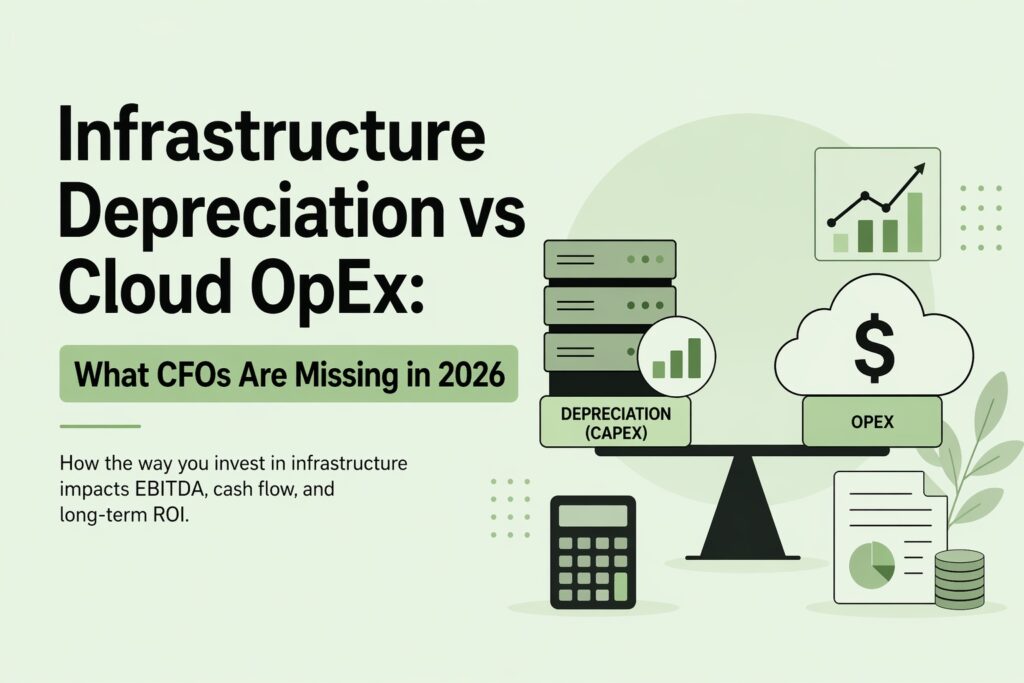
Infrastructure decisions have quietly shifted from technical preferences to financial strategy. The difference between infrastructure depreciation and cloud OpEx is no longer an accounting footnote, it is a driver of EBITDA performance, forecasting accuracy, and valuation.
Cloud infrastructure is treated as a recurring operating expense. Dedicated infrastructure, by contrast, can often be capitalized and depreciated over time under frameworks influenced by Financial Accounting Standards Board guidance.
That distinction changes how costs appear on financial statements, how margins are calculated, and how predictable the business becomes. In 2026, the companies that understand this difference are not just optimizing infrastructure, they are optimizing financial outcomes.
The Accounting Divide: Depreciation vs OpEx
Cloud infrastructure is straightforward from an accounting perspective. It is pure operating expense, recognized fully in the period it is incurred. Every dollar spent directly reduces operating income.
Dedicated infrastructure introduces a different dynamic. When structured appropriately, infrastructure investments can be treated as capital expenditures and depreciated over time. Instead of recognizing the full cost immediately, the expense is spread across the useful life of the asset. The result is a fundamental shift in how infrastructure impacts financial statements.
With cloud, cost is immediate, variable, and fully exposed. With dedicated infrastructure, cost becomes structured, predictable, and amortized over time.
This is not just accounting mechanics. It directly influences how a business reports profitability and manages growth.
Why This Distinction Changes Financial Outcomes
The difference between OpEx and depreciation reshapes financial performance in three important ways.
First, it changes margin visibility. Cloud costs scale linearly with usage, which means margins compress as workloads increase. Dedicated infrastructure, once deployed, allows incremental workload growth without proportional cost increases.
Second, it impacts planning accuracy. Variable OpEx introduces uncertainty into forecasting models. Depreciated infrastructure creates fixed cost baselines, making financial planning more stable and defensible.
Third, it alters capital efficiency. Businesses that rely entirely on OpEx infrastructure often appear asset-light, but they also sacrifice the ability to control long-term cost curves.
This is where many organizations miscalculate. They optimize for short-term flexibility while introducing long-term financial volatility.
The EBITDA Illusion of Cloud Infrastructure
Cloud infrastructure is often perceived as financially efficient because it avoids upfront capital investment. On the surface, this improves cash flow and reduces initial friction. But that perception can be misleading.
Because cloud costs are fully expensed, they continuously impact operating income. As workloads scale, so does the expense base. Over time, this creates pressure on EBITDA, especially for compute-intensive or AI-driven environments.
Dedicated infrastructure behaves differently. Once capitalized, the cost is distributed over time, smoothing its impact on financial statements. The business gains the ability to decouple workload growth from immediate expense growth.
The result is a quieter but meaningful shift: Cloud optimizes for entry. Dedicated infrastructure optimizes for sustained margin performance.
Predictability, Forecasting, and Financial Control
Finance teams do not struggle with cost, they struggle with variance.
Cloud environments introduce variability through usage-based billing, dynamic scaling, and pricing complexity. Even well-managed environments can produce unpredictable cost patterns.
Dedicated infrastructure, by contrast, introduces cost stability. Monthly expenses become consistent, performance becomes predictable, and forecasting models become more reliable.
This stability matters at the board level. Predictable infrastructure translates into predictable financial outcomes, which directly impacts valuation, investor confidence, and strategic planning.
When Dedicated Infrastructure Becomes the Financial Advantage
The shift toward dedicated infrastructure is not immediate. It emerges as workloads mature and stabilize. Early-stage environments benefit from cloud flexibility. But as usage becomes consistent, the economics begin to change.
At a certain point, organizations realize they are no longer paying for flexibility, they are paying for unnecessary variability. This is typically where dedicated infrastructure begins to outperform. Costs flatten, performance stabilizes, and ROI becomes measurable in ways that cloud environments often cannot match.
For AI workloads, high-throughput applications, and always-on systems, this transition tends to happen sooner than expected.
Why This Matters in 2026
The infrastructure conversation is no longer about cost alone. It is about financial structure, predictability, and long-term efficiency. In 2026, organizations are being evaluated not just on growth, but on the quality and predictability of that growth.
Infrastructure decisions now influence how revenue converts to profit, how stable forecasts appear, and how confidently leadership can plan.
That makes infrastructure a finance decision as much as a technical one.
GPU Dedicated Servers vs Cloud GPU: Cost Comparison
At a surface level, cloud GPU infrastructure appears flexible and cost-efficient. There is no upfront commitment, and resources can be scaled on demand. For early-stage experimentation, that flexibility has real value. But as workloads stabilize; especially in AI training, inference pipelines, and high-throughput rendering, the cost model begins to shift in ways that are not immediately obvious.
Cloud GPU environments operate on a usage-based pricing model, where compute, storage, bandwidth, and I/O are all billed independently. As utilization increases, costs scale linearly, or in many cases, unpredictably. Idle time, data transfer, and burst usage all contribute to cost variability, which makes long-term forecasting difficult.
Dedicated GPU servers operate under a fundamentally different model. Infrastructure is provisioned as fixed-cost, high-performance compute, where the entire system is available exclusively to a single workload or organization. There is no contention for resources, no performance throttling due to multi-tenancy, and no incremental billing tied to usage spikes.
The result is not simply lower cost, it is cost stability.
In cloud environments, performance and cost are tightly coupled. In dedicated environments, performance becomes predictable while cost remains constant. Over time, this creates a widening gap in cost per unit of output, particularly for sustained workloads.
This is why many organizations begin in the cloud but transition to dedicated GPU infrastructure once utilization becomes consistent. The decision is less about technology and more about financial efficiency and control.
For a deeper breakdown of how cost variability impacts ROI, see our analysis on infrastructure economics in our blog.
The following comparison highlights the differences between cloud GPU vs dedicated GPU servers, focusing on cost, performance, and ROI predictability.
Cloud GPU vs Dedicated GPU: Financial and Performance Comparison
| Metric | Cloud GPU Infrastructure | Dedicated GPU Servers |
|---|---|---|
| Cost Model | Variable, usage-based | Fixed monthly cost |
| Pricing Predictability | Low, fluctuates with usage | High, consistent billing |
| Performance | Shared / multi-tenant | Fully dedicated resources |
| Resource Contention | Possible during peak demand | None |
| Scalability Cost Curve | Increases linearly (or unpredictably) | Flattens over time |
| Cost per Training Run | Variable, difficult to forecast | Stable and measurable |
| Data Transfer Costs | Additional and often significant | Typically included or minimal |
| Idle Resource Cost | Billed during allocation | No incremental cost once deployed |
| Throughput Consistency | Variable | Predictable |
| ROI Predictability | Low | High |
For organizations running continuous GPU workloads, the shift from variable cloud cost to fixed infrastructure is where ROI becomes measurable and controllable.
When to Use Dedicated GPU Servers (AI, LLMs, Rendering)
The decision to move to dedicated GPU infrastructure is rarely driven by a single factor. It emerges as workloads mature and the limitations of shared environments become more visible.
For AI training and large language models, the primary constraint is throughput. Training cycles require sustained, uninterrupted access to GPU resources. In shared cloud environments, even minor performance variability can extend training times, increasing total cost and delaying output.
Dedicated GPU servers eliminate that variability. With full access to compute, memory, and high-speed NVMe storage, training pipelines run consistently, reducing iteration time and improving overall efficiency. This is particularly important for organizations working with large datasets or continuous model refinement.
In inference environments, predictability becomes even more critical. Latency-sensitive applications; such as real-time AI processing, recommendation engines, or automation pipelines, depend on consistent performance. Dedicated infrastructure ensures that response times remain stable, even under load.
Rendering and high-performance computing workloads follow a similar pattern. Whether processing video, simulations, or complex datasets, these workloads benefit from guaranteed resource availability. Shared environments introduce variability that can disrupt timelines and inflate costs.
The common thread across all of these use cases is utilization. When GPU workloads are intermittent, cloud flexibility is valuable. When workloads are continuous or growing, dedicated infrastructure becomes the more efficient and predictable choice.
Cost Per Training Run: Cloud vs Dedicated
One of the most practical ways to evaluate GPU infrastructure is to move beyond monthly pricing and focus on cost per training run.
In cloud environments, the cost of a single training cycle includes more than just GPU time. Storage I/O, data transfer, orchestration overhead, and idle time between jobs all contribute to the total cost. Because pricing is variable, the same training run can produce different costs depending on system load, availability, and scaling behavior.
This introduces a level of uncertainty that is difficult to model, particularly for organizations running frequent or large-scale training jobs.
Dedicated GPU servers change this equation. With fixed monthly pricing and consistent performance, the cost of each training run becomes predictable. Training time stabilizes, resource availability is guaranteed, and there are no additional charges for data movement within the environment. Over time, this leads to a lower and more consistent cost per completed workload.
Consider a scenario where a model requires repeated training cycles. In a cloud environment, each iteration incurs variable costs and potential delays. In a dedicated environment, the same cycles can be executed back-to-back with no performance degradation or cost fluctuation.
This is where the financial advantage becomes clear. Cloud optimizes for access. Dedicated infrastructure optimizes for output efficiency.
For organizations focused on scaling AI capabilities, this distinction is critical. The goal is not simply to run workloads; it is to run them predictably, efficiently, and at a known cost per result.
FAQs
What is the difference between OpEx and depreciation in infrastructure?
OpEx is recognized immediately as an expense, reducing operating income in the current period. Depreciation spreads the cost of an asset over time, smoothing its financial impact.
Why does cloud infrastructure affect EBITDA more directly?
Because cloud costs are fully expensed, they directly reduce operating income each month. As usage grows, so does the expense.
Can dedicated servers always be depreciated?
Treatment depends on how the infrastructure is structured and accounted for, but dedicated environments often allow for more favorable long-term cost recognition.
When should a company move from cloud to dedicated infrastructure?
The shift typically occurs when workloads become predictable and continuously utilized, making variable pricing less efficient than fixed-cost infrastructure.
Board-Level Takeaway
Infrastructure is no longer just an IT decision, it is a financial architecture decision.
The choice between OpEx and depreciation directly impacts EBITDA, forecasting reliability, and long-term valuation.
Organizations that prioritize predictable infrastructure performance gain a measurable advantage in financial clarity and control.
My Thoughts
If your infrastructure costs are increasing while predictability is decreasing, it may be time to rethink the model.
At ProlimeHost, we design enterprise-grade dedicated server environments built around one principle: Predictable Performance = Predictable ROI. From high-performance compute to GPU-accelerated infrastructure, our solutions are engineered to deliver consistent output without cost volatility.
If you’re evaluating when to transition from cloud to dedicated, or simply want a clearer financial picture of your infrastructure, let’s have a conversation.
Steve Bloemer
Director of Sales & Operations
ProlimeHost
📞 877-477-9454
🌐 https://www.prolimehost.com