The Wrong Question Has Dominated This Conversation for Years
Imagine you’re sitting in a quarterly budget review. The IT department has submitted next year’s infrastructure proposal, and somewhere in the discussion someone asks a familiar question.
“Should we buy servers and colocate them, or should we lease dedicated servers?”
On the surface, it sounds straightforward. Compare the monthly costs, estimate hardware expenses, and choose whichever option appears less expensive. Unfortunately, that’s also the quickest way to arrive at the wrong conclusion.
Infrastructure rarely behaves like a household purchase where the lowest price automatically represents the best value. Servers become part of an organization’s operating model. They require planning, maintenance, monitoring, upgrades, replacement, and ongoing management. Every one of those activities consumes either money, employee time, or both. The monthly invoice may be the most visible expense, but it is almost never the largest contributor to the total cost of ownership over the life of the infrastructure.
This is where many organizations unintentionally underestimate their long-term costs. They compare rack fees against server rental fees while overlooking depreciation schedules, warranty administration, procurement delays, hardware failures, staffing requirements, replacement inventory, shipping expenses, and the opportunity cost of diverting highly skilled engineers away from strategic initiatives. Those hidden expenses rarely appear on the initial proposal, yet they often determine whether an infrastructure investment ultimately delivers value.
The conversation becomes even more important as organizations grow. What works efficiently for three servers can become remarkably inefficient for thirty. Likewise, a solution that appears expensive during the first year may prove considerably more economical after five years once operational efficiencies are taken into account. Long-term infrastructure planning has a habit of rewarding those who look beyond the obvious numbers.
Looking Beyond Purchase Price
Business leaders frequently distinguish between cost and value, yet infrastructure purchasing sometimes ignores that distinction. A server purchased for $8,000 may seem less expensive than leasing comparable hardware over several years, but that comparison assumes the purchase price represents the complete investment. It doesn’t.
Ownership introduces responsibilities that extend well beyond the acquisition itself. Every physical component eventually fails. Storage devices wear out. Memory modules occasionally develop faults. Power supplies fail without warning. Firmware requires updates. Security vulnerabilities demand remediation. Hardware eventually reaches the end of its useful life regardless of how well it has been maintained.
When an organization owns the hardware, every one of those responsibilities belongs to the organization as well. Someone must monitor warranties, maintain spare parts, coordinate repairs, schedule maintenance windows, arrange shipping, update inventory records, and eventually plan for replacement. None of those activities are particularly glamorous, yet together they represent a significant operational investment that often goes unmeasured.
Dedicated server hosting approaches the problem differently. Instead of purchasing physical assets, businesses purchase availability, performance, and support. The provider assumes responsibility for maintaining the underlying hardware while the customer focuses on applications, services, and business operations. From an accounting perspective, that difference shifts many unpredictable capital expenses into predictable operating expenses, simplifying both budgeting and long-term financial planning.
Neither approach is inherently superior. Each has situations where it excels. The challenge lies in recognizing that hardware cost represents only one chapter in a much longer financial story.
Understanding Total Cost of Ownership
Financial professionals rarely evaluate major investments based solely on acquisition costs. They examine lifecycle costs because those provide a much more accurate picture of long-term value. Infrastructure deserves the same treatment.
Total Cost of Ownership (TCO) encompasses every expense associated with acquiring, operating, maintaining, and eventually replacing technology assets. Industry organizations such as the National Institute of Standards and Technology (NIST), Gartner, and the Uptime Institute consistently encourage organizations to evaluate infrastructure decisions through this broader lens because operational costs frequently exceed the original purchase price over time.
Consider what happens during a typical five-year infrastructure lifecycle. Hardware must be purchased or leased. Power and cooling consume ongoing resources. Operating systems require updates. Storage capacity expands. Security patches become routine. Components occasionally fail. Business requirements evolve. New applications demand additional compute capacity, while aging hardware gradually becomes less efficient than newer platforms.
Viewed individually, these expenses appear manageable. Viewed collectively, they often reshape the economics of an infrastructure strategy.
One company may proudly announce that it owns every server in its data center. Another may lease every piece of hardware from a dedicated hosting provider. Five years later, the second organization may have spent less money overall—not because the monthly invoices were lower, but because operational efficiency eliminated dozens of smaller expenses that quietly accumulated over time.
That’s why executives increasingly focus on lifecycle economics instead of purchase price.
Capital Expenditure Versus Operating Expense
Perhaps the most significant financial distinction between colocation and dedicated servers involves the way each affects capital allocation.
Colocation generally begins with a substantial capital investment. Servers, storage systems, networking equipment, spare components, and related infrastructure become organizational assets that appear on the balance sheet. Those assets depreciate over time, and although depreciation provides accounting benefits, it also ties capital into equipment that gradually loses value.
Dedicated servers, by comparison, typically convert infrastructure into an operating expense. Rather than purchasing depreciating assets, organizations pay predictable monthly fees for access to enterprise-grade hardware. This approach preserves capital that can instead be invested in product development, acquisitions, hiring, marketing, or other initiatives capable of generating revenue.
For growing companies, preserving liquidity can be more valuable than owning hardware outright. Every dollar committed to infrastructure is a dollar unavailable for strategic opportunities elsewhere in the business. That reality has become particularly relevant as technology refresh cycles continue to shorten and hardware innovation accelerates.
Of course, there are exceptions. Organizations with significant cash reserves and highly specialized hardware requirements may find ownership financially advantageous over longer periods. Businesses operating under regulatory requirements or highly customized infrastructure architectures may also prefer capital ownership despite the additional responsibilities.
The key point is that infrastructure decisions should align with broader financial strategy rather than existing solely within the IT department. When finance and technology leaders evaluate investments together, conversations become far more productive because they extend beyond processor specifications and monthly hosting fees.
The Hidden Cost of Engineering Time
One of the least appreciated components of infrastructure ownership isn’t hardware at all. It’s people.
Experienced systems engineers represent some of the most valuable employees within modern organizations. Their expertise drives automation, security, performance optimization, cloud integration, disaster recovery planning, and application reliability. Every hour they spend replacing failed hardware, coordinating warranty claims, updating inventory spreadsheets, or arranging emergency shipments is an hour unavailable for higher-value work.
This doesn’t imply that hardware maintenance lacks importance. Quite the opposite. Maintaining reliable infrastructure remains essential. The question is whether those responsibilities represent the highest and best use of internal talent.
Organizations frequently calculate server costs while overlooking engineering costs. Yet engineering labor often exceeds hardware maintenance expenses over the life of an infrastructure deployment. Even seemingly minor administrative tasks accumulate. Coordinating replacement drives, documenting asset inventories, scheduling maintenance windows, validating firmware revisions, and managing refresh projects all consume valuable technical resources.
Dedicated hosting providers distribute those responsibilities across specialized operational teams whose primary focus is maintaining infrastructure at scale. Individual businesses benefit from that expertise without dedicating their own engineering staff to physical hardware management. For many organizations, that shift alone materially improves operational efficiency.
There’s another dimension that receives even less attention.
When highly skilled engineers spend less time managing physical infrastructure, they gain more time to improve automation, strengthen cybersecurity, optimize applications, reduce technical debt, and accelerate digital transformation initiatives. Those projects often generate measurable business value that extends far beyond the savings associated with hardware maintenance itself.
In other words, infrastructure decisions don’t merely influence technology costs.
They influence organizational productivity.
Procurement Delays Rarely Appear on Financial Statements
One aspect of infrastructure planning receives surprisingly little attention until it becomes a crisis: procurement. Purchasing enterprise hardware isn’t as simple as clicking a button and waiting for a delivery truck. Organizations must define specifications, obtain competitive quotes, secure budget approval, submit purchase orders, coordinate with vendors, schedule delivery, rack equipment, configure systems, and finally migrate workloads. Even in healthy supply chains, that process can consume weeks. During periods of hardware shortages, it can stretch into several months.
Those delays carry a real cost, even if they never appear as a line item in an accounting report. When a new customer deployment waits six weeks for hardware to arrive, revenue is delayed. When developers postpone a product launch because infrastructure isn’t available, competitive opportunities may disappear. The business absorbs those costs whether anyone measures them or not.
Dedicated server hosting changes that equation. Reputable providers maintain inventory specifically so customers can deploy quickly, often within hours or days instead of months. The value isn’t simply convenience. Faster deployment accelerates projects, reduces idle engineering time, and allows organizations to respond more quickly to changing business conditions. Agility has become a competitive advantage, and infrastructure should support that objective rather than slow it.
Technology Obsolescence Is a Financial Risk
Every executive understands depreciation. Fewer appreciate the practical consequences of technology depreciation. Hardware doesn’t merely lose accounting value over time; it gradually becomes less efficient, less power-conscious, and less capable of supporting modern workloads. A server that performed exceptionally five years ago may still function perfectly, yet consume more electricity, require more maintenance, and deliver significantly lower performance per watt than current platforms.
Organizations that own hardware eventually face a difficult decision. Should they continue operating aging systems because they are fully depreciated, or replace them before maintenance costs and performance limitations begin affecting the business? Neither choice is free. Extending the lifecycle increases operational risk, while replacing hardware demands another round of capital investment.
Dedicated hosting shifts much of that lifecycle risk to the provider. As newer processor generations become available, businesses can migrate to updated platforms without carrying obsolete assets on their balance sheet or attempting to recover residual value from aging equipment. That flexibility becomes particularly valuable as processor technology continues advancing at an impressive pace.
This isn’t an argument against ownership. Rather, it’s a reminder that ownership includes responsibility for deciding when equipment has reached the point where keeping it costs more than replacing it.
Scalability Should Never Be an Afterthought
Growth rarely follows perfectly predictable patterns. Some businesses double in size within a year. Others experience seasonal spikes, mergers, acquisitions, or unexpected customer wins that rapidly change infrastructure requirements. Building an infrastructure strategy around today’s workloads alone often creates unnecessary constraints tomorrow.
Colocation scales well, but scaling generally requires additional hardware purchases. That means forecasting future demand, committing capital in advance, and hoping projections prove accurate. Buy too little, and expansion is delayed. Buy too much, and expensive equipment sits underutilized while depreciating.
Dedicated server hosting offers a different form of flexibility. Capacity can typically be added incrementally as demand increases. Instead of making a large capital commitment based on projected growth, organizations can align infrastructure spending more closely with actual business expansion. For finance departments, this improves cash flow management. For operations teams, it reduces the pressure to predict future demand with perfect accuracy.
That difference becomes increasingly meaningful as organizations expand into multiple regions or launch new digital services. Infrastructure should adapt to business growth, not dictate its pace.
Security and Reliability Depend More on Process Than Ownership
One misconception still surfaces in infrastructure discussions: that owning hardware automatically provides greater security. In reality, security depends far more on operational discipline than ownership.
Both colocation facilities and enterprise dedicated hosting providers typically operate within professionally managed data centers featuring redundant power, environmental controls, physical access restrictions, and continuous monitoring. Whether the hardware belongs to the customer or the provider has relatively little impact on these foundational protections.
What matters is how systems are maintained. Are firmware updates applied consistently? Are access controls reviewed regularly? Is remote management secured? Are backups tested? Are disaster recovery procedures documented and practiced? These questions determine resilience far more effectively than a purchase receipt.
Organizations evaluating infrastructure should therefore compare operational maturity rather than simply comparing ownership models. A well-managed dedicated environment can be every bit as secure and reliable as a colocated deployment, while a poorly maintained owned environment may expose significant operational risk despite complete hardware ownership.
Making the Decision: A Business Framework
After examining the financial and operational considerations, the choice becomes less about ideology and more about business objectives.
If your organization already owns specialized equipment, employs experienced infrastructure engineers, and expects relatively stable workloads over many years, colocation may provide excellent long-term value. Ownership offers maximum customization and direct control over every aspect of the hardware environment.
Conversely, if your business prioritizes predictable operating expenses, rapid scalability, simplified lifecycle management, and preserving capital for strategic initiatives, dedicated server hosting frequently becomes the more attractive option. Neither choice is universally correct because every organization balances cost, flexibility, risk, and growth differently.
The most successful companies resist the temptation to frame the discussion as “which technology is better?” Instead, they ask a more productive question: “Which infrastructure model best supports our business strategy over the next five years?”
That subtle change in perspective often leads to better decisions.
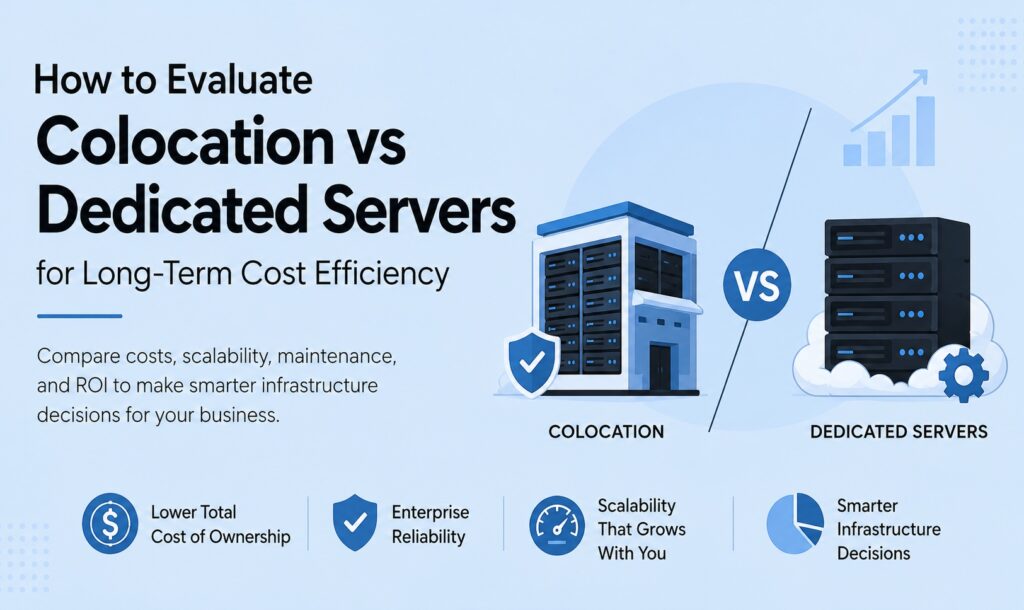
Colocation vs. Dedicated Servers Comparison
| Evaluation Criteria | Colocation | Dedicated Servers |
|---|---|---|
| Initial Capital Investment | High | Very Low |
| Monthly Cost Predictability | Moderate | High |
| Hardware Ownership | Customer | Provider |
| Hardware Maintenance | Customer Responsibility | Provider Responsibility |
| Warranty Administration | Customer | Provider |
| Technology Refresh | Customer Planned | Provider Facilitated |
| Deployment Speed | Weeks to Months | Hours to Days |
| Engineering Overhead | Higher | Lower |
| Cash Flow Flexibility | Lower | Higher |
| Best Fit | Specialized, stable environments | Growing, agile organizations |
The table summarizes the decision, but it shouldn’t replace careful analysis. Infrastructure investments rarely succeed because they scored well in a comparison chart. They succeed because they align with business priorities, financial strategy, and operational capabilities.
Continuing Your Infrastructure Planning
If you’re evaluating long-term infrastructure strategy, several related ProlimeHost resources expand on topics discussed throughout this article.
When considering how infrastructure investments fit within broader financial planning, read How to Build an Infrastructure Budget That Survives Growth:
https://www.prolimehost.com/blogs/how-to-build-an-infrastructure-budget-that-survives-growth/
If you’re uncertain whether existing systems are being fully utilized before expanding capacity, How to Measure Server Utilization Before Buying Additional Hardware provides a practical framework:
https://www.prolimehost.com/blogs/measure-server-utilization-before-buying-new-hardware/
Organizations preparing funding requests should also review How to Build an Infrastructure Business Case That Wins Budget Approval:
https://www.prolimehost.com/blogs/infrastrcture-business-case/
To improve service reliability while aligning infrastructure with business expectations, explore How to Create Infrastructure Service Level Objectives (SLOs) That Support Business Growth:
https://www.prolimehost.com/blogs/how-to-create-infrastructure-slos-for-business-growth/
Finally, infrastructure planning should always include contingency planning. How to Create an Infrastructure Exit Strategy Before Vendor Lock-In Becomes a Business Risk examines that topic in depth:
https://www.prolimehost.com/blogs/infrastructure-exit-strategy-vendor-lock-in-risk/
For organizations ready to evaluate enterprise hosting solutions, ProlimeHost offers both Dedicated Server Hosting and GPU Dedicated Servers designed for performance-focused workloads.
Dedicated Servers:
https://www.prolimehost.com/dedicated-server-hosting/
GPU Dedicated Servers:
https://www.prolimehost.com/gpu-dedicated-servers/
Additional research from organizations including NIST, the Uptime Institute, Gartner, VMware, and Red Hat provides valuable guidance when developing long-term infrastructure strategies.
Frequently Asked Questions
Is colocation always less expensive than dedicated servers?
Not necessarily. Colocation often appears less expensive when comparing only recurring facility fees, but ownership introduces additional costs such as hardware purchases, depreciation, maintenance, engineering labor, warranty management, and refresh cycles. Evaluating Total Cost of Ownership usually provides a much more accurate comparison.
When does dedicated hosting usually provide the best return on investment?
Dedicated hosting frequently delivers the strongest ROI when businesses value predictable budgeting, rapid scalability, reduced operational overhead, and preserving capital for revenue-generating initiatives. Companies experiencing rapid growth often find these advantages outweigh the benefits of hardware ownership.
Should every organization avoid purchasing servers?
Absolutely not. Organizations with specialized hardware requirements, regulatory obligations, or substantial existing investments may benefit significantly from colocation. The correct decision depends on business objectives rather than industry trends.
How often should enterprise servers be refreshed?
Although every environment differs, many organizations begin evaluating hardware refreshes after four to six years. Performance requirements, maintenance costs, power efficiency, and warranty status all influence the appropriate timing.
What’s the biggest mistake businesses make when comparing these models?
Most organizations compare monthly invoices instead of lifecycle economics. That approach overlooks engineering labor, procurement delays, depreciation, opportunity costs, and technology refresh expenses that frequently determine the true financial outcome.
Conclusion
Choosing between colocation and dedicated server hosting isn’t about deciding which technology is more impressive. It’s about determining which investment supports the organization’s broader business strategy with the least financial friction and the greatest long-term value.
Businesses that evaluate infrastructure solely by purchase price often discover hidden operational costs years later. Those that examine cash flow, staffing, procurement, scalability, depreciation, lifecycle management, and business agility tend to make decisions that remain beneficial long after the original hardware would have been replaced.
Infrastructure should never be viewed as an isolated IT expense. It is a business asset that influences productivity, innovation, customer experience, and financial performance. When viewed through that broader lens, the conversation naturally shifts away from servers themselves and toward the outcomes those servers enable.
That’s where the best infrastructure decisions are made.
My Thoughts
Whether you’re considering colocation, dedicated server hosting, or a hybrid infrastructure strategy, ProlimeHost can help you evaluate each option using measurable business criteria rather than marketing promises. Our team works with organizations to identify solutions that improve performance, simplify operations, and maximize long-term return on investment.
Contact ProlimeHost today to discuss your infrastructure goals and discover which platform best supports your organization’s growth strategy.
About the Author
Steve Bloemer
Director of Sales & Operations
ProlimeHost
Steve Bloemer has spent decades helping businesses design infrastructure solutions that balance technical performance with sound financial planning. His experience spans enterprise hosting, dedicated servers, infrastructure strategy, capacity planning, and operational optimization.
By combining practical engineering knowledge with an executive-level understanding of business objectives, he helps organizations build hosting environments that remain reliable, scalable, and cost-effective for years to come.
Contact Information
ProlimeHost
Phone: 877-477-9454
Website: https://www.prolimehost.com