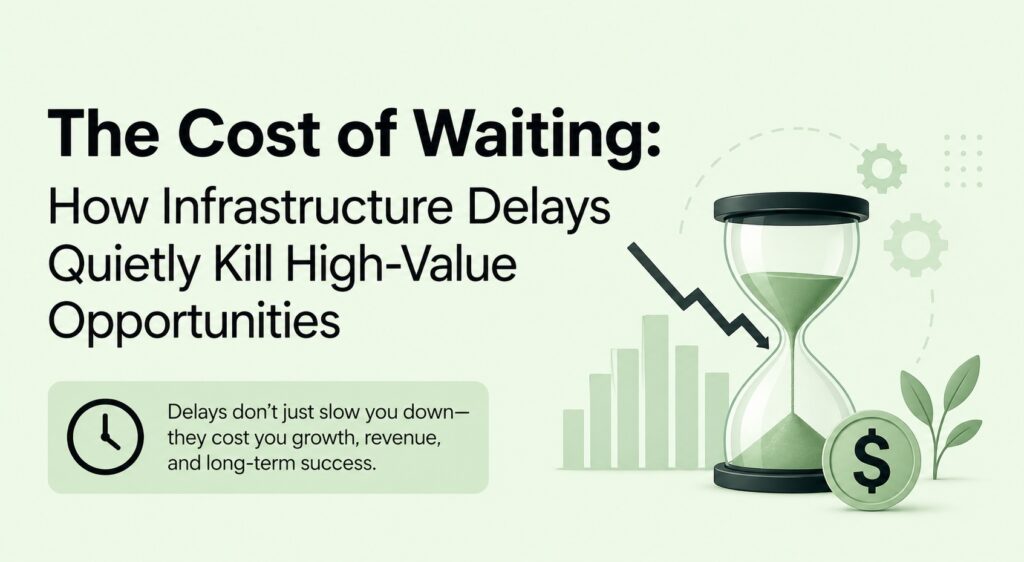
The Cost of Waiting
There is a cost that rarely shows up in dashboards, financial reports, or infrastructure reviews. It doesn’t appear as a line item in your cloud bill or a spike in your monitoring alerts. Yet in 2026, it is one of the most expensive mistakes organizations continue to make.
That cost is waiting. Waiting to deploy. Waiting to scale. Waiting to fix performance bottlenecks. Waiting for approvals, provisioning, or “the right time.”
The uncomfortable reality is this: high-value opportunities don’t wait for infrastructure. And when infrastructure lags behind demand, revenue doesn’t just get delayed, it disappears.
The Invisible Financial Drain of Infrastructure Delays
Most organizations still evaluate infrastructure through a cost lens. They ask what something costs per month, whether utilization is optimized, or if there’s a cheaper alternative. Those questions feel responsible, but they miss a much larger financial dynamic. Opportunity cost has become the dominant variable.
When infrastructure isn’t ready, several things happen quietly in the background. Customer acquisition campaigns underperform because systems can’t handle peak demand. AI training jobs take longer than expected, delaying time-to-market. Latency increases just enough to reduce conversions without triggering alerts. Internal teams slow down because resources are constrained or inconsistent.
None of these failures show up as “downtime.” Instead, they show up as missed revenue that never gets recorded.
This is where most infrastructure strategies break down. They optimize for visible costs while ignoring invisible losses.
Time-to-Revenue Is Now the Core Metric
In high-growth environments, infrastructure is no longer just a technical foundation. It has become a timing mechanism. The faster you can deploy, scale, and deliver consistent performance, the faster revenue materializes. The slower you move, the more value leaks out of the system.
This shift is especially visible in AI, SaaS, and real-time applications. A delayed deployment doesn’t just push timelines, it reduces competitive advantage. Being first to market, or even simply being fast enough, often determines who captures demand.
Companies that lead in speed-to-market consistently outperform competitors in both revenue growth and valuation. The implication is straightforward: speed is no longer an operational metric, it is a financial outcome.
The “Almost Ready” Trap
One of the most damaging patterns in infrastructure strategy is the idea of being “almost ready.” Almost enough capacity. Almost fast enough performance. Almost scalable architecture.
This creates a dangerous middle ground where systems function, but not at the level required to capture full value. The impact is subtle but significant. Applications load slightly slower. AI inference takes slightly longer. APIs respond just late enough to degrade user experience.
Individually, these issues seem minor. Collectively, they compound into meaningful revenue loss.
If you’ve already explored topics like The Risk of ‘Almost Fast Enough’, the connection becomes clear. Performance gaps don’t need to be catastrophic to be costly. They just need to exist.
Infrastructure Delays vs Revenue Impact
To understand the financial implications, consider how timing affects outcomes across different workloads:
| Scenario | Immediate Deployment | Delayed Deployment |
|---|---|---|
| Product Launch | Captures peak demand cycle | Misses early adopters and momentum |
| AI Model Training | Faster iteration and deployment | Slower innovation cycle |
| Traffic Spikes | Maintains conversion rates | Drops in engagement and revenue |
| Enterprise Workloads | Predictable output and SLAs | Inconsistent performance and risk |
The difference is not incremental. It is exponential over time. Every delay compounds lost opportunity, especially in competitive markets where timing determines visibility and adoption.
Why Cloud Flexibility Often Masks Delay
Cloud infrastructure is often positioned as the solution to speed and scalability challenges. In theory, it offers instant provisioning and elastic resources. In practice, the reality is more complex.
Provisioning delays, resource contention, unpredictable performance, and cost constraints frequently slow down actual execution. Teams hesitate to scale aggressively due to cost uncertainty. Workloads compete for shared resources. Performance varies under load.
If you’ve read Cloud Cost Volatility vs Dedicated Server Predictability, you already know the tradeoff. Flexibility without predictability often introduces hesitation. And hesitation leads to delay.
Delay is where value is lost.
Predictable Performance Eliminates Waiting
The alternative is not just faster infrastructure. It is predictable infrastructure. When performance is consistent, capacity is known, and deployment timelines are reliable, organizations operate with confidence. They launch faster, scale without hesitation, and align infrastructure decisions with revenue goals.
This is where dedicated environments fundamentally change the equation. Instead of reacting to constraints, teams can plan for outcomes.
If you’re evaluating options, reviewing Dedicated Server vs Cloud: Cost Comparison (2026 ROI Breakdown) can provide additional context on how predictability impacts financial performance.
The Compounding Effect of Waiting
What makes infrastructure delays particularly dangerous is their compounding nature. A one-week delay in deployment doesn’t just shift revenue by one week. It can reduce total lifetime value. It can allow competitors to capture market share. It can slow internal momentum and reduce iteration cycles. Over time, these small delays accumulate into measurable business impact.
This is why leading organizations treat infrastructure as a strategic asset rather than a technical necessity. They understand that every moment infrastructure is not ready is a moment revenue is at risk.
Why This Matters in 2026
In today’s environment, demand cycles are shorter, competition is faster, and customer expectations are higher than ever. There is less margin for delay.
Infrastructure is no longer just supporting the business. It is directly influencing how quickly the business can respond to opportunity. Organizations that recognize this shift are not asking how to reduce infrastructure cost. They are asking how to eliminate friction between opportunity and execution.
That is a fundamentally different conversation.
Frequently Asked Questions
How do infrastructure delays impact ROI?
Infrastructure delays reduce ROI by extending time-to-revenue, lowering conversion rates, and limiting scalability during peak demand. The financial impact is often indirect but significant over time.
Why don’t monitoring tools detect these issues?
Most monitoring tools focus on uptime and system health, not revenue impact. Performance degradation that affects user behavior often goes undetected because systems are technically “operational.”
Is faster infrastructure always more expensive?
Not necessarily. While upfront costs may be higher, predictable performance often reduces long-term costs by improving efficiency, increasing conversion rates, and eliminating wasted spend on underperforming resources.
How can businesses reduce infrastructure-related delays?
By prioritizing predictable performance, reducing provisioning friction, and aligning infrastructure strategy with revenue goals rather than purely cost optimization.
Waiting Is Not Neutral
Waiting feels safe. It feels like a cautious, measured approach to decision-making. In reality, waiting is an active cost. Every delayed deployment, every postponed upgrade, every moment of hesitation creates a gap between potential and realized revenue.
The organizations that win in 2026 are not just the ones with the best technology. They are the ones that move the fastest from opportunity to execution.
My Thoughts
If your infrastructure is slowing down deployment, limiting performance, or introducing hesitation into critical decisions, it may be time to rethink the model.
At ProlimeHost, we focus on predictable performance and rapid deployment so your infrastructure never becomes the reason an opportunity is missed.
Contact us today at sa***@*********st.com or call 877-477-9454 to discuss how we can help you eliminate delays and turn infrastructure into a revenue driver.