Executive Summary
For years, infrastructure conversations revolved around one dominant concern: downtime. If systems failed, applications crashed, or networks became unreachable, businesses lost money immediately. Entire operational strategies were designed around preventing outages because uptime represented reliability, customer trust, and financial stability all at once. Hosting providers competed aggressively around uptime percentages, redundant routing, and disaster recovery guarantees because those metrics genuinely mattered in traditional hosting environments.
AI infrastructure is changing that conversation in ways many organizations did not initially expect.
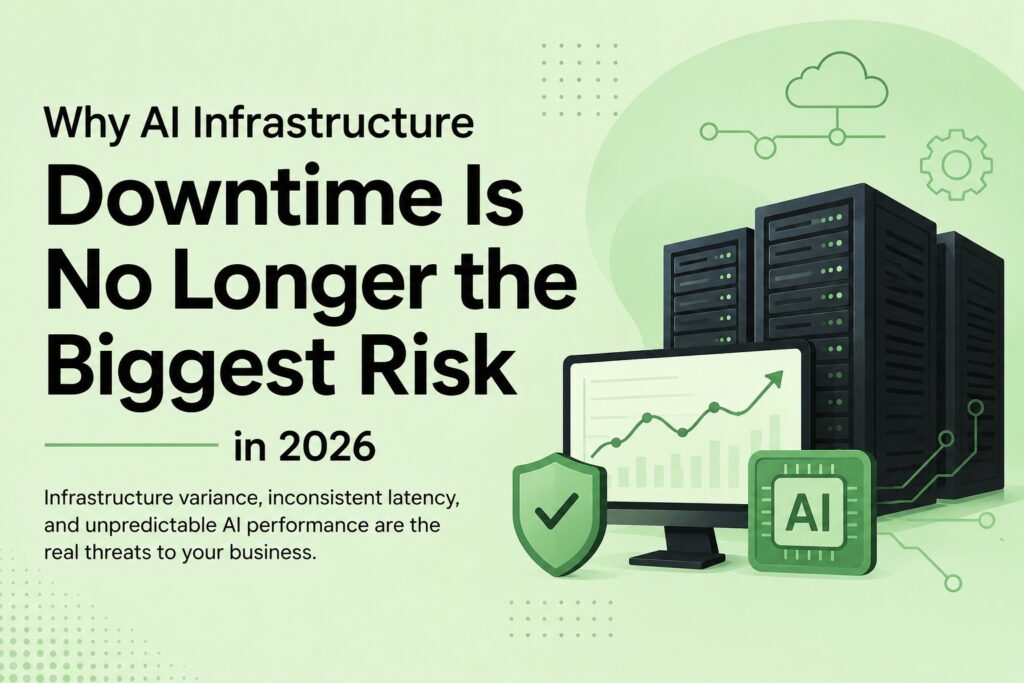
In 2026, the larger operational threat often is not that systems go completely offline. Instead, environments remain technically operational while performance slowly becomes inconsistent underneath the surface. AI inference begins responding more slowly during peak periods. Storage throughput fluctuates unpredictably. GPU queues quietly grow longer as concurrency increases. APIs stay online, yet the overall experience gradually becomes uneven enough that customers and employees start noticing something feels different, even if they cannot immediately explain why.
An inference environment averaging under one second response times during initial deployment may quietly drift toward two or three second responses six months later once datasets expand, concurrency rises, and AI adoption spreads internally across multiple departments. Oddly enough, many organizations do not immediately recognize the operational danger because the decline happens gradually. Teams adapt to the slowdown in real time. Engineers become accustomed to slightly longer response cycles. Leadership notices softer productivity metrics without necessarily connecting them back to infrastructure behavior immediately.
That shift matters because infrastructure inconsistency creates a different kind of business damage than downtime. Outages are visible. Everyone notices them immediately. Monitoring systems activate, engineers escalate incidents, executives get involved, and customers understand something is temporarily broken. Performance variance behaves much more quietly. It slowly affects customer engagement, operational forecasting, analytics responsiveness, employee productivity, and AI adoption without producing dramatic incidents severe enough to trigger emergency response.
At ProlimeHost, we increasingly work with organizations discovering that predictable AI infrastructure has become just as important as raw compute capacity. Companies are no longer asking only whether infrastructure can scale. They are asking whether infrastructure can scale predictably six months from now after workloads evolve, customer demand grows, AI adoption expands internally, and data environments become significantly more complex. Those questions represent a major shift in how businesses now think about infrastructure planning.
Why Infrastructure Variance Quietly Creates Business Risk
A complete outage is obvious. A website disappears, an application stops functioning, or a service becomes unreachable. Customers immediately recognize the problem, and internal teams quickly understand the urgency of the situation. The operational response becomes immediate because the issue is impossible to ignore.
Performance inconsistency creates a much more difficult operational challenge because it develops gradually rather than catastrophically. A recommendation engine that responds slightly slower during traffic spikes rarely triggers executive alarms. A customer support chatbot that gradually becomes sluggish over several months may not produce support tickets serious enough to initiate infrastructure reviews. An analytics platform that occasionally hesitates under concurrency pressure often gets blamed on “temporary load” rather than deeper architectural instability.
Yet over time, those subtle changes begin affecting customer behavior in measurable ways.
Customers disengage faster from platforms that feel inconsistent. Employees stop trusting internal AI tools that no longer feel responsive enough for day-to-day workflows. Real-time dashboards stop feeling real-time. Recommendation engines become less effective because small latency increases alter engagement behavior more than many organizations initially realize. Operational forecasting becomes less reliable because system responsiveness no longer behaves consistently enough to maintain confidence in underlying infrastructure performance.
Some organizations first notice the issue through support trends rather than infrastructure monitoring. Support teams begin hearing comments like “the platform feels slower lately” or “AI responses seem inconsistent during the afternoon.” Nothing appears severe enough individually to trigger escalation. Collectively, though, the operational pattern becomes difficult to ignore.
What makes this especially dangerous is that infrastructure variance often remains invisible inside traditional uptime metrics. A platform can maintain excellent uptime percentages while still delivering increasingly inconsistent operational experiences underneath the surface. GPU utilization dashboards may appear healthy while inference queues quietly expand behind the scenes. Storage systems remain technically available while throughput variability introduces delays during model loading. APIs continue functioning even as customer-facing responsiveness gradually weakens under sustained demand.
That disconnect between technical availability and operational experience is becoming one of the defining infrastructure challenges of modern AI deployments.
AI Workloads Expose Infrastructure Weaknesses Differently
Traditional hosting environments behaved relatively predictably for years because workloads followed more stable operational patterns. AI workloads behave very differently. Inference pipelines create highly variable concurrency demands. Storage systems experience sustained throughput pressure during model loading operations. GPU scheduling becomes increasingly sensitive under shared environments. Even subtle network routing inconsistencies can influence latency enough to affect customer-facing performance when AI systems operate continuously at scale.
This is partly why organizations increasingly revisit dedicated infrastructure strategies for long-term AI deployment planning. Public cloud infrastructure still provides enormous value for many use cases. Elasticity, rapid provisioning, geographic flexibility, and operational convenience remain incredibly useful for development environments, burst experimentation, temporary scaling projects, and testing pipelines. Cloud environments continue making tremendous sense for many organizations.
Stable production AI workloads, however, introduce different operational priorities.
Organizations running customer-facing inference systems throughout the day often require tighter control over workload behavior, GPU allocation consistency, storage performance stability, and network predictability. They want infrastructure environments that behave consistently not merely during benchmark testing, but during sustained real-world operational growth months after deployment. They want to reduce noisy-neighbor effects, unpredictable resource contention, fluctuating storage performance, and infrastructure variability that becomes increasingly difficult to forecast over time.
A surprisingly common issue in multi-tenant AI environments involves workloads performing beautifully overnight while slowing noticeably during regional business hours once shared GPU contention increases. Technically, nothing failed. Operationally, though, the customer experience changed substantially enough to affect engagement and workflow responsiveness.
That operational reality is driving increased attention toward solutions like GPU Dedicated Servers and Dedicated Servers because dedicated environments help reduce unpredictable variables that frequently emerge in heavily shared infrastructure ecosystems. The objective is not simply adding more hardware capacity. The objective is building environments that continue behaving predictably long after initial deployment excitement fades and workloads become operationally mature.
Organizations exploring private AI infrastructure, dedicated GPU hosting, and bare metal AI servers increasingly do so not because public cloud failed them entirely, but because operational predictability eventually became more valuable than unlimited elasticity for certain workloads.
Why Predictable Infrastructure Has Become a Financial Conversation
A few years ago, infrastructure planning discussions primarily belonged to engineering departments. Today those conversations increasingly involve operations leadership, finance teams, executive management, and even boards of directors because AI systems now influence revenue generation, customer retention, analytics visibility, employee productivity, and long-term operational forecasting.
When infrastructure consistency weakens, business consistency often weakens shortly afterward.
This is why leadership teams increasingly ask different questions during infrastructure planning discussions. Instead of focusing only on scalability, they ask whether latency will remain stable as AI adoption expands internally. They ask whether inference responsiveness will remain predictable during concurrency spikes six months after deployment. They ask whether operational costs can still be forecast accurately once workloads grow substantially larger and more demanding than initial projections suggested.
One CFO recently described the challenge perfectly during a planning discussion: “The hardest part is not the hardware expense anymore. It is trying to explain why performance variability keeps affecting operational forecasting.” That observation reflects what many organizations are now experiencing as AI infrastructure becomes intertwined with everyday business operations.
Those questions reflect a broader realization happening across the industry. Infrastructure decisions are no longer merely technical decisions. They have become operational risk decisions, customer experience decisions, and financial planning decisions simultaneously.
Organizations reevaluating long-term AI deployment strategy increasingly revisit resources like How to Benchmark Dedicated Servers Properly Before Deployment, How to Size AI Infrastructure Correctly in 2026, and Why AI Inference Performance Degrades Over Time because organizations increasingly recognize that infrastructure quality involves much more than maximum theoretical compute performance.
More compute power alone does not automatically eliminate instability. In many cases, it simply allows unstable operational behavior to scale faster.
The Industry Is Quietly Redefining Infrastructure Quality
For years, infrastructure quality was measured primarily through uptime percentages, redundancy models, and scaling flexibility. Those factors still matter. No organization wants outages, failed deployments, or unstable networking environments. But AI workloads are forcing the industry to recognize that operational consistency may ultimately matter just as much as raw availability.
Industry analysts including Gartner and infrastructure leaders like NVIDIA increasingly emphasize the importance of predictable infrastructure behavior as AI adoption accelerates across enterprise environments. Stable inference responsiveness, predictable throughput, workload isolation, and operational consistency are becoming critical business considerations rather than purely technical optimization goals.
There is also a psychological component that many organizations underestimate. Once employees or customers begin perceiving AI systems as inconsistent, rebuilding confidence becomes surprisingly difficult even after performance improves again. People adapt quickly to reliable systems, but they also remember friction longer than many companies expect.
That is part of why AI latency optimization, high-performance AI hosting, and predictable AI infrastructure costs are becoming more prominent strategic conversations across enterprise planning discussions.
And honestly, many organizations do not fully recognize the financial consequences of infrastructure inconsistency until customer engagement metrics begin quietly shifting in the wrong direction. By the time dashboards clearly reveal the business impact, the underlying operational drift has often existed for months already.
That is what makes infrastructure variance so dangerous compared to traditional downtime.
It rarely announces itself loudly.
FAQs
So uptime still matters?
Absolutely. Uptime still matters enormously. But many businesses are discovering that systems can maintain excellent uptime while still delivering inconsistent performance underneath the surface. The operational challenge becomes harder because nothing appears completely broken even though customer experience gradually weakens over time.
Why do AI environments seem to become less stable months after deployment?
Usually because workloads evolve faster than original planning assumptions anticipated. AI adoption expands internally, concurrency increases, datasets grow larger, and operational demands become more complex. Environments that initially appeared oversized eventually begin operating much closer to sustained capacity limits than expected.
Sometimes the infrastructure itself is still technically healthy. The workload simply evolved beyond the operational assumptions used during deployment planning.
Are organizations moving away from cloud infrastructure?
Not entirely. Most businesses are becoming more selective about workload placement. Cloud environments still work extremely well for experimentation, testing, temporary scaling, and development flexibility. Stable long-term production AI workloads, however, often benefit from more predictable resource allocation and workload isolation.
That balance is why hybrid infrastructure strategies continue gaining traction across enterprise AI deployments.
Why are dedicated GPU environments gaining attention again?
Mostly because organizations want tighter operational consistency. Dedicated environments reduce noisy-neighbor effects, improve workload predictability, stabilize inference performance, and provide greater visibility into sustained operational behavior over time.
Predictability itself is quietly becoming a competitive advantage.
Final Thoughts
Infrastructure planning in 2026 looks very different from infrastructure planning only a few years ago because AI workloads expose operational weaknesses differently than traditional applications ever did. Small latency fluctuations become customer experience problems. Minor throughput inconsistencies become forecasting problems. Gradual performance drift becomes a retention problem.
That reality is forcing organizations to rethink how infrastructure quality should actually be measured.
At ProlimeHost, we help businesses deploy Dedicated Servers, GPU Infrastructure, and AI server hosting environments designed around predictable performance, operational consistency, and scalable long-term reliability. Whether organizations are building private AI environments, inference clusters, analytics platforms, or customer-facing SaaS systems, the objective increasingly remains the same: eliminate operational uncertainty before uncertainty becomes expensive.
Because in 2026, the most dangerous infrastructure problems are often not the loudest ones. Sometimes they are the quiet inconsistencies that slowly erode confidence while everything still appears “mostly fine.”
Contact ProlimeHost
Sales: 877-477-9454
Author: Steve Bloemer, Director of Sales & Operations at ProlimeHost