Executive Summary
Remote management has transformed the way organizations operate dedicated server infrastructure. Administrators can deploy operating systems, troubleshoot hardware issues, monitor performance, reboot servers, and access consoles from virtually anywhere in the world. The convenience is undeniable. Yet the same technologies that make modern infrastructure easier to manage can also become some of its greatest security risks when implemented incorrectly.
Many organizations invest heavily in firewalls, endpoint protection, intrusion detection systems, and application security while paying comparatively little attention to the administrative layer that controls their infrastructure. Management interfaces such as IPMI, iDRAC, and iLO often possess more authority than the operating systems running on the servers themselves. If compromised, they can provide attackers with direct access to systems, data, and administrative controls that bypass traditional security mechanisms entirely.
Designing a secure remote management environment is not simply a matter of changing passwords or limiting login attempts. It requires a layered approach that combines network segmentation, VPN technologies, multi-factor authentication, access controls, monitoring, and operational discipline. Organizations that take the time to build these protections into their infrastructure gain more than security. They gain confidence, stability, and the ability to scale without creating hidden vulnerabilities that may not surface until it is too late.
I’ve seen organizations spend weeks hardening operating systems while leaving management interfaces publicly accessible because “we’ll fix that later.” Sometimes they do. Sometimes six months pass before anyone remembers.
What Is a Secure Remote Management Environment?
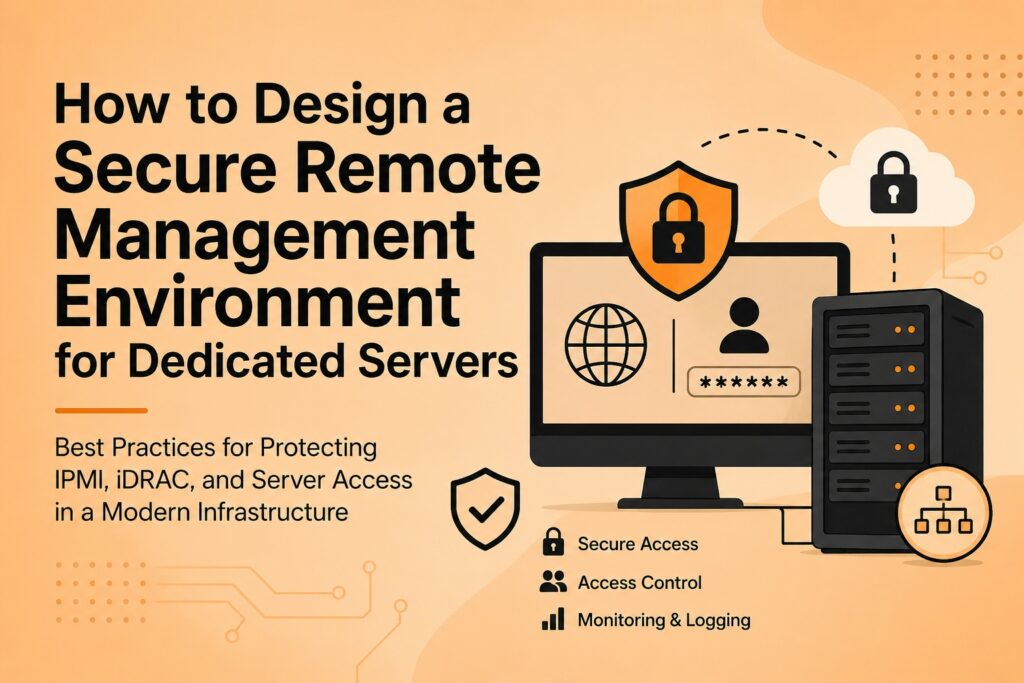
A secure remote management environment is a dedicated infrastructure architecture that allows administrators to access servers remotely through protected channels such as VPNs, private management networks, multi-factor authentication, and access controls while preventing unauthorized access to administrative interfaces.
Why Remote Management Security Has Become a Business Priority
There was a time when remote management interfaces were used primarily by enterprise IT departments operating inside corporate networks. Today, distributed teams, hybrid work environments, cloud-connected infrastructure, and geographically dispersed data centers have made remote administration a necessity rather than a convenience.
The challenge is that attackers have evolved alongside these technologies. Automated scanning tools continuously search the internet for exposed management interfaces, vulnerable firmware versions, and weak authentication mechanisms. Publicly accessible IPMI ports, improperly secured iDRAC systems, and outdated management controllers are routinely targeted because they offer something every attacker wants: administrative control.
What makes the risk particularly significant is that management systems operate beneath the operating system layer. An attacker who gains access to a server’s management interface may not need to compromise the operating system at all. They can often reboot systems, mount remote media, reinstall operating systems, or access console sessions directly. In practical terms, a compromised management interface can provide full control over the server regardless of how secure the operating system itself may be.
This reality has forced organizations to rethink how remote management should be designed. Security can no longer be treated as an afterthought or something bolted onto infrastructure after deployment. It must be integrated into the architecture from the beginning.
The Hidden Risks of Publicly Exposed Management Interfaces
One of the most common mistakes organizations make is exposing management interfaces directly to the public internet. The reasoning is usually understandable. Public access simplifies administration and reduces deployment complexity. Administrators can connect from anywhere without establishing VPN connections or navigating additional security controls.
Unfortunately, convenience often comes at a cost.
A publicly accessible management interface effectively announces its presence to anyone scanning the internet. While strong passwords and firmware updates certainly help, they do not eliminate risk. Attackers frequently exploit newly discovered vulnerabilities before organizations have an opportunity to patch affected systems. Even well-managed environments can become vulnerable when administrative interfaces remain visible to the outside world.
The problem becomes even more concerning as infrastructure grows. A single exposed server may represent a manageable risk. Hundreds of servers distributed across multiple locations create a much larger attack surface. Every exposed management interface becomes another potential entry point, another device requiring continuous monitoring, and another opportunity for human error.
Organizations often underestimate how frequently these systems are targeted. The reality is that automated reconnaissance tools operate continuously. Public management interfaces are not discovered occasionally. They are discovered repeatedly, sometimes within minutes of becoming accessible.
Building a Layered Remote Management Architecture
The most secure remote management environments share a common characteristic: they separate management traffic from production traffic. This principle sounds simple, yet it forms the foundation of nearly every successful infrastructure security strategy.
Production networks exist to serve customers, applications, and business operations. Management networks exist solely for administrators. Treating these two functions as separate environments dramatically reduces risk because administrative systems no longer need to be exposed to the same threats facing public services.
A dedicated management network creates a controlled path through which administrative activities occur. Rather than allowing direct access to IPMI or iDRAC interfaces from the public internet, administrators first authenticate through secure access mechanisms before reaching management resources. This approach limits exposure while providing organizations with greater visibility into administrative activity.
The concept is not new. Financial institutions, healthcare organizations, government agencies, and large enterprises have relied on network segmentation for years because it works. By isolating management systems from production workloads, organizations create an additional barrier that attackers must overcome before reaching critical administrative functions.
Why VPNs Should Be Considered the Starting Point
For many organizations, the most effective improvement they can make is moving management interfaces behind a VPN. Rather than allowing direct internet access, administrators establish an encrypted connection to a trusted network before accessing management resources.
The benefits extend beyond encryption. A VPN effectively hides management systems from public discovery. If an attacker cannot see a management interface, they cannot directly target it. While this does not eliminate every risk, it significantly reduces exposure and makes opportunistic attacks far less likely.
VPN-based management environments also centralize authentication. Instead of securing dozens or hundreds of individual management interfaces separately, organizations can enforce consistent access policies at a single entry point. Multi-factor authentication, device verification, logging, and access controls become easier to manage when administrative traffic flows through a centralized architecture.
At ProlimeHost, many dedicated server clients choose to place IPMI and remote management access behind VPN-protected networks or access-control lists rather than exposing management interfaces publicly. This approach aligns with enterprise security best practices while preserving the flexibility administrators need to manage infrastructure efficiently.
Organizations looking to implement VPN-protected management environments can discuss private networking and secure access options with the ProlimeHost team.
The Importance of Access Controls and Least Privilege
Technology alone does not create security. Processes matter just as much.
One of the most overlooked aspects of remote management security involves user permissions. Over time, organizations often accumulate administrative accounts, temporary access exceptions, and permissions that were granted for specific projects but never removed. The result is an environment where more individuals have elevated access than necessary.
The principle of least privilege provides a straightforward solution. Users should receive only the permissions required to perform their responsibilities and nothing more. This reduces the potential impact of compromised credentials and limits the opportunities for accidental misconfiguration.
Regular access reviews are equally important. Permissions that made sense six months ago may no longer be appropriate today. Teams change. Responsibilities shift. Contractors complete projects. Yet administrative access often remains unchanged unless organizations actively review and adjust permissions.
The strongest authentication system in the world cannot compensate for excessive administrative privileges.
Monitoring, Logging, and Security Visibility
Many organizations invest heavily in application monitoring while paying surprisingly little attention to their management infrastructure. This creates a dangerous blind spot because attacks against administrative systems frequently begin long before visible damage occurs.
A secure remote management environment should generate logs for authentication attempts, VPN activity, privilege escalations, configuration changes, and firmware updates. These logs provide valuable visibility into how administrative systems are being used and can help identify suspicious behavior before it develops into a serious incident.
Monitoring is not merely about detecting successful attacks. It is about recognizing unusual patterns. Repeated failed login attempts, access from unexpected geographic locations, unusual login times, or changes to management configurations may all indicate elevated risk. Organizations that actively monitor these signals often detect threats earlier and respond more effectively.
Security visibility becomes increasingly important as infrastructure scales. A handful of servers may be manageable through manual oversight. Hundreds of systems require structured monitoring and auditing processes to maintain confidence in the environment.
Comparison Chart: Remote Management Security Approaches
| Management Model | Security Risk | Administrative Convenience | Recommended For |
|---|---|---|---|
| Public IPMI with Password Only | Very High | High | Not Recommended |
| Public IPMI with MFA | High | High | Temporary Use Cases |
| VPN-Protected Management Access | Low | Moderate | Most Businesses |
| VPN + MFA + ACL Restrictions | Very Low | Moderate | Security-Focused Organizations |
| Fully Segmented Private Management Network | Lowest | Moderate | Enterprise Environments |
Security Is an Ongoing Process, Not a Project
One of the most dangerous assumptions organizations make is believing security can be completed. In reality, security is a continuous process that evolves alongside infrastructure, threats, and business requirements.
Firmware updates must be applied. Access permissions must be reviewed. Authentication policies require periodic evaluation. Monitoring systems need maintenance and tuning. Even well-designed environments can become vulnerable if they are not actively managed.
This is particularly true in dedicated server environments where long hardware lifecycles can create a false sense of stability. A server that has operated reliably for several years may still contain outdated firmware, legacy configurations, or access policies that no longer reflect current security requirements. Consistent review and maintenance remain essential components of any effective security strategy.
Organizations that view security as an ongoing operational discipline generally achieve better outcomes than those that approach it as a one-time deployment exercise.
Frequently Asked Questions
Should IPMI or iDRAC ever be exposed directly to the internet?
It can be done, but most security professionals would strongly discourage it. A VPN or private management network typically provides far better protection with relatively little additional complexity.
Is multi-factor authentication really necessary for server management?
Yes. Stolen credentials remain one of the most common causes of unauthorized access. MFA creates another barrier that attackers must overcome, and that extra layer often makes a significant difference.
What is the biggest mistake companies make with remote management security?
Honestly, it is usually convenience. Teams expose management interfaces publicly because it is easier during deployment, then leave them that way for years. What starts as a temporary decision quietly becomes permanent infrastructure.
Do small businesses need private management networks?
Not every small business requires a fully segmented enterprise architecture, but VPN-protected access and strong authentication should be considered baseline requirements regardless of company size.
Does ProlimeHost support secure remote management configurations?
Yes. ProlimeHost supports VPN-protected management access, access-control list configurations, private networking options, DDoS protection, and dedicated server deployments designed around modern security best practices.
Final Thoughts
The goal of remote management security is not to make administration difficult. The goal is to make unauthorized administration nearly impossible.
Organizations spend significant resources protecting applications, databases, and customer data, yet the management layer often remains one of the most powerful components within the infrastructure stack. If that layer is compromised, many other security controls become far less effective. Building a secure remote management environment therefore deserves the same level of attention as any other critical business system.
By combining private management networks, VPN access, multi-factor authentication, access controls, monitoring, and disciplined operational practices, organizations can dramatically reduce risk while maintaining the flexibility that modern infrastructure requires. The investment is relatively small compared to the potential consequences of a compromised management environment.
In infrastructure, some of the best security measures are the ones nobody notices. When management systems are hidden from public view, protected by multiple layers of authentication, and continuously monitored, they become far more difficult targets. That alone makes the effort worthwhile.
Learn More About ProlimeHost Dedicated Server Solutions
If you are evaluating dedicated servers and want to build a secure management environment from day one, ProlimeHost offers enterprise-grade dedicated server solutions, private networking options, DDoS protection, and 24/7/365 support.
Related Resources:
Related Articles:
For additional information, contact ProlimeHost at 877-477-9454 or visit https://www.prolimehost.com.
About the Author
Steve Bloemer is Director of Sales & Operations at ProlimeHost. Since 2015 he has worked with businesses deploying dedicated server infrastructure across multiple U.S. datacenter locations. His experience includes infrastructure planning, security architecture, performance optimization, operational risk management, and helping organizations design hosting environments that balance security, reliability, and scalability.