Executive Summary
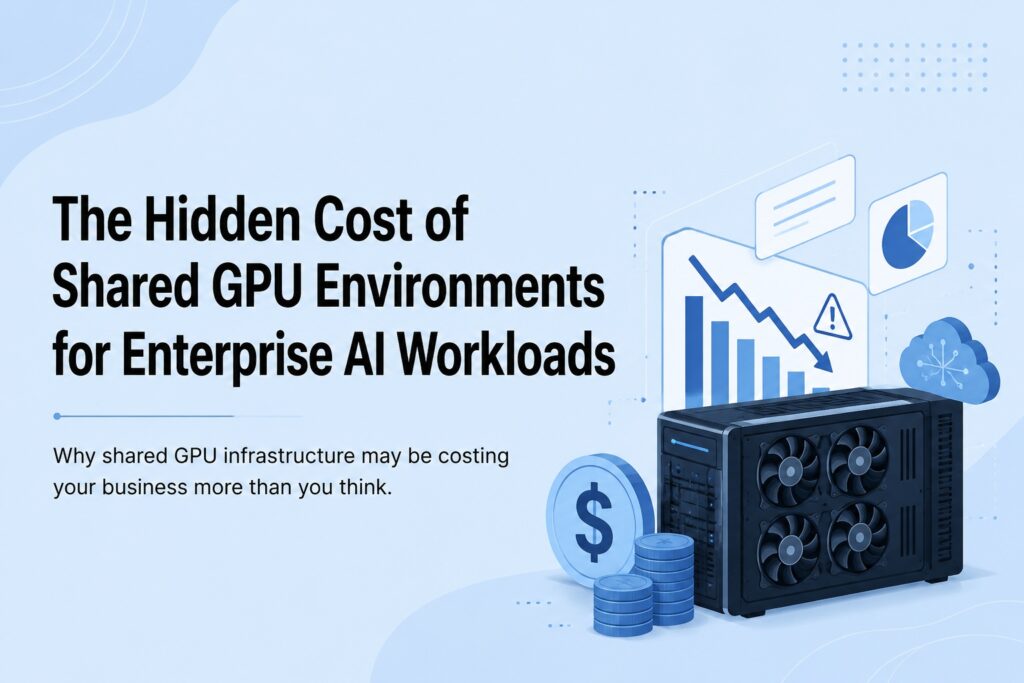
For many organizations entering the AI race in 2026, shared GPU infrastructure initially appears to solve several problems at once. Public cloud providers promise instant scalability, rapid deployment, flexible expansion, and the ability to consume GPU resources only when needed. From a budgeting perspective, that model sounds efficient. Why invest heavily in dedicated GPU infrastructure when enterprise teams can simply scale elastically as workloads grow?
The problem is that enterprise AI workloads rarely behave as predictably as cloud marketing material suggests.
As organizations begin moving beyond proof-of-concept deployments into large-scale inference pipelines, customer-facing AI systems, analytics platforms, and production model environments, infrastructure consistency starts becoming more important than theoretical scalability. Many companies discover this gradually. Response times begin fluctuating during peak usage periods. Fine-tuning jobs complete inconsistently. Token generation speeds drift unpredictably. Storage throughput becomes uneven. Engineers spend weeks troubleshooting application layers that may not actually be responsible for the performance degradation they are seeing.
At first, these issues appear isolated. Over time, they compound into operational instability that directly impacts customer experience, engineering productivity, and financial forecasting.
This is where the hidden cost of shared GPU environments starts becoming visible.
The true expense is often not the GPU rental itself. The larger financial burden emerges through infrastructure variance. Enterprise AI systems depend heavily on predictable latency, consistent throughput, stable storage performance, and uninterrupted resource allocation. Once workloads begin competing against other tenants inside heavily shared GPU ecosystems, even small fluctuations can ripple through the entire environment.
At ProlimeHost, we increasingly work with organizations discovering that unstable AI infrastructure creates downstream business costs that traditional cloud pricing calculators never account for. The invoices may show GPU utilization percentages and compute hours, but they rarely show the operational drag caused by inconsistent infrastructure performance. They certainly do not show the revenue impact of degraded user experiences or slower AI-driven workflows.
And that distinction matters far more in 2026 than many organizations expected.
Why Shared GPU Infrastructure Starts Breaking Down at Scale
The modern AI environment is extremely sensitive to infrastructure stability. That sensitivity increases dramatically as organizations move into production-scale deployments where AI systems become directly tied to customer interactions, internal automation, revenue generation, or operational decision-making.
A lightweight internal chatbot may tolerate occasional latency spikes without creating serious business problems. A customer-facing AI recommendation engine cannot. A voice processing platform cannot. A large-scale retrieval augmented generation environment supporting thousands of concurrent users certainly cannot.
The issue is not simply raw GPU availability. AI infrastructure performance depends on the synchronization of multiple layers operating together efficiently. Storage throughput, network latency, orchestration scheduling, PCIe bandwidth, memory allocation, and GPU interconnect performance all influence how smoothly enterprise AI systems operate under load.
Inside shared GPU environments, organizations are rarely operating independently. Multiple tenants may compete for backend resources simultaneously, even when providers advertise isolated virtual GPUs or segmented compute pools. Shared storage fabrics, oversubscribed networking layers, orchestration congestion, and backend scheduling contention can quietly introduce instability underneath workloads that initially appeared stable during testing.
That instability tends to emerge slowly rather than catastrophically.
Inference requests begin taking slightly longer during peak periods. Batch jobs miss expected completion windows. AI response consistency becomes uneven throughout the day. Some teams notice token generation speed fluctuating unpredictably while others observe sudden increases in queue times. Engineering departments often spend enormous amounts of time attempting to optimize software pipelines without realizing that the underlying issue may actually be infrastructure contention occurring somewhere deeper within the environment.
One of the more frustrating aspects of this problem is that traditional monitoring systems frequently fail to expose it clearly. GPU utilization metrics may still appear relatively normal even while workloads experience growing latency instability underneath the surface. Leadership teams reviewing dashboards may conclude that the infrastructure remains healthy because utilization percentages look acceptable.
Meanwhile, operational performance quietly deteriorates.
We discussed similar patterns in our previous article regarding AI inference degradation:
https://www.prolimehost.com/blogs/ai-inference-performance-addressed/
Why Infrastructure Variance Becomes a Financial Problem
Many organizations initially evaluate GPU infrastructure primarily through direct cost comparison. They compare hourly GPU rental pricing against the cost of purchasing or leasing dedicated infrastructure and attempt to determine which model appears cheaper on paper.
That comparison usually misses the larger operational picture.
The financial impact of unstable AI infrastructure often appears indirectly through reduced efficiency, slower workflows, inconsistent application behavior, and degraded customer experiences. Those costs rarely show up immediately inside monthly infrastructure reports, which is precisely why they are so easy to underestimate.
Consider an enterprise customer support platform powered by AI-driven inference systems. If shared infrastructure introduces even modest latency increases during peak usage periods, support interactions may begin slowing down subtly over time. Customers wait slightly longer for responses. Agents override AI-generated workflows more frequently because confidence in the system declines. Escalations increase. Engineering teams allocate additional hours toward troubleshooting. Productivity gradually decreases even though the underlying infrastructure technically remains operational.
The infrastructure invoice continues arriving every month.
The operational inefficiency caused by inconsistent performance usually does not appear anywhere near that invoice.
This is why predictable AI infrastructure performance increasingly matters more than simply maximizing theoretical GPU utilization percentages. Organizations operating enterprise AI workloads eventually discover that infrastructure variance creates business variance. Once AI systems become tied directly to customer interactions or internal operations, unpredictability itself becomes expensive.
Many finance teams only recognize this after cloud GPU spending expands dramatically while internal confidence in AI systems simultaneously begins declining. That combination creates a particularly dangerous situation because leadership may continue increasing infrastructure spending while overall operational reliability continues deteriorating.
Why AI Workloads React Differently Than Traditional Virtualized Applications
Traditional virtualization environments were largely designed around workloads capable of tolerating some degree of resource fluctuation. General web hosting, lightweight databases, business applications, and many conventional SaaS platforms can usually survive occasional contention without creating immediate operational disruption.
AI workloads behave very differently.
Modern inference pipelines, distributed training environments, vector search systems, and large-scale language model deployments rely heavily on synchronized performance between compute, storage, networking, and memory subsystems. Small inconsistencies inside one layer often compound rapidly across the rest of the environment.
When storage systems cannot feed models quickly enough, GPUs may remain underutilized while inference queues still grow. Shared networking congestion can introduce unpredictable latency spikes between nodes. Oversubscribed backend fabrics may create unstable throughput patterns during periods of high demand. Orchestration layers operating across heavily shared environments may delay workload scheduling unexpectedly during peak utilization windows.
None of these problems necessarily appear catastrophic in isolation. Together, however, they create environments that feel increasingly unstable as workloads scale.
This is one reason many organizations are shifting toward private AI infrastructure and dedicated GPU servers rather than relying entirely on shared public cloud ecosystems for long-term production workloads. The goal is not necessarily maximum theoretical scalability. More often, the objective becomes operational consistency and predictable performance behavior.
Our recent article on AI storage architecture explores these infrastructure dependencies further: https://www.prolimehost.com/blogs/ai-storage-architecture-2026/
Shared GPU vs Dedicated GPU Infrastructure
| Infrastructure Factor | Shared GPU Environment | Dedicated GPU Infrastructure |
|---|---|---|
| GPU Resource Isolation | Limited | Full Isolation |
| Performance Consistency | Variable | Predictable |
| Inference Latency Stability | Often inconsistent | Highly stable |
| Storage Throughput | Shared contention possible | Dedicated allocation |
| Multi-Tenant Risk | High | None |
| Financial Forecasting | Difficult | Predictable |
| AI Scaling Reliability | Variable under load | Controlled scaling |
| Security & Compliance | Shared exposure surface | Private environment |
| Long-Term ROI | Often unstable | Easier forecasting |
| Infrastructure Customization | Limited | Extensive |
Organizations operating customer-facing AI systems increasingly prioritize consistency over theoretical elasticity because unpredictable performance creates downstream business instability that becomes difficult to forecast financially.
Security and Compliance Concerns Continue Growing
Performance inconsistency is only part of the broader enterprise concern surrounding shared GPU infrastructure.
AI systems increasingly process highly sensitive datasets involving financial transactions, healthcare information, proprietary intellectual property, customer analytics, legal documentation, internal communications, and regulated operational records. As organizations expand AI adoption, security teams often begin reevaluating whether heavily shared GPU environments align properly with internal governance policies or compliance requirements.
Even when public cloud providers maintain strong isolation standards, many enterprise security teams remain uncomfortable with critical inference workloads operating inside densely multi-tenant ecosystems where backend infrastructure layers remain shared among numerous unrelated organizations.
This concern becomes even more significant for companies developing proprietary AI models or operating inside industries where compliance visibility and infrastructure control matter heavily. In many situations, dedicated GPU infrastructure ultimately becomes less about maximizing raw performance and more about maintaining operational transparency, predictable security boundaries, and greater administrative control over AI environments.
That shift is accelerating throughout 2026 as enterprise AI systems become increasingly integrated into day-to-day business operations.
Why Elastic AI Infrastructure Often Sounds Better Than It Performs
The cloud industry spent years promoting elasticity as the solution to nearly every infrastructure planning problem. For many traditional workloads, elasticity absolutely provides meaningful advantages. Rapid scaling, temporary burst capacity, and flexible deployment models transformed how businesses approached infrastructure management.
AI workloads complicate that equation significantly.
Scaling compute resources does not always scale AI performance linearly. In some environments, adding additional GPUs into unstable shared ecosystems may actually increase orchestration complexity, synchronization overhead, storage contention, and latency inconsistency. Organizations sometimes discover they are paying for larger GPU allocations while simultaneously experiencing less predictable operational performance.
That creates a dangerous illusion where infrastructure spending rises faster than actual business efficiency.
Eventually finance teams begin asking difficult questions. Why are AI infrastructure costs increasing faster than operational output? Why are engineering teams continuously troubleshooting latency instability despite expanding GPU allocations? Why do customer-facing AI systems behave inconsistently even when utilization metrics appear healthy?
At some point, leadership teams begin recognizing that the environment itself may be contributing to the instability.
The Shift Toward Dedicated and Private AI Infrastructure
Throughout 2026, more organizations are reevaluating how they deploy production AI workloads. This does not mean public cloud GPU platforms no longer provide value. They absolutely remain useful for experimentation, temporary scaling, development environments, and burst-oriented compute requirements.
Production AI infrastructure is increasingly becoming a separate discussion entirely.
Organizations operating large inference environments now prioritize predictable latency, stable throughput, private networking, dedicated storage performance, compliance visibility, and controlled scaling behavior much more heavily than they did even two years ago. As AI systems become directly tied to customer experiences and operational workflows, infrastructure consistency starts carrying far greater financial importance.
That shift is driving increased demand for: https://www.prolimehost.com/gpu-servers/ as well as: https://www.prolimehost.com/dedicated-servers/ particularly among SaaS providers, analytics firms, AI startups, financial organizations, healthcare technology companies, and enterprise software vendors deploying production-scale AI workloads.
FAQs
Are shared GPU environments always problematic?
Not necessarily. Smaller development workloads, proof-of-concept environments, testing systems, and temporary burst compute scenarios can work extremely well inside shared GPU platforms. The larger problems usually emerge once AI workloads become operationally critical and customer-facing.
Why does GPU utilization sometimes appear normal while performance degrades?
Because utilization metrics often fail to expose backend contention involving storage systems, networking layers, orchestration scheduling, or shared memory bottlenecks. The GPUs themselves may still appear fully active while workloads experience growing latency underneath the surface.
It confuses a lot of teams initially because the dashboards technically look healthy.
Is dedicated GPU infrastructure more expensive?
Short-term pricing can sometimes appear higher initially. Long-term operational predictability often changes the ROI calculation substantially, particularly for sustained enterprise AI workloads where infrastructure instability creates hidden business costs.
What workloads benefit most from dedicated GPU servers?
Large-scale inference systems, private LLM environments, vector databases, AI SaaS platforms, real-time analytics, recommendation engines, and latency-sensitive AI applications generally benefit the most from dedicated infrastructure consistency.
Does ProlimeHost offer private AI infrastructure?
Yes. ProlimeHost GPU Servers and Dedicated Servers support enterprise AI deployments requiring predictable performance, private networking, scalable GPU environments, and high-throughput storage architectures.
Some organizations deploy single-node environments initially. Others move directly into multi-node GPU clusters depending on workload maturity and projected scaling requirements.
Final Thoughts
The hidden cost of shared GPU infrastructure rarely appears during the initial purchasing decision. Most organizations encounter the real operational consequences later through inconsistent latency, unstable throughput, engineering slowdowns, degraded customer experience, and increasingly unpredictable AI performance.
As enterprise AI matures, infrastructure consistency is becoming just as important as raw compute power itself.
In some cases, perhaps even more important.
The future of enterprise AI likely will not belong entirely to public cloud infrastructure or entirely to private dedicated environments. Most organizations will operate somewhere between those two extremes depending on workload sensitivity, scaling requirements, compliance needs, and financial priorities.
However, for production AI systems where reliability, latency stability, operational control, and predictable financial forecasting matter heavily, dedicated infrastructure is becoming increasingly difficult to ignore.
To learn more about enterprise AI hosting solutions, visit ProlimeHost or contact the team directly at 877-477-9454.
Author: Steve Bloemer
Director of Sales & Operations at ProlimeHost
Steve Bloemer has worked in the hosting and infrastructure industry for more than two decades, helping businesses deploy scalable dedicated server, GPU, and enterprise hosting environments across the United States and internationally. His work focuses heavily on AI infrastructure, enterprise hosting strategy, performance optimization, and the financial realities surrounding modern compute environments.
At ProlimeHost, Steve works directly with organizations deploying private AI clusters, large-scale inference environments, SaaS platforms, analytics systems, and high-performance dedicated infrastructure requiring predictable uptime, low latency, and scalable GPU resources.
His writing frequently explores the intersection of infrastructure performance, operational risk, financial forecasting, and long-term ROI for enterprise technology teams navigating rapidly evolving AI workloads.