There was a time when choosing storage was relatively simple.
You estimated how much data your business needed to store, added a little room for growth, purchased a server with enough disk space, and moved on to the next project. Storage was often treated as a checkbox on an infrastructure planning worksheet. As long as there was enough capacity available, most organizations considered the job done.
Today, that approach can create serious problems.
Modern applications consume data in ways that would have seemed unimaginable just a few years ago. Databases process millions of transactions. SaaS platforms serve users around the globe around the clock. AI models continuously read and analyze massive datasets. Even relatively small businesses often generate more data in a month than some enterprises generated in an entire year a decade ago.
The challenge is no longer simply storing information. The challenge is moving that information quickly, efficiently, and reliably enough to support increasingly demanding workloads.
That raises an important question. If processors continue becoming faster and networks continue becoming more capable, why do some applications still struggle with performance issues?
More often than not, the answer is storage architecture.
A poorly designed storage environment can undermine even the most powerful infrastructure deployment. Meanwhile, the right storage architecture can unlock performance gains that organizations often never realized were possible.
Executive Summary
Choosing the proper storage architecture begins with understanding how applications interact with data rather than focusing exclusively on storage capacity. Different workloads require different approaches. Transaction-heavy databases often benefit from high-performance NVMe storage. Media platforms and backup repositories frequently perform better with scalable object storage solutions. AI environments require storage architectures capable of delivering enormous volumes of data without creating bottlenecks.
Organizations that align storage infrastructure with workload requirements generally experience better application performance, smoother scalability, and lower long-term operational costs. The goal is not necessarily to purchase the fastest storage available. The goal is to build an architecture that supports current business objectives while remaining flexible enough to accommodate future growth.
Why Storage Decisions Have Become Business Decisions
For many years, storage discussions remained largely confined to IT departments. Today, they increasingly affect executive leadership, finance teams, and strategic planners.
Why?
Because storage performance influences far more than technical metrics.
When applications slow down, customers notice. When analytics platforms take longer to process information, business decisions are delayed. When AI workloads cannot access data efficiently, expensive GPU resources sit idle waiting for information to arrive.
Those consequences carry real financial implications.
In fact, many organizations discover that infrastructure performance variability creates costs that extend far beyond hardware expenses. Infrastructure bottlenecks can reduce productivity, impact customer satisfaction, and slow revenue-generating activities. The businesses that recognize this relationship early often make better long-term infrastructure decisions than those focused solely on acquisition costs.
Storage architecture sits at the center of many of these discussions because virtually every modern application depends on fast, reliable access to data.
Understanding How Modern Applications Actually Use Storage
One of the biggest misconceptions surrounding storage architecture is the belief that all applications use storage in roughly the same way.
Nothing could be further from the truth.
Consider a transactional database supporting an e-commerce platform. Every second, customers are searching products, updating carts, processing payments, and creating orders. Latency matters. Even small delays can impact user experience and conversion rates.
Now compare that workload to a video archive containing years of content. The storage requirements may be significantly larger, yet the performance requirements are often much different. Scalability and cost efficiency may matter more than ultra-low latency.
Then there are AI workloads.
As discussed in our previous article, Why AI Storage Architecture Is Becoming More Important Than GPU Count, organizations frequently invest heavily in compute resources only to discover that storage limitations prevent those resources from reaching their full potential. Fast GPUs cannot compensate for slow data delivery. Eventually, storage becomes the limiting factor.
This is why selecting storage architecture based solely on capacity often produces disappointing results. Two environments with identical storage volumes can deliver dramatically different performance depending on how the architecture is designed.
Block Storage, Object Storage, and File Storage Explained
The storage industry loves technical terminology. Unfortunately, many of those terms create more confusion than clarity.
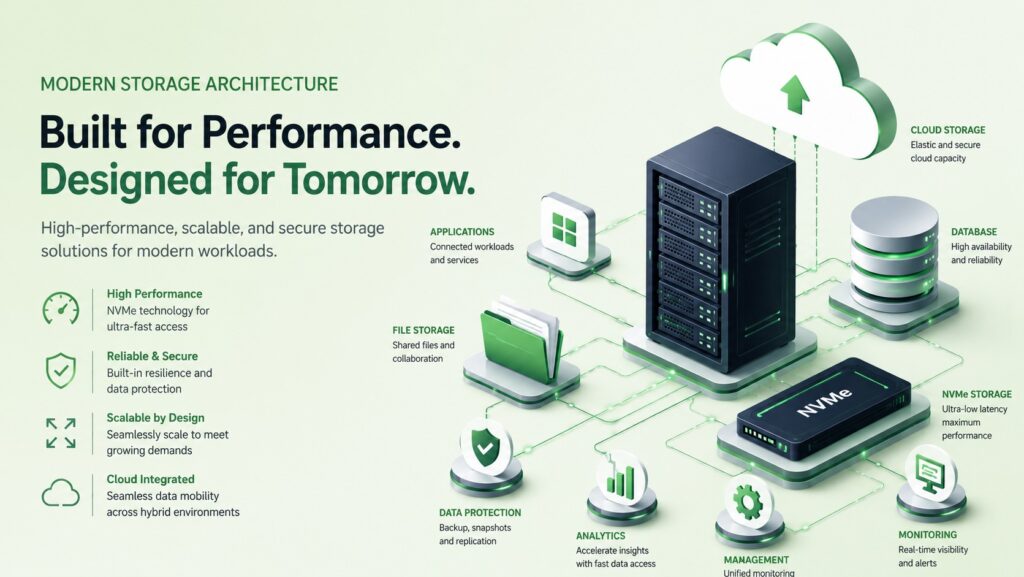
At a high level, most modern storage environments rely on three primary architectural approaches: block storage, object storage, and file storage.
Block storage remains the preferred choice for workloads requiring consistent low latency and predictable performance. Databases, virtual machines, ERP systems, and many enterprise applications benefit from block-based architectures because they allow applications to access storage directly and efficiently.
Object storage takes a different approach. Rather than organizing data into traditional file structures, it stores information as individual objects containing both data and metadata. This architecture excels when organizations need to manage massive volumes of unstructured information, including backups, media libraries, log repositories, and AI datasets. The scalability advantages can be remarkable.
File storage remains familiar because it closely resembles the folder structures most users interact with every day. Shared document repositories, collaborative environments, and departmental file systems often continue to rely on file-based architectures because of their simplicity and compatibility.
The important takeaway is that none of these architectures is universally superior.
Each solves a different problem.
The best storage architecture is the one that aligns with the specific workload requirements of the application it supports.
Why NVMe Is Changing Infrastructure Design
Few infrastructure technologies have transformed storage performance as dramatically as NVMe.
Traditional hard drives eventually gave way to SSDs. SSDs delivered significant performance improvements and fundamentally changed expectations for application responsiveness. NVMe represents the next major evolution.
By communicating directly through the PCIe bus, NVMe storage dramatically reduces latency while increasing throughput compared to traditional storage interfaces. The result is faster database performance, improved virtualization density, more responsive applications, and significantly better support for data-intensive workloads.
The benefits become particularly evident in environments involving analytics, machine learning, AI inference, and large-scale databases.
Organizations deploying modern infrastructure frequently discover that storage performance becomes one of the primary determinants of overall application responsiveness. This is especially true for businesses evaluating dedicated infrastructure solutions. In our article, How to Build a Dedicated Server Capacity Plan That Scales With Business Growth, we explored how storage planning often influences long-term scalability just as much as processor or memory selection.
Storage is no longer a supporting component.
Increasingly, it has become a primary performance driver.
Storage Architecture Comparison
| Storage Architecture | Primary Strength | Best Use Cases | Scalability | Performance |
|---|---|---|---|---|
| Block Storage | Low latency | Databases, ERP, Virtual Machines | Moderate | Very High |
| Object Storage | Massive scalability | Backups, Archives, AI Datasets | Excellent | Moderate |
| File Storage | Simplicity and compatibility | Shared Files and Collaboration | Moderate | Moderate |
| Distributed Storage | Redundancy and resilience | Cloud-Native Applications | Excellent | High |
| NVMe-Based Storage | Extreme throughput and low latency | AI, Analytics, High-Performance Databases | High | Exceptional |
Planning for the Future Instead of Today
One of the most expensive infrastructure mistakes a business can make is designing solely around current requirements.
Growth rarely arrives in a perfectly predictable manner.
A SaaS platform serving hundreds of users today may support thousands next year. A pilot AI project can quickly evolve into a production environment requiring exponentially more storage capacity and throughput. Even traditional business applications continue generating larger datasets as organizations retain more operational and customer information.
The businesses that scale most effectively are typically those that begin planning for future requirements before growth arrives.
This does not mean overprovisioning infrastructure unnecessarily. It means selecting technologies and architectures that can evolve alongside the business.
In many cases, the cost of planning ahead is significantly lower than the cost of redesigning infrastructure later.
The Hidden Cost of Choosing the Wrong Storage Architecture
When businesses evaluate storage infrastructure, they often focus on one number.
Cost.
That is understandable. Budgets matter. Capital expenditures matter. Monthly recurring costs matter.
But what if the cheapest storage solution ultimately becomes the most expensive?
An underperforming storage environment can create ripple effects throughout an organization. Databases take longer to respond. Applications become less responsive. Employees wait longer for reports. Customers experience delays. AI projects fail to deliver expected results because infrastructure limitations prevent efficient processing.
Those costs rarely appear on a hardware invoice.
They show up in lost productivity, reduced customer satisfaction, and missed business opportunities.
Sometimes the most expensive infrastructure decision is the one that appeared cheapest at the beginning.
Why Dedicated Infrastructure Often Delivers Better Storage Performance
Public cloud platforms have undoubtedly transformed the hosting industry. They offer flexibility, rapid deployment, and impressive scalability.
Yet there are situations where dedicated infrastructure provides significant advantages.
Storage-intensive applications often benefit from predictable performance and dedicated resources. Businesses running high-performance databases, virtualization environments, AI workloads, and analytics platforms frequently discover that dedicated servers provide greater consistency than heavily shared environments.
At ProlimeHost, many clients choose dedicated infrastructure specifically because they need predictable storage performance alongside powerful compute resources.
Organizations evaluating dedicated solutions can explore our Dedicated Server Hosting platform:
For businesses building AI environments, our GPU Server Hosting solutions provide access to powerful GPU resources paired with high-performance NVMe storage:
Companies seeking flexible development and application hosting environments may also benefit from our VPS Hosting platform:
Security should also remain part of the conversation. Storage architecture is only one piece of the infrastructure puzzle. Organizations concerned with secure administration should review our guide on How to Design a Secure Remote Management Environment for Dedicated Servers.
Frequently Asked Questions
Is faster storage always better?
Not necessarily.
Faster storage is valuable when workloads can benefit from the additional performance. For archival data or infrequently accessed files, a lower-cost architecture may provide better overall value. This is one of those situations where understanding the workload matters more than chasing benchmark numbers.
Should every application use NVMe storage?
No.
While NVMe delivers exceptional performance, not every workload requires that level of speed. A backup repository has very different requirements than a real-time transactional database.
What storage architecture works best for AI workloads?
Most AI environments benefit from high-throughput storage architectures capable of delivering data consistently to GPUs. In many cases, NVMe-based solutions provide the performance needed to prevent storage bottlenecks and maximize GPU utilization.
How do I know if storage is causing performance issues?
That’s actually a common question.
Organizations often notice symptoms such as slow database response times, application lag, delayed analytics processing, or underutilized computing resources. Storage monitoring and workload analysis can usually determine whether the storage layer is contributing to the problem.
What is the biggest storage planning mistake businesses make?
Focusing exclusively on capacity.
Performance, scalability, redundancy, and workload characteristics often have a much greater impact on long-term success than storage volume alone.
Conclusion
Choosing the right storage architecture is no longer simply a technical decision delegated to infrastructure teams.
It is a business decision.
The organizations that achieve the best results are rarely those that purchase the largest storage systems or chase the latest technology trends. Instead, they take the time to understand how their applications use data, how workloads are evolving, and how infrastructure decisions support long-term business objectives.
The result is an environment that performs better, scales more efficiently, and adapts more easily as requirements change.
As modern applications continue generating larger datasets and demanding faster access to information, storage architecture will only become more important. Businesses that make thoughtful decisions today will be better positioned to handle tomorrow’s challenges without costly redesigns or disruptive migrations.
Ready to build a storage infrastructure that grows with your business rather than holding it back?
Contact ProlimeHost to discuss dedicated server, NVMe storage, GPU hosting, and custom infrastructure solutions designed around your specific workload requirements.
ProlimeHost
Website: https://www.prolimehost.com
Dedicated Servers: https://prolimehost.com/dedicated-server-hosting/
GPU Servers: https://www.prolimehost.com/gpu-server-hosting/
VPS Hosting: https://www.prolimehost.com/ssd-vps-server/
Phone: 877-477-9454
Author: Steve Bloemer
Director of Sales & Operations, ProlimeHost
Marine Corps Veteran | Infrastructure Strategist | Technology Writer