
The Economics of Hosting: How Predictable Performance Beats Elastic Promises

Elastic cloud hosting sounds flexible, but it often hides unpredictable costs and unstable performance. Learn why ProlimeHost’s dedicated infrastructure delivers stronger ROI, reliability, and long-term value through predictable performance.


Introduction: The Hidden Costs of Elastic Cloud Promises

Cloud hosting is often marketed as the ultimate solution for scalability. Need more resources? Just click a button. But beneath the promise of flexibility lies a hard truth: elasticity comes at a cost. Every automated scaling event, data transfer, or I/O spike quietly adds up, leaving businesses with unpredictable bills and variable performance.

Dedicated hosting takes a different approach. Rather than renting shared resources that fluctuate with others’ usage, you invest in a physical machine that’s entirely your own. The result is stability — in performance, cost, and control — something the cloud’s elastic model struggles to deliver.


Elasticity vs. Predictability: What Businesses Overlook

Elastic infrastructure is convenient when workloads change frequently, but the trade-off is unpredictability. During peak demand — product launches, campaigns, or seasonal traffic — your usage (and your bill) can spike without warning.

Predictable hosting eliminates that volatility. Every CPU cycle, gig of RAM, and bandwidth allocation belongs solely to you. You know what you’re paying for, you know how it performs, and you’re not sharing resources with anyone else. Over time, that consistency translates to more than performance — it becomes a financial advantage.

At ProlimeHost, we design our dedicated servers around that very principle. AMD EPYC and Threadripper processors deliver enterprise-grade reliability and power, ensuring workloads remain stable regardless of what’s happening elsewhere in the data center.


Many organizations are surprised when their monthly cloud bills exceed expectations by 30% or more. What begins as a pay-as-you-go model often evolves into a complex maze of usage fees — bandwidth, storage I/O, and API calls among them.Dedicated servers, on the other hand, offer financial clarity. A single, predictable monthly cost covers your entire infrastructure. There are no data egress fees, no throttled performance tiers, and no surprise invoices at month’s end. This level of transparency helps teams plan long-term budgets, forecast growth more accurately, and invest in scaling with confidence.

In short, cloud elasticity may promise agility, but predictable performance provides stability — and in business, stability always wins.


Performance Stability: Why Predictability Equals Profitability

When your business relies on uptime and response speed, performance fluctuations aren’t just inconvenient — they’re costly. Latency impacts user experience, sales conversions, and even SEO rankings.

ProlimeHost’s infrastructure is engineered for sustained stability. Our Cisco-powered network, redundant routing, and 99.99% uptime ensure every application performs at its best. With dedicated resources, there’s no noisy neighbor interference, no random CPU throttling, and no question about who controls the environment. Predictable infrastructure means predictable performance — and that directly affects profitability.


Case Study: ProlimeHost’s Dedicated ROI Advantage

A mid-sized SaaS company recently migrated from a leading cloud provider to ProlimeHost’s Ryzen-powered dedicated servers. Within 60 days, their average monthly hosting costs dropped by 42%. At the same time, end-user response times improved by nearly 20%, and the team gained full transparency over their environment.

By eliminating unpredictable resource charges and performance fluctuations, the company could reinvest those savings into product development — something impossible under the elastic pricing structure of their former provider. The result was clear: predictable performance led to measurable growth.


Conclusion: Build a Future on Stability, Not Surprises

Elastic cloud platforms sell the dream of flexibility, but in practice, they often create complexity and cost unpredictability. Dedicated hosting delivers something far more valuable — the power of control. With ProlimeHost, businesses can rely on consistent performance, transparent billing, and infrastructure designed to scale on their terms.

When every second of uptime and every dollar of budget counts, predictability isn’t a limitation — it’s a strategic advantage.


FAQs

Is cloud hosting cheaper for startups?
Initially, it might appear that way. But as usage scales, cloud costs increase exponentially. Dedicated servers offer stable monthly pricing and deliver more performance per dollar in the long run.

Can dedicated servers still scale as my business grows?
Yes. ProlimeHost offers flexible configuration upgrades and seamless scaling options without the downtime or migration challenges associated with public clouds.

What’s the biggest financial benefit of predictable hosting?
Budget stability. Predictable costs eliminate the risk of surprise billing and allow accurate forecasting — something CFOs and IT leaders value highly.


Ready to Build Your ROI-Driven Infrastructure?

Let’s design a hosting solution centered on predictability, performance, and profit.
📞 Call us: +1-877-477-9454
📧 Email: sales@prolimehost.com
🌐 Learn more: https://www.prolimehost.com/dedicated-servers/

The post The Economics of Hosting: How Predictable Performance Beats Elastic Promises first appeared on ProlimeHost.

Why ProlimeHost VPS Delivers the Best Return on Your Hosting Investment

If you’re weighing your options between shared hosting, VPS, or dedicated servers, your real question is about value; how much performance, reliability, and scalability you can get for every dollar spent.

That’s where ProlimeHost VPS shines. Built on enterprise-grade infrastructure and powered by a premium Cisco network, it offers near-dedicated performance at a fraction of the cost.


Table of Contents

  1. Introduction: Balancing Cost and Performance
  2. VPS vs Shared vs Dedicated: ROI Overview
  3. Why ProlimeHost VPS Offers Superior ROI
  4. ROI Comparison: The Numbers Behind the Value
  5. Long-Term ROI Gains
  6. Real-World Business Impact
  7. FAQs
  8. Ready to Maximize ROI?

Introduction: Balancing Cost and Performance

Every business wants predictable uptime, consistent performance, and room to grow without overspending. Shared hosting is often too limited, and dedicated servers, while powerful, can be costly for smaller workloads.
That’s where a ProlimeHost VPS offers the best of both worlds: dedicated resources, lightning-fast SSD performance, and seamless scalability, all backed by a network engineered for uptime and reliability.


VPS vs Shared vs Dedicated: ROI Overview

While dedicated servers deliver peak performance, ProlimeHost VPS achieves a near-identical experience at a much lower total cost. This balance of price, performance, and uptime is what drives its stronger ROI.


Why ProlimeHost VPS Offers Superior ROI

The foundation of this ROI advantage comes from infrastructure, scalability, and support.

ProlimeHost VPS environments are powered by AMD EPYC and Xeon processors, RAID-10 SSD storage, and a Cisco-powered backbone, ensuring that every resource works efficiently for your applications.
As your business grows, resources can be increased instantly — no migrations or downtime required. This scalability means you only pay for what you need when you need it.

Reliability also plays a major role. With 99.99% uptime and 24/7 expert support, ProlimeHost minimizes costly outages and administrative overhead, helping your team focus on innovation rather than troubleshooting.


ROI Comparison: The Numbers Behind the Value

The ProlimeHost VPS delivers nearly triple the ROI of shared hosting. That margin comes from better uptime, faster performance, and a modest but meaningful conversion rate lift — all contributing to measurable revenue growth.


Long-Term ROI Gains

Over 24 and 36 months, ProlimeHost VPS continues to outperform shared hosting by more than 280% in ROI advantage.

The compounding benefit of consistent uptime, scalable performance, and reduced administrative time means that every month spent on a ProlimeHost VPS improves your overall cost efficiency. or long-term projects, this translates into tangible savings and sustained operational stability.


Real-World Business Impact

The advantages of VPS hosting aren’t just theoretical, they’re visible in how it transforms business operations across industries.

For e-commerce, faster page loads and reliability during peak traffic directly increase conversions.

In AI and data analytics, VPS environments provide an affordable way to test models before scaling up to dedicated GPU servers.

Financial and analytics-driven companies benefit from low-latency performance that ensures consistent uptime for critical applications, while media and entertainment businesses use high-speed SSD storage to optimize rendering, encoding, and content delivery.

Across all these sectors, predictable performance translates to predictable profit.


FAQs

Q1: How does a VPS deliver better ROI than shared hosting?

ProlimeHost VPS typically yields three times the ROI by improving uptime, stability, and user experience — which directly lift conversion rates and reduce operational costs.

Q2: What makes ProlimeHost VPS more reliable than budget providers?

Enterprise-grade infrastructure, redundant power systems, and a Cisco network backbone ensure consistent uptime and data integrity. Many low-cost VPS hosts oversubscribe their hardware. ProlimeHost does not.

Q3: Can VPS resources be scaled without downtime?

Yes. CPU, RAM, and storage can all be upgraded seamlessly, allowing you to scale in real time without interrupting services.

Q4: Is VPS hosting suitable for AI or GPU-based workloads?

Yes. It’s an excellent starting point for smaller AI inference tasks, API-driven workloads, and development environments before transitioning to full GPU-dedicated servers.


Ready to Maximize ROI?

A ProlimeHost VPS offers the perfect balance of affordability, performance, and reliability — backed by 22+ years of uptime and enterprise-grade infrastructure.

🚀 Build your VPS today:
👉 https://www.prolimehost.com/vps-hosting/

Or speak directly with our hosting specialists:
📧 sales@prolimehost.com | ☎ (877) 477-9454

The post Why ProlimeHost VPS Delivers the Best Return on Your Hosting Investment first appeared on ProlimeHost.

Cloud Hosting vs Dedicated Servers: What You Need to Know Before You Invest

If you’re ready to scale your infrastructure and demand predictable performance, reliability, and ROI — this guide is for you.

Cloud hosting is often marketed as the “modern” choice. But for businesses that value control, uptime, and long-term cost stability, dedicated servers often prove to be the smarter investment. Let’s break down the biggest differences and why hundreds of enterprises are moving from cloud to dedicated environments in 2025.


Table of Contents

  1. Performance and Resource Contention
  2. Cost Efficiency and Scalability
  3. Security and Compliance
  4. Control and Customization
  5. Reliability and Downtime Risks
  6. Transparency and Troubleshooting
  7. Why Businesses Choose ProlimeHost
  8. Ready to Upgrade? Let’s Build Your Solution

Performance and Resource Contention

Cloud Hosting:
Shared virtual resources often suffer from “noisy neighbor” effects — unpredictable latency, slower I/O, and resource throttling when other tenants consume heavy loads. For consistent uptime under pressure, that’s a gamble you shouldn’t take.

Dedicated Servers:
You own every CPU cycle, every gig of RAM, and every I/O operation. ProlimeHost’s enterprise-grade AMD EPYC and Threadripper servers are built for sustained high-performance workloads, from AI training and rendering to enterprise ERP systems with zero resource sharing.


Cost Efficiency and Scalability

Cloud Hosting:
Cloud pricing scales fast and not in your favor. Continuous workloads can send monthly invoices soaring, especially with bandwidth egress and API usage costs. Vendor lock-in makes it difficult to migrate once you’ve committed.

Dedicated Servers:
Predictable, flat-rate monthly pricing ensures you know your exact spend. Scaling may be physical rather than virtual, but it’s cost-efficient over time and you maintain full hardware ownership. ProlimeHost helps clients scale linearly with no hidden fees or inflated “cloud math.


Security and Compliance

Cloud Hosting:
Multi-tenant environments increase risk exposure and complicate compliance frameworks such as HIPAA, PCI-DSS, or ISO 27001. Data isolation and auditability often rely on provider-level assurances rather than physical segregation.

Dedicated Servers:
Complete isolation means complete control. Your data never shares space with another tenant, making compliance simpler and audits faster. ProlimeHost’s infrastructure is built for businesses with strict data governance and security mandates.


Control and Customization

Cloud Hosting:
You’re limited by platform restrictions, from kernel versions and virtual NIC tuning to unsupported hardware acceleration. No IPMI or BIOS-level access means no fine-grained optimization.

Dedicated Servers:
ProlimeHost clients enjoy full root and hardware-level control, including IPMI, RAID configuration, and GPU customization. When every microsecond counts, this flexibility becomes a business advantage.


Reliability and Downtime Risks

Cloud Hosting:
Even the largest cloud providers face global outages. When one region goes down, so does everyone on it. Shared dependencies create systemic risks you can’t fully control. I believe it was just last week that AWS went down affecting thousands of their clients.

Dedicated Servers:
With ProlimeHost, your server is your own, backed by redundant power, premium Cisco-powered networking, and 22+ years of proven uptime. Our dedicated infrastructure minimizes external dependencies and maximizes resilience.


Transparency and Troubleshooting

Cloud Hosting:
Performance issues in the cloud often vanish into a black box. Without access to hardware telemetry or system-level diagnostics, troubleshooting becomes guesswork.

Dedicated Servers:
ProlimeHost provides full visibility from hardware health to bandwidth analytics. You always know what’s running, where, and why. That transparency is the cornerstone of true enterprise reliability.


Why Businesses Choose ProlimeHost

22+ Years of Proven Uptime
Two decades of enterprise hosting experience means real-world expertise, not trial and error.

Enterprise-Grade Hardware
AMD EPYC, Threadripper, and GPU-optimized systems built for sustained performance, not bargain-bin components.

Premium Cisco-Powered Network
Low-latency global connectivity backed by Tier-1 carriers and 99.99% network uptime guarantees.

Scalable, Cost-Effective Solutions
From single-tenant environments to multi-server clusters, ProlimeHost engineers design infrastructure that grows with your business.


Ready to Upgrade? Let’s Build Your Solution

If your business has outgrown the limitations of cloud hosting, unpredictable costs, throttled performance, or compliance gaps, it’s time to move up to a dedicated infrastructure designed for reliability, control, and long-term ROI.

💡 Contact Our Experts Today
📧 sales@prolimehost.com
📞 (877) 477-9454
🌐 www.prolimehost.com

Let’s build a solution that guarantees performance without compromise.

The post Cloud Hosting vs Dedicated Servers: What You Need to Know Before You Invest first appeared on ProlimeHost.

Why Cloud Hosting Is Often More Expensive Than Dedicated Server Hosting

Table of Contents

  1. Introduction: The Perception of “Cheaper Cloud”
  2. Infrastructure Complexity
  3. Scalability and Flexibility Costs
  4. Licensing, Management, and API Layers
  5. Data Transfer and Hidden Fees
  6. Exclusive vs. Shared Performance
  7. Redundancy and Reliability Premium
  8. Summary: Which One Fits Your Needs?
  9. FAQs
  10. Contact ProlimeHost

Introduction: The Perception of “Cheaper Cloud”

Cloud hosting is often marketed as a cost-saving, on-demand solution for modern businesses. It promises quick scalability, high availability, and flexibility, all while avoiding upfront hardware investments. However, when you dig deeper, the real costs of cloud infrastructure often surpass those of traditional dedicated server hosting.

Let’s explore why cloud hosting’s convenience can come at a premium compared to dedicated solutions.


Infrastructure Complexity

Behind every cloud instance lies a network of interconnected virtual servers managed by orchestration software, hypervisors, and storage arrays. This complexity ensures reliability but also drives up costs. Maintaining multiple data centers, replication services, and dynamic resource allocation consumes more power, staffing, and hardware; all reflected in your monthly invoice.

Dedicated servers, by contrast, are straightforward. You pay for a single machine with direct access to physical hardware — no virtualization overhead or orchestration layers to pay for.


Scalability and Flexibility Costs

Cloud hosting is built on elasticity; the ability to scale resources instantly. That flexibility is ideal for unpredictable workloads, but it’s not free. Providers must keep large amounts of compute, RAM, and storage available for potential spikes, leading to over-provisioned capacity.

When you scale up, you’re paying not just for what you use, but also for the convenience of immediate access to excess capacity.

A dedicated server, however, provides consistent power at a fixed cost, making it more economical for stable, ongoing workloads.


Licensing, Management, and API Layers

Cloud environments include advanced management systems — dashboards, automation tools, APIs, and monitoring services — designed for operational efficiency. These are valuable, but they introduce extra software licensing and management costs.

Dedicated servers let you run your preferred OS, hypervisor, or control panel without those hidden layers. You maintain control while avoiding many of the recurring platform fees that cloud environments charge.


Data Transfer and Hidden Fees

Bandwidth in the cloud isn’t free and it’s often one of the most underestimated expenses. Most cloud providers charge separately for outbound traffic, storage I/O, snapshots, and even API requests. The more your app grows, the higher these costs climb.

In contrast, ProlimeHost’s dedicated servers include predictable bandwidth and storage allocations, ensuring your total cost of ownership remains steady month after month.


Exclusive vs. Shared Performance

In cloud hosting, resources are virtualized and shared across many users. Providers must balance workloads to maintain performance fairness.

Dedicated servers, on the other hand, deliver raw, exclusive hardware performance; no noisy neighbors, no virtualization penalties, and no resource contention.That’s why industries like AI, finance, and e-commerce often rely on dedicated infrastructure for maximum processing power and predictable results.


Redundancy and Reliability Premium

One of cloud hosting’s major advantages and cost drivers is redundancy. Cloud data is replicated across multiple nodes and zones, offering nearly instant failover and high availability (HA). This requires continuous replication, monitoring, and backup systems — all costly to operate.

Dedicated servers achieve reliability through enterprise-grade components and robust network engineering, but without the multi-node redundancy that inflates cloud pricing.


Summary: Which One Fits Your Needs?

Feature Cloud Hosting Dedicated Server Hosting
Cost Model Variable / Pay-as-you-go Fixed monthly rate
Performance Virtualized and shared Exclusive hardware
Scalability Instant, automated Manual or hybrid
Redundancy Multi-zone replication Hardware-based
Best For Startups, short-term scaling, testing High-performance, stable workloads

Ultimately, cloud hosting costs more because you’re paying for flexibility, redundancy, and convenience.

Dedicated servers, especially from ProlimeHost, offer cost efficiency, stability, and total control — making them ideal for sustained workloads and long-term business growth.


FAQs

Q1: Is cloud hosting ever cheaper than dedicated servers?
Yes — for short-term or fluctuating workloads, cloud hosting can be cheaper since you only pay for what you use. But for stable, long-term use, dedicated servers usually offer better value.

Q2: Which performs better — cloud or dedicated?
Dedicated servers typically outperform the cloud for compute-heavy or storage-intensive workloads since they provide direct hardware access without virtualization layers.

Q3: Can I get redundancy with a dedicated server?
Absolutely. You can implement redundancy using RAID, load balancers, or failover systems, ProlimeHost engineers can configure these solutions based on your uptime goals.

Q4: Why do enterprises still choose dedicated servers?
Because dedicated infrastructure delivers consistent performance, predictable pricing, and total control, which are essential for business-critical operations.


Contact ProlimeHost

Ready to build a cost-efficient, high-performance hosting solution?
Let ProlimeHost help you design the perfect infrastructure for your needs.

📧 Email: sales@prolimehost.com
📞 Call: +1 (877) 477-9454
🌐 Visit: www.prolimehost.com

The post Why Cloud Hosting Is Often More Expensive Than Dedicated Server Hosting first appeared on ProlimeHost.

 AMD EPYC • Threadripper • GPU Dedicated Servers from $89 month – 22 Years of Proven Uptime!

Unlike our competition, ProlimeHost does not assemble the cheapest hardware in the market and call it a dedicated server. We have carefully planned solutions to mitigate downtime and eliminate IT hurdles to keep you online uninterrupted. On top of this, we have engaged well-trained certified hosting professionals to manage the system with the simple goal that customer should run their businesses instead of fixing their servers. If you are looking for strict network uptime and super-fast servers, let us help you build a solution that delivers performance with maximum availability.

WHY CHOOSE PROLIMEHOST?

✅ 22+ Years of Excellence
✅ Premium Cisco-Powered Network
✅ Enterprise-Grade Hardware
✅ 99.99% Network Uptime
✅ Cost-Effective Solutions
✅ Flexible & Scalable Plans
✅ Unmatched Technical Support

💡 LET US HELP YOU BUILD A HOSTING SOLUTION THAT ENSURES PERFORMANCE, RELIABILITY & PEACE OF MIND

CPU / Model RAM Storage Port / Bandwidth Notes Price / mo
Intel Xeon W-1250 64GB DDR4 1.92TB NVMe 1G / 50 TB BW $89
AMD Ryzen 7700 64GB DDR5 1.92TB NVMe 1G / 50 TB BW $99
AMD Ryzen 9700X 64GB DDR5 3.84TB PCIe4 NVMe 10G / 50 TB BW $126
AMD Ryzen 5950X 128GB DDR4 1.92TB NVMe 1G / 50 TB BW $129
AMD Ryzen 5950X 128GB DDR4 1.92TB NVMe 10G / 50 TB BW $149
AMD Ryzen 9950X 96GB DDR5 3.84TB PCIe4 NVMe 10G / 50 TB BW $189
AMD Ryzen 9900X 192GB DDR5 3.84TB PCIe4 NVMe 10G / 50 TB BW $199
AMD Ryzen 7950X 128GB DDR5 2 × 960GB NVMe 1G / 50 TB BW $199
AMD Ryzen 9950X3D 256GB DDR5 2 × 3.84TB PCIe4 NVMe 25G / 50 TB BW $299
AMD Ryzen 9950X 128GB DDR5 2 × 6.4TB NVMe 10G / 50 TB BW $299

🎮 GPU & AI SERVERS

CPU / Model RAM Storage GPU Port / Bandwidth Price / mo
AMD Ryzen 9950X 96GB DDR5 3.84TB PCIe4 NVMe NVIDIA RTX A5000 10G / 50 TB BW $399
Dual Intel Gold 6148 512GB DDR4 4 × 3.8TB NVMe 3.0 NVIDIA GT 1030 10G / 50 TB BW $410
AMD Ryzen 9950X 192GB DDR5 3.84TB PCIe4 NVMe RTX 5090 10G / 50 TB BW $419
AMD EPYC 7443P 512GB DDR4 2 × 1.92TB PCIe4 NVMe 2 × RTX 4060Ti 16GB 10G / 50 TB BW $425
AMD EPYC 9355 768GB DDR5 2 × 3.84TB Gen5 NVMe RTX PRO 6000 (96GB VRAM) 10G / 50 TB BW $999
AMD EPYC 7443P 512GB DDR4 2 × 3.84TB Gen4 NVMe 2 × A100 80GB 10G / 100 TB BW $1549
Dual AMD EPYC 9654 768GB DDR5 REG 2 × 3.84TB Gen5 NVMe 4 × RTX 5090 25G / 100 TB BW $2699

>>>>> LOOKING FOR SOMETHING CUSTOM? <<<<<
—————————————————————-

Our sales team would be happy to design a bespoke server configuration that fits your exact requirements at affordable pricing.

We also have a wide range of Storage Servers, AMD EPYC, and Threadripper systems in stock and ready for quick deployment.

———————–
Key Network Features
————————
Direct Uplinks: Seamless connections to top-tier global carriers, including Level 3, NTT, Zayo, Telia, and China Unicom, ensuring low-latency and high-reliability data transit.

Asia Optimization: Tailored for APAC performance with real-time route optimization, direct links to China Unicom, and extensive peering with regional ISPs to enhance connectivity and reduce packet loss

High Capacity Infrastructure: Over 1Tbps of total uplink capacity, featuring multiple 100Gbps+ connections. Includes multi-path 100G links to our robust, highly peered Los Angeles core network for maximum throughput and redundancy.

Let’s ConnectCall: 877-477-9454. | Emailsales@prolimehost.com

Live Chatwww.prolimehost.com | Skype: jn.rounak

The post  AMD EPYC • Threadripper • GPU Dedicated Servers from $89 month – 22 Years of Proven Uptime! first appeared on ProlimeHost.

IPv4 vs IPv6: Why the Internet’s Next Generation Still Isn’t Fully Here

Table of Contents

Understanding the Basics

  1. Key Differences Between IPv4 and IPv6
  2. Why IPv6 Adoption Has Been So Slow
  3. How IPv6 Improves Networking
  4. What This Means for Hosting and Data Centers
  5. Frequently Asked Questions
  6. Contact ProlimeHost

Understanding the Basics

Every device connected to the internet from smartphones and servers to IoT gadgets needs an IP address to communicate. For decades, this role has been filled by IPv4, the original Internet Protocol addressing scheme. However, as the number of connected devices exploded, the pool of IPv4 addresses began running out, leading to the development of IPv6 as a long-term solution.

IPv6 isn’t just an expansion; it’s a complete evolution of how devices identify, connect, and communicate securely across global networks.

Key Differences Between IPv4 and IPv6

1. Address Format and Size

  • IPv4: 32-bit addressing (e.g., 192.168.1.1) allows about 4.3 billion addresses.
  • IPv6: 128-bit addressing (e.g., 2001:db8:85a3::8a2e:370:7334) offers 340 undecillion possible combinations.

This increase ensures every person, device, and even virtual instance can have a unique global IP.

2. Configuration and Management

  • IPv4 typically uses manual setup or DHCP for assigning addresses.
  • IPv6 offers stateless auto-configuration (SLAAC) — allowing devices to self-assign without manual input, ideal for large data centers and IoT environments.

3. NAT vs Direct Connectivity

IPv4’s scarcity led to widespread use of Network Address Translation (NAT), where multiple users share a single public IP.
IPv6 removes that bottleneck. Each device gets its own globally routable IP, simplifying peer-to-peer and remote access connections.

4. Security and Efficiency

IPv6 was built with end-to-end encryption (IPsec) as a fundamental component. Its simplified packet headers also improve routing speed and network performance. Additionally, multicasting and QoS (Quality of Service) are far better supported; critical for AI workloads, streaming, and real-time communications.

5. Compatibility and Coexistence

IPv4 and IPv6 cannot directly communicate. Most modern infrastructures use dual-stack configurations — running both simultaneously to ensure universal compatibility.

Why IPv6 Adoption Has Been So Slow

Despite clear advantages, global IPv6 rollout has been slower than anticipated. The reasons are more practical than technical:

1. IPv4 Still Works

IPv4 continues to serve billions of users daily, aided by NAT and subnetting. For most organizations, “if it isn’t broken, don’t fix it” still applies.

2. Migration Costs

Transitioning to IPv6 requires updating routers, firewalls, monitoring tools, and applications — an investment that doesn’t yield immediate profit.

3. Dual-Stack Complexity

Operating IPv4 and IPv6 side by side adds administrative burden and new security policies to manage.

4. Limited End-User Impact

End users rarely notice the difference between IPv4 and IPv6, so demand pressure remains low.

How IPv6 Improves Networking

  • Massive scalability: Every device on Earth can have a unique IP.
  • Better performance: Reduced header overhead and routing simplicity.
  • Enhanced security: IPsec built into the core protocol.
  • No NAT: True end-to-end connections for faster, cleaner communication.
  • IoT and AI-ready: Supports exponential growth in connected devices and smart infrastructure.

What This Means for Hosting and Data Centers

For hosting providers like ProlimeHost, IPv6 isn’t optional — it’s the next stage in network evolution.

As AI, GPU workloads, and global virtualization increase, IPv6 ensures that every dedicated server, VM, and AI model node can operate independently and securely within vast distributed architectures.

By gradually adopting IPv6 alongside IPv4, ProlimeHost helps clients stay ahead of the curve — avoiding future address exhaustion issues and ensuring long-term scalability.

Frequently Asked Questions

1. Will IPv4 be discontinued soon?

No. IPv4 remains dominant and will coexist with IPv6 for many years. However, IPv6 adoption continues to rise among ISPs, cloud providers, and AI-driven infrastructure platforms.

2. Can I run both IPv4 and IPv6 on my server?

Yes. Most dedicated servers and modern OS environments support dual-stack configuration, allowing both protocols to function simultaneously.

3. Does IPv6 improve speed or performance?

Indirectly, yes. IPv6 simplifies routing and reduces NAT overhead, leading to cleaner, more efficient connections — though results depend on the network’s setup.

4. How does IPv6 impact security?

IPv6 integrates IPsec encryption and authentication, enhancing end-to-end data protection across the network.

5. Why should hosting clients care?

Because IPv6 is the foundation of future-proof hosting. As the Internet of Things, AI clusters, and cloud ecosystems expand, IPv6 ensures your business infrastructure can scale without limitations.

Contact ProlimeHost

Future-proof your infrastructure with IPv6-ready dedicated servers and enterprise-grade networking solutions.

📧 Email: sales@prolimehost.com
📞 Call: +1 (877) 477-9454
🌐 Visit: www.prolimehost.com

The post IPv4 vs IPv6: Why the Internet’s Next Generation Still Isn’t Fully Here first appeared on ProlimeHost.

High-Capacity Storage Servers – Up to 60 Enterprise HDDs | 100 TB Bandwidth | HW RAID

Looking for enterprise-grade storage with unbeatable performance? ProlimeHost brings you High-Capacity Storage Servers in the USA, built for businesses that demand reliability, scalability, and speed.

  • Massive Storage Capacity – Configurations with up to 60 Enterprise-grade HDDs for durability and performance.
  • Hardware RAID – Ensures data integrity, redundancy, and blazing-fast access speeds.
  • 100 TB Bandwidth Included – Handle heavy data transfers, backups, and global workloads without worrying about overages.
  • Enterprise Reliability – Built on a premium network with 99.9% uptime SLA and 24/7 expert support.

⚡ Perfect for:
✅ Big Data & Analytics
✅ Backup & Disaster Recovery
✅ Media Storage & Content Delivery
✅ Growing SaaS & Cloud Applications

Contact us at sales@prolimehost.com or Call Phone: +1 877-477-9454 & let us help you build a hosting solution that ensures performance, reliability, and peace of mind.

—————————————————————–
Limited Stock Available – Once gone, they’re gone!
—————————————————————-

Dual Intel E5-2690v4 (28 Cores / 56 Threads)
128GB RAM
960GB NVMe
12 x 14TB SAS HDD
HW RAID or JBOD
10Gbps Port / 100TB Outbound
/29 IPv4
$399/mo

Dual Intel E5-2690v4 (28 Cores / 56 Threads)
128GB RAM
960GB NVMe
12 x 16TB HDD
HW RAID or JBOD
10Gbps Port / 100TB Outbound
/29 IPv4
$459/mo

AMD EPYC 7402P (24 Cores / 48 Threads)
256GB RAM
240GB SSD
36 x 28TB Enterprise HDD
1Gbps Port / 100TB Outbound
/29 IPv4
$1199/mo

Dual Intel Bronze 3106 (16 Cores / 32 Threads)
384GB RAM
480GB SSD
60 x 18TB HDD
JBOD
10Gbps Port / 100TB Outbound
/29 IPv4
$1299/mo

AMD EPYC 7402 (24 Cores / 48 Threads)
256GB RAM
2 x 1.92TB NVMe
36 x 28TB HDDHW RAID or JBOD
10Gbps Port / 100TB Outbound
/29 IPv4
$1399/mo

AMD EPYC 7402P (24 Cores / 48 Threads)
256GB RAM
1.92TB NVMe
48 x 24TB Enterprise HDD
10Gbps Port
/29 IPv4
$1469/mo

Secure your High-Capacity Storage Server today and give your business the infrastructure it deserves.

Contact us at sales@prolimehost.com or Call Phone: +1 877-477-9454 & let us help you build a hosting solution that ensures performance, reliability, and peace of mind.

WHY CHOOSE PROLIMEHOST?

✅ 21+ Years of Excellence
✅ Premium Cisco-Powered Network
✅ Enterprise-Grade Hardware
✅ 99.99% Network Uptime
✅ Cost-Effective Solutions
✅ Flexible & Scalable Plans
✅ Unmatched Technical Support

———————–
Key Network Features
————————
Direct Uplinks: Seamless connections to top-tier global carriers, including Level 3, NTT, Zayo, Telia, and China Unicom, ensuring low-latency and high-reliability data transit.

Asia Optimization: Tailored for APAC performance with real-time route optimization, direct links to China Unicom, and extensive peering with regional ISPs to enhance connectivity and reduce packet loss.

High Capacity Infrastructure: Over 1Tbps of total uplink capacity, featuring multiple 100Gbps+ connections. Includes multi-path 100G links to our robust, highly peered Los Angeles core network for maximum throughput and redundancy.

Contact us
 at sales@prolimehost.com or Call Phone: +1 877-477-9454 & let us help you build a hosting solution that ensures performance, reliability, and peace of mind.

█ ProlimeHost – Dedicated Server Hosting & Kvm SSD VPS
█ Three Datacenter Location: Los Angeles, Denver & Singapore
█ SuperMicro Hardware | Multiple Bandwidth Providers | 24/7 on Site Engineers

The post High-Capacity Storage Servers – Up to 60 Enterprise HDDs | 100 TB Bandwidth | HW RAID first appeared on ProlimeHost.

What It Takes to Be Branded via AI in 2025

What It Takes to Be Branded via AI in 2025

Table of Contents

  1. Introduction: The AI-Defined Era of Branding
  2. AI-Crafted Brand Identity
  3. AI-Optimized Messaging and Voice
  4. AI Discoverability: Ranking in Generative Search
  5. AI Personalization and User Experience
  6. AI Monitoring and Brand Intelligence
  7. The Infrastructure That Powers AI Branding
  8. My Thoughts: The Future of Brand Recognition
  9. FAQs
  10. Contact Us

Introduction: The AI-Defined Era of Branding

Branding is no longer built solely through design or clever messaging — it’s engineered through intelligence. In 2025, successful brands don’t just market to humans; they market to algorithms.

Search engines, generative AI assistants, and recommendation engines all interpret, summarize, and amplify what your brand represents. To stay visible, trusted, and relevant, companies must become AI-branded; creating identities that machines recognize, interpret, and promote as authoritative.

AI-Crafted Brand Identity

Artificial intelligence now acts as both designer and strategist. Tools such as Midjourney, Adobe Firefly, and DALL·E can help craft entire brand ecosystems ; from mood boards to logo families — all guided by tone, industry, and emotion.

An AI-crafted identity emerges when:

  • Logos and visuals are generated and refined through iterative AI prompts.
  • Color schemes are chosen for psychological resonance, validated by audience data.
  • Templates maintain visual continuity across social, web, and video platforms.

For modern brands, AI isn’t replacing creativity — it’s amplifying it with precision and scalability.

AI-Optimized Messaging and Voice

Consistency of tone defines trust. Using advanced natural-language models, businesses can now fine-tune brand voice across every channel. From blog posts to chatbots, AI ensures the same persona; confident, empathetic, professional, or innovative — resonates everywhere.

At ProlimeHost, for example, our brand voice reflects trust through technology; forward-thinking yet approachable. AI-powered writing assistants trained on past communications maintain this personality automatically, freeing human teams to focus on strategy and story.

AI Discoverability: Ranking in Generative Search

Traditional SEO is evolving into AI visibility. As users turn to ChatGPT, Perplexity, or Gemini for recommendations, those platforms analyze credible data sources to form their responses.

Being AI-discoverable means:

  • Structuring your content for machine understanding (schema markup, metadata).
  • Maintaining factual consistency across domains and platforms.
  • Publishing expert-level content that LLMs trust and cite.

In short, your brand must “train” the AI web — feeding it accurate, high-quality information that secures your spot in the next generation of search.

AI Personalization and User Experience

True branding happens at the moment of experience. AI-powered websites now personalize everything — from homepage visuals to product recommendations — based on user behavior, location, or intent.

Imagine a visitor exploring AI infrastructure services: the page dynamically adjusts to highlight GPU-dedicated servers, AI deployment guides, and relevant case studies. This adaptive interaction strengthens emotional connection, turning each visitor into a unique experience rather than a generic session.

AI Monitoring and Brand Intelligence

Branding doesn’t end with creation — it’s an ongoing dialogue.
AI-driven sentiment analysis and brand intelligence platforms continuously scan the web, analyzing mentions, tone, and engagement trends.

These systems:

  • Detect early signs of reputation risk.
  • Identify emerging opportunities for collaboration.
  • Forecast engagement dips before they impact revenue.

This feedback loop turns branding from a static exercise into a living, evolving ecosystem.

The Infrastructure That Powers AI Branding

Behind every AI-driven brand lies the infrastructure that makes intelligence possible. Running AI-generated content systems, personalization engines, or real-time analytics demands powerful computing.

That’s where ProlimeHost’s GPU-Dedicated Servers shine.
Designed for parallel processing, GPU servers enable:

  • Real-time rendering of dynamic web experiences.
  • High-speed AI content generation and analysis.
  • Scalable hosting for chatbots, personalization engines, and visual tools.

If your brand runs on intelligence, your infrastructure must be as strong as your imagination.

My Thoughts: The Future of Brand Recognition

To be branded via AI is to exist in both human and machine memory — simultaneously. It’s about crafting an identity that’s recognizable not only by your audience but also by the algorithms that shape discovery and trust.

AI doesn’t erase authenticity — it amplifies it. When guided correctly, AI can ensure your brand speaks clearly, acts intelligently, and evolves continuously in a data-driven world.

FAQs

1. What’s the difference between traditional branding and AI branding?
Traditional branding focuses on visuals and emotional connection through human creativity. AI branding integrates automation, personalization, and algorithmic discoverability — ensuring both humans and machines understand and value your identity.

2. How do AI tools maintain brand consistency?
AI models trained on your previous content replicate tone, word choice, and messaging style, ensuring uniformity across marketing materials, support interactions, and social engagement.

3. Can small businesses benefit from AI branding?
Absolutely. AI tools democratize branding — offering startup-level teams enterprise-grade design, SEO, and personalization capabilities once available only to large corporations.

4. What kind of hosting is best for AI-driven branding platforms?
GPU-powered dedicated servers provide the computing performance necessary for generative design tools, personalization engines, and AI analytics. They enable faster data processing and dynamic user experiences.

Contact Us

AI branding isn’t a trend — it’s the foundation of digital identity moving forward. If you’re ready to make your brand discoverable, intelligent, and future-proof, partner with ProlimeHost.

Contact our AI infrastructure specialists today to explore GPU-optimized hosting solutions for your brand’s next evolution.

📩 Email: sales@prolimehost.com
📞 Phone: +1 (877) 477-9454
🌐 Visit: www.prolimehost.com

The post What It Takes to Be Branded via AI in 2025 first appeared on ProlimeHost.

Cloud Hosting vs. Dedicated Hosting: Understanding Infrastructure and Resource Allocation

As businesses continue to scale and adapt to a digital-first world, choosing the right hosting infrastructure becomes a pivotal decision. The choice between cloud hosting and dedicated hosting affects everything—from performance and scalability to cost and control.

In this guide, we’ll break down the distinctions between the two, helping you determine which solution aligns best with your goals.

Table of Contents

  1. Infrastructure and Resource Allocation

  2. Performance and Reliability

  3. Scalability and Flexibility

  4. Cost Structure

  5. Security and Control

  6. My Thoughts: Choosing What Fits Best

  7. FAQs

  8. Contact ProlimeHost

Infrastructure and Resource Allocation

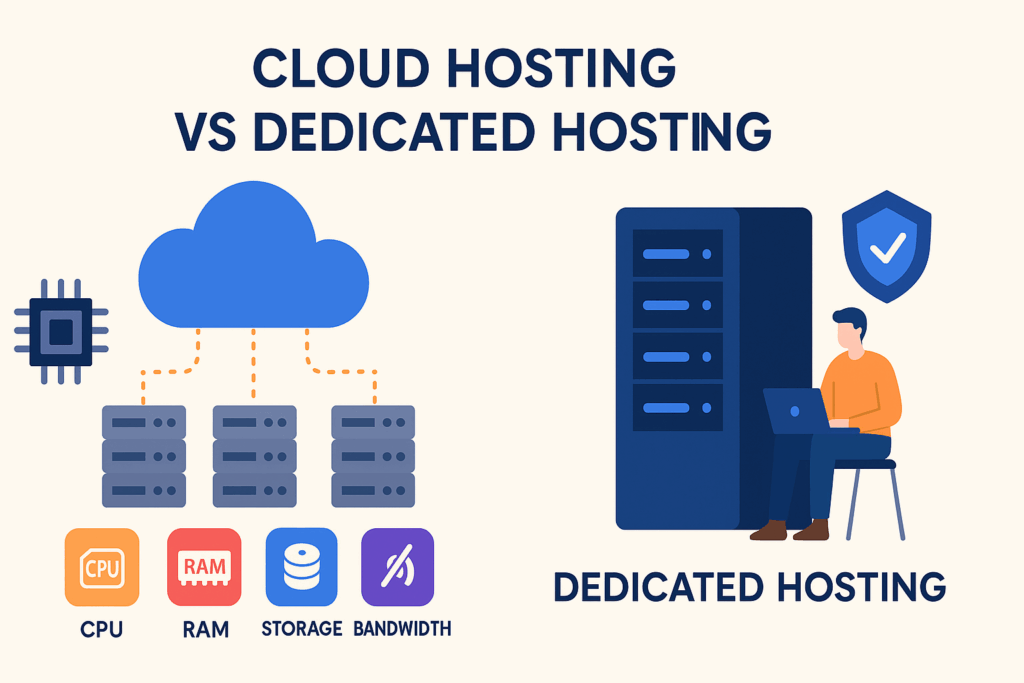
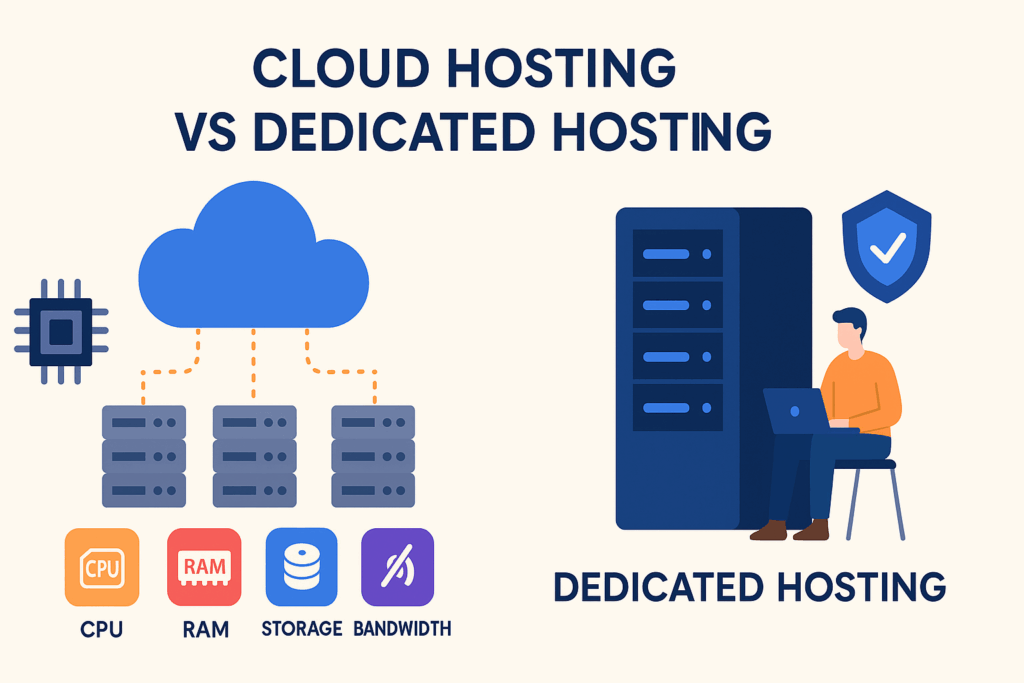
Cloud hosting operates on a virtualized network of interconnected servers, allowing your website or application to draw from a shared pool of computing resources such as CPU, RAM, storage, and bandwidth. This distributed model delivers flexibility and redundancy, meaning that if one server experiences issues, another automatically takes over. It’s perfect for scenarios like Black Friday promotions or viral marketing campaigns, where demand spikes suddenly.

In contrast, dedicated hosting gives you exclusive access to a single physical server. All hardware resources belong solely to your business, ensuring predictable performance and eliminating “noisy neighbor” issues often seen in shared or public cloud environments.

Performance and Reliability

Cloud infrastructure is designed for high uptime and redundancy. If one node fails, workloads seamlessly shift to another within the network. However, because resources are distributed among multiple clients, performance can fluctuate depending on the provider’s resource management and traffic load.

Dedicated servers, on the other hand, deliver consistent and high-performance results. With no resource sharing, you gain full and reliable access to processing power—ideal for resource-intensive applications such as large eCommerce platforms, enterprise-level software, or high-traffic websites.

Scalability and Flexibility

One of the cloud’s greatest advantages is elastic scalability. You can easily scale resources up or down to accommodate traffic surges or business growth without downtime or hardware intervention. This makes cloud hosting the go-to choice for businesses with seasonal or unpredictable traffic patterns.

In a dedicated environment, scaling typically involves physical hardware upgrades or migration to a more powerful server. While this requires more planning, it ensures long-term stability and often aligns more closely with performance and budget expectations for organizations running mission-critical workloads.

Cost Structure

Cloud hosting typically operates on a pay-as-you-go model, meaning you pay only for the resources you consume. This is especially appealing for startups or short-term projects with fluctuating workloads. However, costs can escalate quickly during sustained high usage periods.

Dedicated hosting, in contrast, follows a fixed monthly or annual pricing model, providing predictable expenses. While the initial investment may be higher, it offers better long-term value for businesses that require guaranteed performance, security, and control over their environment.

Security and Control

Cloud providers often include robust security measures—firewalls, backups, DDoS protection, and compliance certifications. Still, because it’s a multi-tenant environment, you have limited control over physical security and certain configuration options.

Dedicated servers give you complete administrative control over your infrastructure. You decide the operating system, security configurations, and applications. This makes dedicated hosting particularly well-suited for regulated industries such as finance, healthcare, and government, where data compliance and isolation are critical.

My Thoughts: Choosing What Fits Best

The decision between cloud and dedicated hosting depends on your organization’s priorities:

  • If scalability, flexibility, and cost-efficiency are at the top of your list, cloud hosting is likely the best fit.

  • If performance consistency, control, and security matter most, dedicated hosting is the stronger choice.

Ultimately, aligning your infrastructure with your business goals ensures you’re ready to grow and adapt as your digital needs evolve.

FAQs

Q1: Can I combine cloud and dedicated hosting?
Yes. Many organizations adopt a hybrid approach, using dedicated servers for core workloads and cloud environments for scalable, on-demand tasks.

Q2: Which option is better for eCommerce websites?
Dedicated hosting generally offers more stability and speed, which are crucial for handling large transaction volumes and maintaining customer trust.

Q3: Is cloud hosting less secure than dedicated hosting?
Not necessarily. Top-tier cloud providers offer strong security, but dedicated hosting provides greater control and customization over protection measures.

Q4: How do I know if I’ve outgrown my cloud setup?
If your workloads demand consistent performance, custom configurations, or data compliance, transitioning to a dedicated server is often the next logical step.

Contact ProlimeHost

At ProlimeHost, we specialize in both dedicated and cloud-based hosting solutions, helping businesses choose the infrastructure that fits their performance, security, and growth goals.

📩 Email: sales@prolimehost.com
📞 Phone: +1 (877) 477-9454
🌐 Website: www.prolimehost.com

Future-proof your business with ProlimeHostwhere performance meets reliability.

The post Cloud Hosting vs. Dedicated Hosting: Understanding Infrastructure and Resource Allocation first appeared on ProlimeHost.

Best Uses for ProlimeHost GPU Dedicated Servers — and Why They Matter

Table of Contents

Introduction

In today’s data-driven world, computational demands are skyrocketing. Traditional CPU-based servers struggle to keep pace with the scale and complexity of modern workloads like AI model training, scientific simulations, and real-time analytics. This is where GPU-powered dedicated servers make all the difference.

ProlimeHost’s GPU Dedicated Servers are built for performance and reliability. From AI research to enterprise-level applications, they deliver the parallel processing power, memory bandwidth, and hardware acceleration needed to tackle even the most demanding compute challenges.

Why GPU Servers Are Essential

GPU servers represent the next leap in computing efficiency. While CPUs excel at sequential tasks, GPUs are engineered for massive parallelism, allowing thousands of cores to process multiple data streams simultaneously. This makes them perfect for deep learning, large-scale simulations, and any workload requiring real-time computation.

With features such as Tensor Cores, NVLink, and high-speed DDR5 memory, ProlimeHost’s GPU servers can execute complex mathematical operations far faster than CPU-only systems. Dedicated GPU hosting also ensures that no performance is lost to virtualization overhead — providing consistent, predictable results with zero resource contention.

Ultimately, GPU servers are not just about raw speed; they’re about enabling innovation at scale.

Top Use Cases

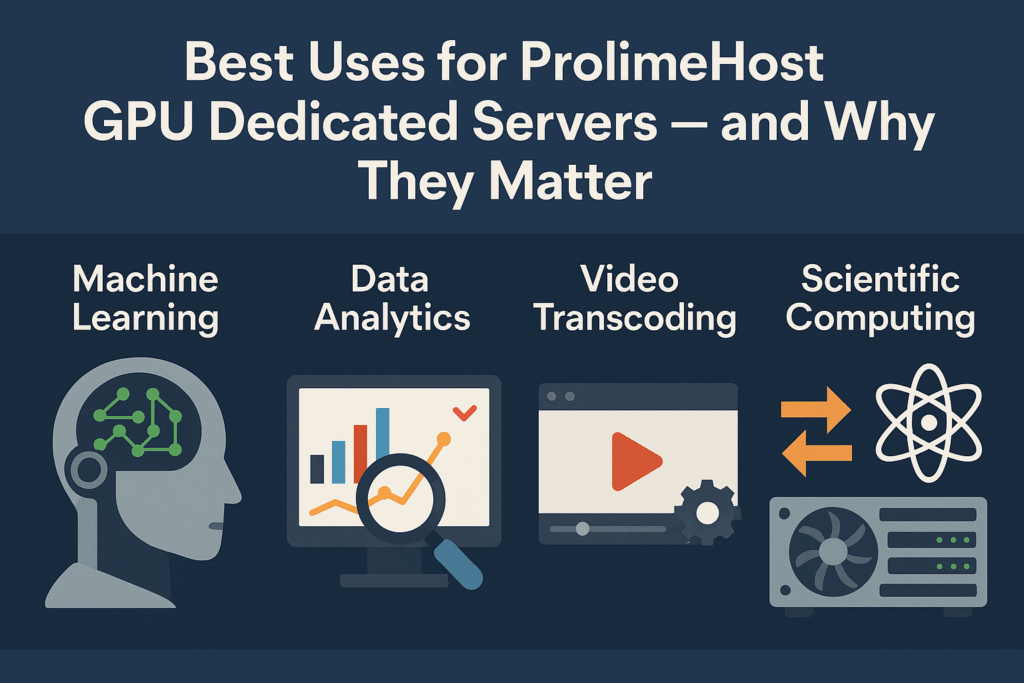
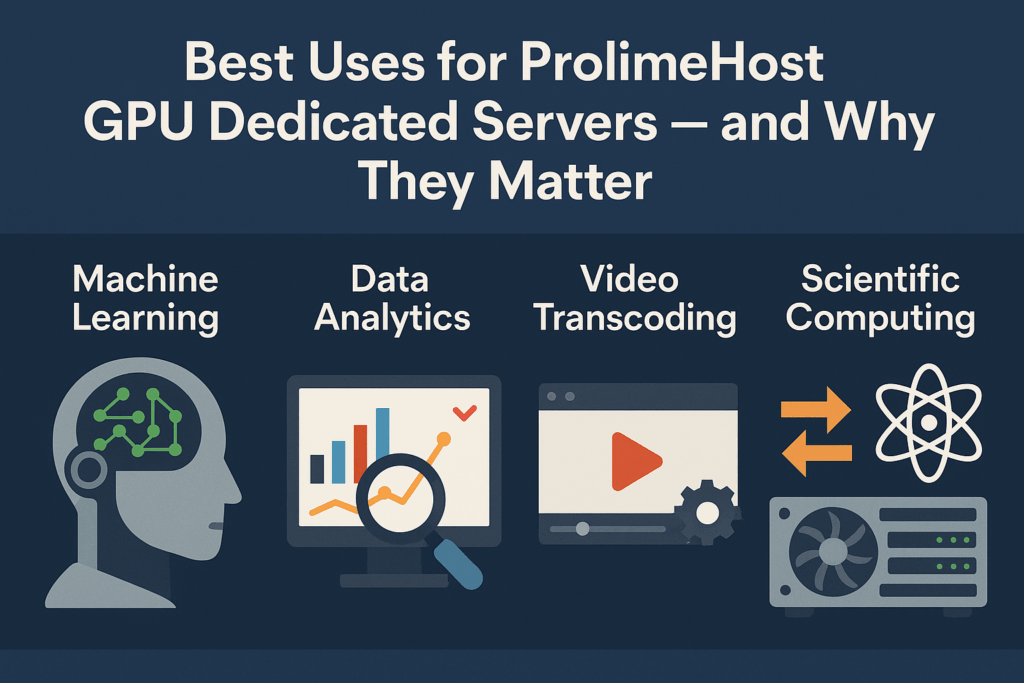
The most impactful use of GPU servers lies in artificial intelligence and machine learning. Training large neural networks — especially transformer architectures like GPT and BERT — requires immense computational power. GPUs accelerate the process exponentially, reducing training time from weeks to days.

Once trained, these models must be deployed efficiently. GPU servers excel at real-time inference, providing low-latency responses for chatbots, vision recognition, recommendation systems, and other high-throughput applications.

In scientific research, high-performance computing (HPC) workloads depend heavily on GPU acceleration. From fluid dynamics and molecular simulations to weather forecasting and genome analysis, GPUs deliver the precision and speed researchers need to handle complex datasets.

The creative industry also benefits immensely. GPU servers power 3D rendering, animation, and VFX, allowing creators to visualize scenes in real time while reducing production timelines. Tools like Blender, OctaneRender, and V-Ray take full advantage of GPU acceleration for photorealistic results.

Finally, GPU servers are invaluable for video processing and transcoding. Streaming services, content creators, and post-production studios rely on GPUs for high-definition video rendering, encoding, and live broadcasting.

While not the primary focus, GPU infrastructure can also support blockchain and cryptographic workloads under certain conditions. However, ProlimeHost prioritizes professional and enterprise AI applications where stability, uptime, and performance take precedence.

Why ProlimeHost’s GPU Servers Stand Out

What sets ProlimeHost’s GPU Dedicated Servers apart is the combination of enterprise-grade hardware, global datacenter coverage, and high-availability network architecture.

Each configuration is optimized for professional workloads, featuring powerful GPUs like the RTX 4090, A100, and Quadro series. Multi-GPU and NVLink configurations enable large-scale training or parallel computation with exceptional throughput.

Every GPU server includes high-speed NVMe storage, DDR5 memory, and robust cooling for sustained peak performance. Located in multiple U.S. datacenters — including Los Angeles, Utah, and Buffalo — ProlimeHost ensures low latency and geographic redundancy for businesses worldwide.

Most builds are provisioned within 72 hours, supported by a 99.9 % uptime SLA, and backed by 24 / 7 expert assistance.

For more details, explore the full lineup on the GPU Dedicated Servers page.

Implementation Best Practices

To fully leverage your GPU infrastructure, it’s crucial to align hardware and software strategies. Start by matching the GPU model to your workload. AI training jobs often demand top-tier GPUs such as the A100 or H100, while smaller tasks like rendering or inference can run efficiently on RTX 4090 or A5000 setups.

Make sure your system is optimized for data throughput. Use NVMe storage for rapid I/O and DDR5 memory for smoother data pipelines. When scaling across multiple GPUs, frameworks such as PyTorch DDP, TensorFlow MirroredStrategy, or Horovod help distribute workloads effectively.

Leverage mixed-precision computation to improve performance, and monitor GPU utilization with tools like nvidia-smi or Nsight Systems. Proper thermal management and checkpointing routines will ensure long-term stability and resilience for continuous training or production workloads.

FAQs

Which GPU model should I choose?
Your choice depends on your workload. For complex AI training, GPUs like the A100 or H100 offer the best performance. For smaller models or rendering, the RTX 4090 or A5000 is ideal.

How quickly can my GPU server be deployed?
ProlimeHost’s stock configurations are typically ready within 72 hours, while custom builds may take slightly longer.

Can I run multi-GPU workloads?
Yes. Our GPU servers fully support multi-GPU configurations and NVLink interconnects, enabling faster communication between cards.

Do you provide uptime guarantees?
Absolutely. We offer a 99.9 % network uptime SLA and around-the-clock expert support.

Where are our datacenters located?
ProlimeHost operates U.S. datacenters in Los Angeles, Utah, and Buffalo, ensuring low latency and regional redundancy.

My Thoughts

The future of AI, analytics, and digital production runs on GPU acceleration — and ProlimeHost is ready to power it. Whether you’re training deep learning models, performing large-scale simulations, or building next-gen creative pipelines, our GPU servers deliver the speed, scalability, and reliability your business demands.

📧 Email: sales@prolimehost.com
📞 Phone: +1 (877) 477-9454

Ready to elevate your compute performance? Discover how our GPU-optimized infrastructure can accelerate your success.

The post Best Uses for ProlimeHost GPU Dedicated Servers — and Why They Matter first appeared on ProlimeHost.